Category: Journalism.SG

  • Journalist defends interview with Chee: he really was evasive

    March 24th, 2010

    A Lianhe Zaobao journalist has shared on Facebook the transcript of her interview with opposition leader Chee Soon Juan, in response to his accusation that she was acting as instrument of “autocratic regime and its controlled media”.

    Zaobao had carried Yew Lun Tian’s lengthy interview with Chee on 28 February, pegged to the 30th anniversary of the Singapore Democratic Party. Yew’s story was picked up by The Straits Times.

    On 17 March, The Straits Times Forum page carried a letter from Chee slamming the article. “The way that the report is written is clearly an attempt to portray me as being evasive about my income,” he said.

    The letter carried a boilerplate reply from the ST Editor: “Our report was based on an article in Lianhe Zaobao. The editor of Zaobao has said that he stands by the article.” Since then, however, the journalist has taken the unusual step of releasing the relevant part of her interview transcript on Facebook.

    “Some speculated on ZB‘s motive,” she noted. “I had not receive any instruction from ‘above’ to do this interview. I initiated this interview simply because I think readers are curious about Dr Chee and that the Anniversary presents an appropriate chance to look at the past and future outlook of SDP.”

    On her questions about Chee’s income, she said: “Rumours have long been flying around about Dr Chee being bankrolled by foreign money. I feel it is valid to put this to Dr Chee because such rumours may affect his credibility as a politician.”

    Why did she imply that Chee’s replies were evasive? “Because they were. I had to ask at least seven times in different ways to get answers. My choice of words ‘When probed several times’ and ‘He replied vaguely’ merely reflected the manner in which he replied.”

  • News veteran Leslie Fong says newspapers may have to pool reporters to cut costs

    by

    BHAVAN JAIPRAGAS

    March 19th, 2010

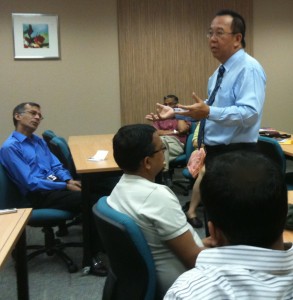
    Newspaper veteran Leslie Fong said that economic pressures may force news media companies to pool their coverage of basic assignments instead of letting their different titles send separate reporters to cover the same event. At present, it is common for press conferences and other events to be attended by several journalists from Singapore Press Holdings, which publishes nine daily newspapers in four languages.

    IMG_04241-293x300A pool system would mean sending just one reporter per language medium to an event, saving manpower cost. The newspapers who are part of the pooling arrangement would all pick up the same story, but develop it in their own way if necessary.

    Fong, who was editor of The Straits Times from 1987 to 2002, was speaking at an Asia Journalism Fellowship seminar about the Business of Journalism yesterday at NTU’s Wee Kim Wee School. Although currently the marketing chief of SPH, Fong was giving his personal views as a veteran newspaperman and stressed that he was not speaking for SPH.

    Responding to a question about what newspapers around the world could do to make themselves more commercially viable, he said that they had little choice but to trim their manpower costs.

    Fong noted that newspapers that do not have foreign bureaus already rely on pool reports for international news, receiving “a common fodder” in the form of wire agency copy. They then customise the stories according to the interests of their readers. “Each newspaper must identify for itself its own niche, use the basic raw materials and add its own expertise to make a story in its typical style,” he said.

    Doing this for local coverage is not common here, but a standard practice in larger countries. Britain’s Press Association and the Press Trust of India, for example, help newspapers in those countries save on reporting costs. Mediacorp recently integrated the newsgathering functions of Today, Channel News Asia and its online operations, with reporters now pooled in an integrated “Newshub”.

    At a recent conference on the future of news media, participants heard that experiments such as Newshub posed major challenges in change management, as they tended to be resisted by deeply entrenched ways of working. Newshub chief Chitra Rajaram, a speaker at the conference, acknowledged that the kinks in the pool system had yet to be ironed out.

    As for the quality of stories, Fong noted that for straightforward stories such as run-of-the-mill crimes, there was not much scope for variety in treatment and little would be lost in having a pool system. Asked if a pool system would lead to stories being told from fewer perspectives and a deterioration of journalistic standards, he said the onus was on each newspaper’s editor to ensure that it adds value to the basic story it receives from the pool, instead of dumping the copy wholesale into its pages.

    Apart from manpower, Fong said newspapers would also be looking into cutting printing costs in order to to remain competitive. At present, newspaper companies around the world have refrained from abandoning the print medium because they are unsure that their online advertising revenue can compensate the loss of circulation revenue. Fong said that it was just a matter of time before e-readers emerged which could effectively replace printed newspapers. Readers could then pay for content through subscriptions or micro-payments.

    He mentioned that the SPH Group was closely monitoring the development of e-readers in the market, including those developed by Creative Technologies, Sony Ericsson and Hearst Corporation. It is also collaborating with a group in WAN-IFRA to explore how E-readership can be monetised and incorporated into the industry effectively.

    On the health of newspapers in Singapore, he said that the English press was still doing well, while the Malay and Tamil papers, though small, remained viable. The Chinese papers were declining faster. He said that being part of a large and profitable media group was thus an advantage: SPH recognised its social obligation to Singapore’s multi-racial society and would continue to publish in the various languages.

  • Independent Judiciary requires respect and support of public

    by

    CHAN SEK KEONG, CHIEF JUSTICE OF SINGAPORE

    March 16th, 2010

    Extract from “Securing and Maintaining the Independence of the Court in Judicial Proceedings” published in the Singapore Academy of Law Journal, March 2010. To download the full article from the journal’s website, click here.

    In a democracy with a form of representative government (based on the doctrine of separation of powers), the Judiciary is one of three arms of government, co-equal in status, and vested with the power, among others, to check the Legislature and the Executive in their exercise of powers vested in them by law and the constitution of the State. Its other primary function is to adjudicate disputes between people and disputes between the people and the State or agencies of the State. The Judiciary acts as an impartial referee to decide what conduct is permissible or not permissible under applicable rules of conduct, whether the rules have been infringed or not infringed, and to provide the remedies for such infringements. To fulfil these functions, the Judiciary has to be independent of the other two arms of government.

    A Judiciary that is not independent would not be able to fulfil such a role, and would provide a weak foundation for democracy and its associated attribute (ie, the rule of law) to flourish. Conversely, the Judiciary requires the existence of the rule of law for continuous independence. There cannot be the rule of law without an independent Judiciary, and vice versa, but with both, there will be security, law and order, and stability, which are requisites for progress and the protection of political and civil rights.

    The respect and support of the public is crucial for the independence of the Judiciary as an institution. In a democratic society, the respect and support of the public is, in fact, one of the best safeguards for the independence of the Judiciary as an institution. Conversely, a lack of respect and support from the public for the Judiciary and its functions can be detrimental to its independence. In this regard, any perception of a lack of respect from the Judiciary’s co-equal institutions, viz, the Executive and the Legislature, could be expected to trickle down to all state bodies and the public, leading to a loss of public confidence in the Judiciary, and, ultimately, a call for the limiting of the independence of the Judiciary. Thus, Art 99 of the Singapore Constitution provides that the conduct of a Supreme Court judge cannot be discussed in Parliament “except on a substantive motion of which notice has been given by not less than one-quarter of the total number of the Members of Parliament”. For acts or words amounting to contempt of the court, the law provides that every person can be punished, from the President, the Prime Minister, down to the man in the street.

    However, mechanisms such as the doctrine of contempt should not be used to stifle fair and reasonable criticism of the work of the Judiciary and also judicial decisions. The right to criticise is only part of the freedom of speech and expression the citizen enjoys in a democracy and its exercise will encourage or ensure that judges are independent in their decision-making. It is a form of public review similar to judicial review of executive acts, where judges look over the shoulders of the Executive to correct its mistakes. Hence, the doctrine of judicial independence calls for the judicious use of the contempt power, and the final appellate court has a responsibility to ensure a judicial restraint in the use of this power. Fair and objective criticism of judicial decisions will instil accountability and greater discipline in decision-making. If no one is allowed to judge judges, there could be lawless courts and irresponsible judging. But criticism of judgments should not lead to the denigration of judges.

  • Government introduces “cooling off period” Bill for elections

    March 12th, 2010

    The Government has introduced amendments to the Parliamentary Elections Act that would extend the existing ban on Polling Day campaigning to include the eve of Polling Day. The move was expected. Prime Minister Lee Hsien Loong had said that a “cooling off” period was necessary to help voters make rational choices.

    Although intended to regulate campaigning, the proposed amendments could also affect citizen journalism. “News” is exempted from the law. However, this exemption covers only licensed media. Internet-only publications, including citizen journalism sites such as The Online Citizen, Yawning Bread and many others, are not individually licensed and so not considered publishers of news under this law.

    This effectively means that their reports of the final rallies must be posted the same night. If they are posted the following day, the eve of Polling Day, they could be charged with violating the “cooling off” law.

    On the bright side, they would not be expected to take down content that was already on their websites. The law would exempt election advertising lawfully published before the start of the eve of Polling Day, as long as it is not subsequently modified.

    • Download the Amendment Bill here.
    • Journalism.sg’s earlier commentary.
  • Online hoax about Lee Kuan Yew’s health receives wide condemnation

    by

    BHAVAN JAIPRAGAS

    March 9th, 2010

    New media practitioners in Singapore reacted sharply to condemn the online hoax regarding Minister Mentor Lee Kuan Yew’s health yesterday. The hoax had caused a significant buzz in the blogosphere over the weekend.

    Dissident blogger Gopalan Nair had posted an entry stating that the Minister Mentor had suffered a serious heart attack on 6 March 2010. The blogpost also mentioned that there were pockets of civil unrest in Singapore following this development and that investors were scrambling to pull out of the country. Yesterday, Nair posted an entry saying that his previous post was a hoax and that “it was a deliberate attempt to highlight how tenuous Singapore is”.

    Socio-political website The Online Citizen (TOC), which had expressed its skepticism about Nair’s post on its Facebook page on Sunday night, launched a scathing condemnation of the California-based lawyer within hours of his revelation that his earlier post was a hoax. TOC’s editor-at-large Remy Choo Zheng Xi asserted that such deliberate misinformation ran contrary to the culture of community moderation that websites such as TOC practised.

    In a facebook entry, TOC’s Andrew Loh bemoaned that Nair had “shot us all who are in the alternative media in the foot”. Loh further pointed out that Nair had a duty to act “more responsibly and with a little more thought” when airing views about Singapore. Elsewhere, prominent political blogger at Sgpolitics.net Ng E-Jay called for the Singapore blogosphere to “boycott and castigate” Nair’s writings. Ng, who recently returned to the TOC core team as its political editor, also expressed his optimism that an informal self-regulating mechanism was taking shape in Singapore’s blogosphere, judging by how netizens had reacted to the hoax.

    Bloggers were not the only ones expressing their anger at Nair’s bizarre behaviour. Popular forums such as HWZ and Sgforums were rife with regular netizens’ critical commentaries against him. The Straits Times reported the controversy today (9 March). It noted that the stock market had not been taken in by the rumour and was unaffected.

    In a sign that Minister Mentor Lee Kuan Yew remains in the pink of health, the Prime Minister’s Office announced that he would be visiting the United Kingdom from 9 to 12 March to meet business and political leaders there.

    Nair however, has not elicited any form of remorse despite the widespread condemnation of his actions by the Singapore blogosphere. In a postscript to his latest post, he expressed hope that the “stress and tension” of the episode would lead to a deterioration of the Minister Mentor’s health.

    Click here for Journalism.sg’s coverage of Gopalan Nair’s run-in with the authorities in the past.

  • News industry ponders the future at Singapore conference

    by

    CHERIAN GEORGE

    February 28th, 2010

    For Singapore journalism, the most poignant moment in the two-day conference on the future of news media may have come via Skype from Florida, when media convergence guru Jeff Jarvis responded to a question from Patrick Daniel, editor in chief of SPH’s English and Malay newspapers.
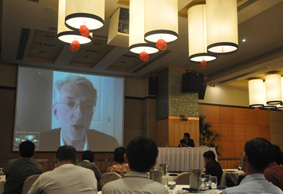
    jarvis_010Assuming that the downward trend in American news industry is ahead of Asia by a few years, what timely lessons could Asian media draw from the missteps of the Americans, Daniel asked.

    Jarvis’ reply drew from the decline of TV Guide, once one of America’s biggest weeklies – but he could just as easily have been referring to The Straits Times and other newspapers in Asia that are still highly profitable.

    American editors could see the trends, he noted, but avoided the inevitable changes because their publications were still flowing with profits. This was the problem with being a cash cow, he said: “Don’t let it blind you to the necessity of changing utterly.”

    American publishers had been guilty of a kind of protectionism, he added, protecting the old business models instead of throwing them open.

    The two-day conference on The Future of News Media & Journalism (25-26 February 2010) was organised by the Asia Journalism Fellowship and the industry association WAN-IFRA. Over the last year or so, the newspaper business in the US has been stunned by high-profile losses and closures, prompting extensive soul searching about where the industry and profession are headed.

    In Asia, news giants continue to be make money, with Singapore Press Holdings posting operating profits of around S$400 million last year despite the recession. However, newspaper circulations here have been stagnant or in slow decline. This has prompted SPH to move aggressively into online and mobile media such as omy.sg. But SPH’s different platforms still work largely in separate silos.

    Part of the conference was devoted to exploring ways to integrate different media more effectively. However, a more fundamental challenge for journalists is to redefine their role, participants heard.

    “It’s not printing on paper or distributing things,” said Jarvis of where journalism’s value lay. “It’s not even information, as information is a commodity. I think it’s in relationships. … Think as a service organisation, not just the manufacturer of a product.”

    Robert Niles, editor of the Online Journalism Review, agreed. “We are ultimately in the community business,” he said.

    This shift will require professional journalists to become more open to collaboration with their communities, speakers said. American news organisations still thought of themselves as publishers when they should have been acting as network builders, Niles said.

    Editors at the conference spoke of the opportunity to reconnect with the public. Reginald Chua, the new editor of Hong Kong’s South China Morning Post, said, “We tend to ask, what do we do, instead of asking what do people want? We really need to ask the question: what do people want.”

    Bambang Harimurti, president of Indonesia’s Tempo group, said that newspapers, which once created a whole new market, were now followers. They had allowed their dependence on advertising revenue to affect their editorial independence.

    “I’m not against advertisements, I just want advertisements on my terms,” he said. He hoped that as micropayment systems developed, news media could depend on readers instead.

    “I would rather depend on millions of people who are willing to pay small amounts, like a few cents, because they believe in what you are doing. That to me is journalism at its best.”

    While the conference heard various ideas about how news media could remain relevant and valued, nobody claimed that it would be possible to return to the years of 30-40 percent profitability. Over the long term, publishers and shareholders would have to get used to much lower margins, even in those news organisations that successfully restructured themselves.

    See also: “The future of journalism in a post-newspaper world“

  • Ex-NMP Siew Kum Hong upbeat about new media’s role in politics

    by

    BHAVAN JAIPRAGAS

    February 5th, 2010

    Former Nominated Member of Parliament Siew Kum Hong painted an optimistic picture for the future of the local new media sphere in a discussion held in Nanyang Technological University (NTU) last Thursday. He had been invited by the university’s sociological society to speak about the new media and political participation in Singapore.

    Siew was particularly upbeat about the role new media entities were playing in cause-based advocacy and in raising the profile of the civil society here.  According to him, one of the reasons for the growth of new media in Singapore was its ability to organise people behind various causes. Dedicated websites and Facebook pages increasingly allow like-minded individuals to find each other easily. The ‘Day Off’ campaign, which calls for a regular day off for domestic workers, and the ‘Say No to Rape’ campaign were a few causes he cited that latched onto the Internet to increase their reach. However, he also expressed concerns over what he called the ‘echo chamber’ effect, as Internet users are at risk of embedding themselves in virtual enclaves where everyone had similar views.

    Siew, who tabled the petition in parliament to repeal section 377A in 2007, shared with the audience the expressions of public support he garnered through the new media during the period. Although parliament eventually retained section 377A, the debate underlined the influence of the Internet, which was the main platform on which members of the public expressed their views on the matter.

    Siew also identified the fact that the dynamics of political engagement in Singapore was changing, partly due to the effects of new media. The Internet he said, allowed robust debate to be brought straight into the domain of establishment figures, without the filtering that may occur in the mainstream media. Foreign Minister George Yeo’s Facebook page is one such example, as opposition figures such as Chee Soon Juan and Goh Meng Seng have engaged the minister through the social networking site. From the controversial Sammyboy 3-in-1 forum to the government’s feedback portal Reach, there has been a considerable increase in political discourse between Singaporeans as compared to two decades ago. Nonetheless, Siew added a caveat on this matter, stating that ‘online participation does not necessarily translate into actual votes’.

    When asked whether the new media would pose a threat to the legacy media, Siew opined that socio-political websites such as The Online Citizen and Temasek Review had the potential to directly challenge their mainstream counterparts. He said this could be done if the websites invested in producing more original content, instead of remaining purely reactionary.

  • Why social media is the next big thing

    by

    THE BUSINESS TIMES

    January 26th, 2010

    Social media is the new buzzword as we enter the new decade. Already it is making huge inroads into the space previously occupied by the mass media and things more traditional. As information technology becomes even more pervasive, social media initially embraced  by youth is spreading rapidly into various sectors of business and society.

    In an ongoing Nanyang Business School-Business Times roundtable discussion series, information technology professors at Nanyang Technological University’s Nanyang Business School (NBS) examine the rapid spread of social media and its implication for businesses, and try to find out if it is the next big thing.

    Click here to read the full article.

  • Great Leap Backwards: National Library puts newspaper archives online

    January 15th, 2010

    Thanks to the National Library, the internet now gives you access to Singapore newspapers dating back to the early 19th century. The library’s NewspaperSG service will make it dramatically easier to do historical research.

    It’s not just historians who will benefit. Journalists writing about the present will now find it much simpler to provide readers with historical context. Pressed for time, most reporters tend to confine their background research to stories that can be accessed on their computers. Databases such as Factiva and Lexis-Nexis go back only a few decades.

    Now, through NewspaperSG, users now have access to more than 548,000 pages of searchable text of the Digitised Straits Times (1845-1982) and microfilms of around 200 Singapore and Malaya newspapers stored at the Lee Kong Chian Reference Library.

    “Users who access the collection through the multimedia stations at our islandwide network of libraries will be able to search, view and print from The Straits Times digitised collection. Offsite users will also be able to access the website and view the articles but limited to the first 50 words of each full-text article,” the library says.

  • Singapore still lacks a functioning public sphere, says researcher

    by

    BHAVAN JAIPRAGAS

    January 13th, 2010

    As long as the government does not get into the act, the mainstream media in Singapore seems to be able to able to fulfill to a large extent the standard theoretical functions of media – to bring the news to the people, provide space for commentary, reflection and deliberation. This was the gist of Institute of Policy Studies research fellow Tan Tarn How’s presentation at The Online Citizen’s special 2009 Year in Review event held at the Post Museum two weeks ago.

    Tan had written a research paper assessing the local mainstream media’s coverage of the AWARE saga last year. He was invited by the organisers to speak on the topic “Debate and its nature in a non-public sphere”.

    In his presentation, Tan commented that the AWARE saga pointed out the fact that there was an unformed public sphere in Singapore – “a space where people can come together to talk about issues which are relevant to them in order to have an influence on government policy”. With mainstream media having to operate under constraints, he said it is yet to be seen if the new media can take up the mantle of being the public sphere, given that they too have to grapple with larger societal issues.

    In reply to a comment by an audience member who claimed that the local mainstream media lacked credibility in light of government regulation, Tan stated that there was empirical evidence to show that Singaporeans continue to regard the mainstream media as their most credible source of news. “There is no correlation between press freedom and press credibility in the world at all”, he said.

    Click here to read more about 2009 Year In Review, an event jointly organised by The Online Citizen and Talk Politics.

    View Tan Tarn How’s complete presentation and response to questions from the audience in the videos below.