
Category: Journalism.SG

  • Disinformation: a debate that needs to be better informed

    Disinformation: a debate that needs to be better informed

    Edited text of a talk at the Columbia Journalism School’s “Disinformation and Elections” conference, New York, 3 October 2019.

    As a student in this room exactly 30 years ago, one of the counterintuitive lessons I recall learning is the need to turn away from the action when it’s captivating everyone else. My journalism teachers here taught me to be sceptical of the media circus. Good journalists and academic love to start the bandwagon rolling, but once it gets crowded, we know it’s time to jump off and gain some distance for a better view.

    That’s exactly how I feel about the “fake news” hoopla, and I will close my remarks here today with some observations about the inadequacies of the global disinformation debate as I see it.

    Singapore’s approach

    The bulk of my presentation, though, will look at how the discussion has played out in Singapore, resulting in what is probably the world’s boldest and most elaborate purpose-built legislation against online disinformation since “fake news” was declared a global crisis in 2017. The law, which took effect yesterday, probably enjoys broad public support combined with a dose of blind faith in the government’s pure intentions.

    I won’t have time to go deep into why I think the disinformation threat to Singapore – though it can’t be treated lightly – is overstated. I’ll only say that disinformation is not like some deadly toxin that causes harm to all people in all places and times. Its effects are highly contextual. Decades of research in India, for example, show quite conclusively that the transformation of inflammatory rumours into bloody riots is never automatic. It requires the mobilisation of an entire riot industry, including political orchestrators, grassroots instigators, and corrupt police.

    Such factors are absent in Singapore, though you would not get that impression if you listened to ministers’ scaremongering speeches suggesting that only internet regulation could keep Indian- or Indonesian-style riots away from our shores. This was a classic case of the cultivation of moral panic. The law’s passage can also be seen as an example of legislative opportunism, riding on the global alarm about so-called fake news.

    I’m not suggesting that the People’s Action Party (PAP) government was entirely insincere in attempting decisive intervention against disinformation. Think of how much mistrust and revulsion Facebook has generated even in liberal democracies, and then try to imagine how much deeper the genuine concern would be among paternalistic government leaders who never had much faith in the free marketplace of ideas in the first place.

    What I am suggesting is that Singapore’s government has gone beyond what is necessary and proportionate to deal with disinformation campaigns by bad actors. It has given itself chilling new powers over professional news media and other good-faith communicators – who, according to all experts, should instead be empowered and enlisted to fight disinformation merchants’ pollution of the information environment.

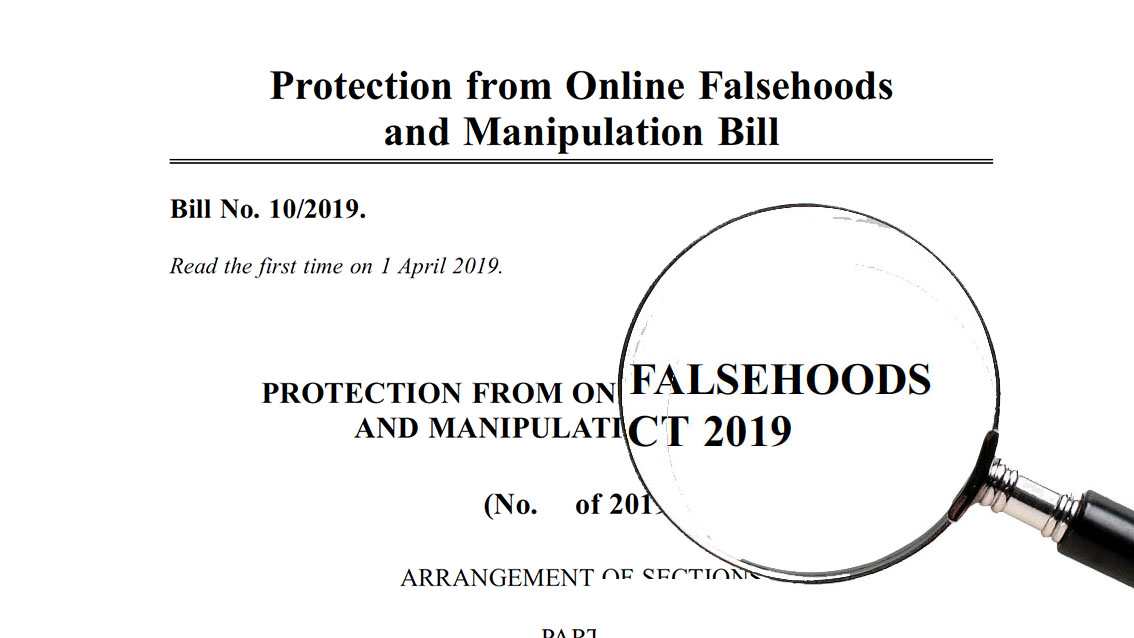
    Whether by accident or by design, the new legislation can be used and abused to restrict dissent. Called the Protection from Online Falsehoods and Manipulation Act (POFMA), the law empowers ministers to trigger take-down or correction orders against online material containing false statements of fact, as well as criminal prosecutions against offenders.

    POFMA is remarkable for the degree of discretion it places in the hands of ministers, including the power to suppress and punish misinformation that ministers deem would damage confidence in their work. It is part of a long tradition of legislation that gives the executive branch enormous latitude to get its job done. This style of lawmaking is completely at odds with the liberal democratic tradition of limiting executive power through strong checks and balances, but it’s part of the formula behind Singapore’s much admired governance, so it is not surprising that most Singaporeans did not raise an eyebrow.

    Western precedents?

    Both the framing of the problem and the formulation of solutions made explicit reference to Western precedents. But the government picked and processed facts to build a case for a strong legislative response. Thus, the import of Western policy agendas and policy responses involved significant domestication.

    The government correctly pointed out that even Western democracies had enacted or were considering new laws. What it overlooked was that the laws being rolled out in liberal democracies include built-in checks against government abuse — such as precise and narrow language—and in any case would operate within a constitutional system of limited government, with a tradition of courts blocking executive overreach, for example.

    Germany’s Net Enforcement Act was frequently cited. Following the lead of credible news organisations including Reuters and the Washington Post, the Singapore government described the new German legislation as a fake news law.

    But that’s not what it is. All the German law does is to impose additional obligations and higher penalties to make sure large internet platform companies comply with existing German laws against hate speech, for example. That’s why it’s called the Net Enforcement Act. This law does not create any new category of prohibited speech; it enforces existing offences more strictly. Since there is no pre-existing prohibition of falsehoods as such, the new law doesn’t cover it.

    It’s certainly true that some of these new European laws have been criticised as unprecedented encroachments on freedom of expression—and indeed their constitutionality is expected to get challenged in court—but it’s important to appreciate that, at a global level, the encroachments are minuscule compared with the liberties that lawmakers are taking in illiberal democracies like Singapore.

    POFMA’s problems

    POFMA tilts the marketplace of ideas in favour of ruling party politicians.

    First, POFMA conflates governmental interests with the wider public interest. The government has said that the Act’s powers can be triggered only if the falsehoods harm the public interest. The Act’s definition of the public interest, though, includes falsehoods deemed to diminish public confidence in the work of any government agency, regardless of whether that agency deserves high levels of public confidence, or whether the alleged falsehood is material to the thrust of the content that the government wants taken down.

    Second, although correction orders may not sound unreasonable in principle—providing wronged parties with a right of reply—they may be difficult to implement in a way that satisfies the law. Furthermore, large platforms and media can be required to post correction notices on other media to make sure the message gets out. Presumably, a news site could be required to buy advertising space in Singapore’s national media to publicise the correction. This could be financially draining. The potentially high cost of compliance is likely to lead to self-censorship.

    Third, POFMA can be triggered only by government ministers. Members of the public and opposition politicians cannot use the law to initiate corrections or take-down orders. In contrast, the new French law, for example, allows candidates of any party to get court orders against falsehoods targeting them during election campaigns.

    Fourth, the government rejected calls for an independent or even arm’s-length regulator, which would have been in line with international best practice for media regulation. Instead, the new body that would issue correction and take-down orders must comply with ministers’ directions.

    POFMA is thus designed as a tool for the exclusive use of government ministers. This is a concern because there is mounting evidence that the ruling party and its network are Singapore’s main users of computational propaganda methods, including influencers, trolls, and inauthentic accounts. Critics of the government—including, ironically, critics of POFMA when it was debated—have had their words twisted and their patriotism questioned by government ministers and other PAP parliamentarians. Their open vilification and dog whistles unleash online attacks by acolytes and other assorted trolls, in a style reminiscent of the intolerant populist movements overseas that are prime producers of toxic disinformation.

    The Singapore government’s legislative response to the weaponisation of social media is, thus, less about demilitarising cyberspace and more about monopolising the means of discursive coercion.

    Predictions

    Since POFMA opened for business only yesterday, it is too early to tell what effect it will have.

    I do not believe that we need to fear the worst-case scenarios—of mass arrests or large-scale take-downs—even though the language of the law may allow for it. This is partly because it is not the Singapore government’s style to fire off the full arsenal of legal weapons at its disposal. It has always been more calibrated and strategic in its use of coercion, which is a key reason why the regime has lasted as long as it has.

    Furthermore, POFMA was striking for the degree of opposition it generated. Several groups expressed strong objections that the government could use the new law to shield itself from scrutiny. The government dismissed these doubts impatiently, but will now probably take care not to prove its critics right. At least initially, it will only use the law in slam-dunk cases of bad faith industrial scale disinformation.

    My main fear is instead the indirect symbolic impact of POFMA. Liberal societies know that public discourse requires what American supreme court judges have called “breathing room”: you need to allow folks to get some things wrong if you want to benefit from what they might say right.

    POFMA is the strongest signal yet from the Singapore government that the public sector need not give critics any such breathing room.

    This will embolden officials to hit out at critics, continuing the recent trend towards more micromanaging of the news media, and rising intolerance of even mildly dissenting viewpoints. The government likes to say that critics must be open to criticism. What it doesn’t say is that its criticism of opponents does not stop there. In liberal democracies, political leaders’ verbal attacks on critics—think of Donald Trump’s repeated broadsides against “the lying New York Times”—have no real material consequences. In contrast, the Singapore government’s expressions of displeasure are backed by multiple and largely unaccountable forms of punishment.

    These include limiting cultural workers’ access to the public sector’s sizeable largesse, blocking careers of journalists and academics working in Singaporean institutions, and withholding visas from non-citizen critics or the foreign spouses of local critics. The government is able to carry out such actions with impunity, not only because of a lack of transparency, but also because its populist nationalist rhetoric has convinced its base that the party’s interest is the public’s interests, and that criticism of the political leadership is anti-national.

    During the parliamentary debate on POMFA in May, government ministers went out of their way to promise that they would not abuse the new law’s powers (though they could not deny that the law’s wording was open to abuse). But, away from the POFMA debate, it continued to send ominous signals of its rising intolerance of criticism. POFMA will be seen in that light. As a result, most journalists, academics and ordinary citizens are likely to engage in even more self-censorship than they currently exercise.

    Talking about disinformation

    I promised at the start to make some more general comments about the disinformation debate globally. Let me make three points.

    First, while disinformation should be a shared global concern, it has different local characteristics. I say this because, as with so many other issues, US hegemony tends to turn the American agenda into the global agenda. Understandably, Americans are alarmed at how online disinformation threatens the integrity of elections here. Yes, this may also be a risk elsewhere. But we need to see it in proportion.

    An objective risk assessment would have to conclude that disinformation put out by Big Tobacco in Asia—spreading doubt about the health risks of smoking—is several orders of magnitude more harmful than election propaganda. According to the World Health Organisation, around one-third of Chinese and one-quarter of Indonesians don’t know about the dangers of second-hand smoke. In contrast, populations with lower levels of socio-economic development such as Egypt and Bangladesh show awareness levels about tobacco risks of more than 90 percent, just like the developed West

    The knowledge gap in Indonesia is actively perpetuated by an industry that is counting on such growth markets to compensate for declining sales in the West. Millions will certainly die and their dependents will suffer, but Indonesia’s anti-disinformation efforts are focused instead on the political arena, where the effects of fake news are nowhere near as certain.

    Second, while the threat posed by digital media adds an unfamiliar and urgent dimension to the disinformation problem, another thing I learnt in journalism school was that we shouldn’t confuse the new and shiny with the important. Yes, Facebook deserves the public scrutiny and shaming they’ve been getting, and this shouldn’t let up. But there’s a danger that the debate about internet platforms is sucking all the oxygen from the room and distorting our perception of the problem.

    For instance, it’s striking how current media coverage and policy debates have let one major industry laugh all the way to the bank—the marketing and public relations consultancies. We know from the Bell Pottinger case in South Africa that such consultants are deeply implicated in political disinformation. Yet the industry has hardly come under scrutiny. Jonathan Corpus Ong and his collaborators’ research on “Architects of Networked Disinformation” is one of the few serious investigations of the topic. In Singapore’s debate, PR and advertising barely figured, and the industry remains under-regulated by POFMA.

    Third, partly because we are so wonderstruck by how new technologies enable viral propaganda, misleading memes and deep fakes, our discussions have tended to be supply-side and message-centric, leading to an emphasis on techno-legal regulatory fixes to sieve out or shoot down falsehoods.

    What’s missing is a more holistic analysis that puts at least as much emphasis on the demand side: why is it that citizens who have more access to information and more freedom to express themselves than any generation in the history of human civilisation voluntarily opt for bad information over good, thus behaving counter to the liberal faith in the marketplace of ideas.

    Many good minds have applied themselves to explaining this post-truth world, and the most persuasive answers tell us it’s something to do with the contradictions within our two-centuries-old formula for progress through capitalist accumulation, and its increasingly obvious failure to deliver social mobility with social justice. If political and media establishments have failed to use the Enlightenment values of progress through reason in inclusive ways, is it any wonder that the excluded are disillusioned, resentful and disbelieving.

    For more on POFMA, visit Academia.SG.
  • Battling disinformation is about trust as much as truth. That’s why the Online Falsehoods Bill needs to be amended.

    Battling disinformation is about trust as much as truth. That’s why the Online Falsehoods Bill needs to be amended.

    By CHERIAN GEORGE

    April 8, 2019

    Since the tabling of the proposed online falsehoods legislation a week ago, my criticisms of the Bill have been widely quoted in mainstream and social media. This isn’t because I’m its biggest opponent but because I’ve chosen to taken it seriously enough to study it — while many other Singaporeans who feel more negatively probably think it’s pointless to give it the time.

    By default rather than design, therefore, my opinions have attained a curious prominence in the current debate. This has had unfortunate results. Junior law minister Edwin Tong’s responses last Wednesday caricatured my inputs, making it seem as if I favour the circulation of untruths. One of his Facebook followers, who clearly had not read what I’d actually written, took Tong’s bait and challenged me: “Does George Cherian feel that public interest and safeguarding our safe, secure and harmonious way of life are not important? The majority of Singaporeans surely do.”

    Before I disengage from this debate, therefore, I should make it clear that I believe the challenge of dealing with industrial-strength disinformation campaigns is a serious one. And because it’s worth doing, it’s worth doing well. (This should be obvious from my Select Committee contributions and other writings as well as last week’s blogs.)

    For a complete list of my writings on this topic, please visit my home page.

    Rather than dive into chapter and verse, as my previous commentaries on the Bill have done, I’d like here to take a step back and look at the big picture.

    Post-truth world is a crisis of trust

    The Bill, I sense, is based on a misappraisal of the problem. The government is attempting to deal with the disinformation threat as if this was a battle over truth. That is a major part of it, of course. But it is also a war for trust. Our national strategies against the enemies of truth will fail — and even backfire and make things worse — if these responses breed cynicism and erode trust.

    Let me explain.

    The circulation of extremely harmful untruths is not what’s new in the current global crisis.

    More than half a century ago, the tobacco industry successfully delayed regulation for decades by spreading the lie that there wasn’t enough medical evidence to act on. They are still at it, resulting in more than 7 million deaths a year. The single most destabilising geopolitical act this century — the US conquest of Iraq — was based on the Bush administration’s lies 17 years ago about Saddam Hussein’s non-existent weapons of mass destruction. The disinformation campaign that threatens to decimate our species, by climate change deniers supported by the energy industry, has been operating for decades, resulting in policy positions that are at least 20 years behind the scientific consensus.

    So, if the advantage has recently shifted in favour of disinformation merchants, it is only partly due to how the internet allows them to bypass traditional media gatekeepers. Let’s not over-romanticise governments and professional news media as guardians of truth. Where were they when big tobacco, big energy and George Bush were selling their lies? None of the disinformation industry’s greatest hits of the last 100 years can be blamed on social media.

    No, what is really new is the erosion of the authority of establishment institutions — governments, centrist political parties, universities, the press — even when they are trying to act responsibly. This trend is linked to the rise of anti-establishment populism around the world. There is a seething resentment against the System that makes alarming numbers of people want to believe the false promises and hate speech of opportunistic politicians and intolerant identity-based movements. Only when we understand this demand side of the equation will we be able to come up with smart supply-side interventions against online disinformation.

    Clumsy regulation can backfire

    In my Select Committee submission and elsewhere, I’ve pointed out how hate propagandists turn the tables on regulators, spinning news about government interventions to make themselves look like the victims. A regulator thinks it’s scoring a goal for truth. In fact, it may be helping the hate merchants sell the lie that the whole game is rigged against them and their base.

    More worryingly, by playing the victim, these malevolent players gain sympathy from the more reasonable citizens in the middle ground, who come to believe that their legitimate grievances — about overly liberal immigration policy, for example — are being suppressed by those in power.

    This is why it is so important that any proposed speech regulation must be bulletproof against accusations that it’s shoring up the status quo and repressing necessary change.

    Too strong or too weak? Yes.

    The issue is not as simple as deciding whether the Bill is too strong or too weak. In some respects, I’m disappointed that the Bill doesn’t go far enough.

    In particular, governments around the world should be far stricter with the public relations and advertising industries. Over the last couple of years, the Bell Pottinger scandal and academic research has told us quite a bit about how some players in this sector have been as corrupt as Facebook (and that’s saying a lot) in facilitating disinformation. It amazes me how little policy scrutiny has been paid to the industry, including in Singapore — where the issue barely figured in weeks of Select Committee hearings.

    I’m glad the Bill at least lays the ground for a code of practice that would help rein in the sector. But on the whole — relative to the kind of tough regulation that they actually deserve — this global industry must be (quietly) laughing its way to the bank, extremely relieved that despite its talent for drawing attention, it has somehow stayed beneath the radar.

    So, if I criticise other aspects of the Bill for being too aggressive, it is not because I’m ideologically opposed to regulating speech. It is mainly because these provisions will erode the kind of capital that we most lack for communication in the public interest during these challenging times — not truth, but trust.

    No need to close every loophole

    The Bill’s drafters seem have been operating on the assumption that the way to counter slippery, devious disinformation merchants is to anticipate and close every loophole. Hence, the Bill’s sweeping language, which gives an extraordinary degree of discretion and flexibility to the executive branch.

    But once we understand that the game is about trust as much as it is about truth, then we realise that this “pao ka liao”, cover-everything approach is counterproductive. It can play into the hands of those trying to push the narrative that the game is rigged.

    We’re not dealing here with a threat like sarin gas, which merits a zero tolerance regulatory regime. That’s not how disinformation works. Humans have survived and will continue to survive with quite a lot of myths and fabrications surrounding us. What matters is being able and willing to turn to superior sources of information and ideas when we need them. Letting some harmful untruths circulate is preferable to actions that would weaken our resilience, including actions by our elected representatives that may undermine their own credibility.

    Instead of trying to close every loophole, therefore, the Bill must ensure that the process of correction and take-down is beyond reproach. This means its application must be subject to thorough checks and balances, even at the expense of fast and flexible action every time the government wants to intervene. The language of the law should permit these powers to be used only when independent reviewers are satisfied that the situation merits it.

    Only then can we build and preserve the moral authority of a democratic state that is trying to act in the public interest. Yes, disinformation is a global crisis. But the world’s capacity to discover, process, and circulate truths is stronger than it has ever been. We are in a battle for trust, as much as for truth, and we won’t win it if those on the side of right are not firm in our principles and scrupulous in our methods.

    My earlier pieces on the Bill

    April 2: Proposed online falsehoods law will help the government deal with dangers, but will it also make the government more dangerous?

    April 3: How would the Online Falsehoods Act affect journalism? This test case could give an answer.

    April 5: Give judges more leeway under fake news laws.

    April 6: Online Falsehoods Bill: Language of the law matters.

  • Online Falsehoods Bill: Language of the Law matters

    Online Falsehoods Bill: Language of the Law matters

    By CHERIAN GEORGE

    April 6, 2019

    For a complete list of my writings on this topic, please visit my home page.

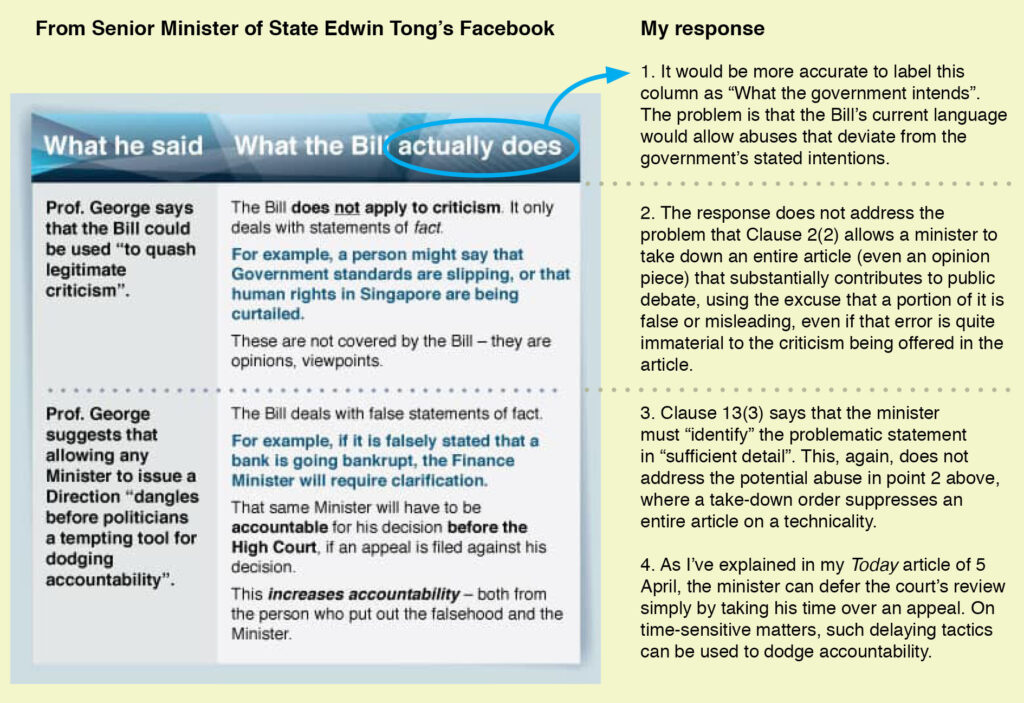
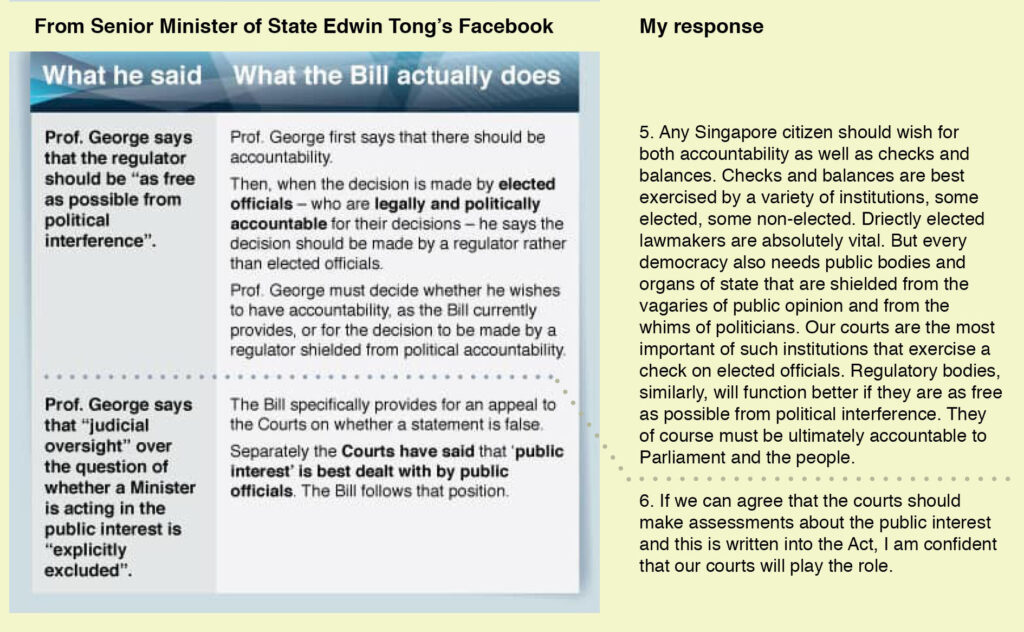
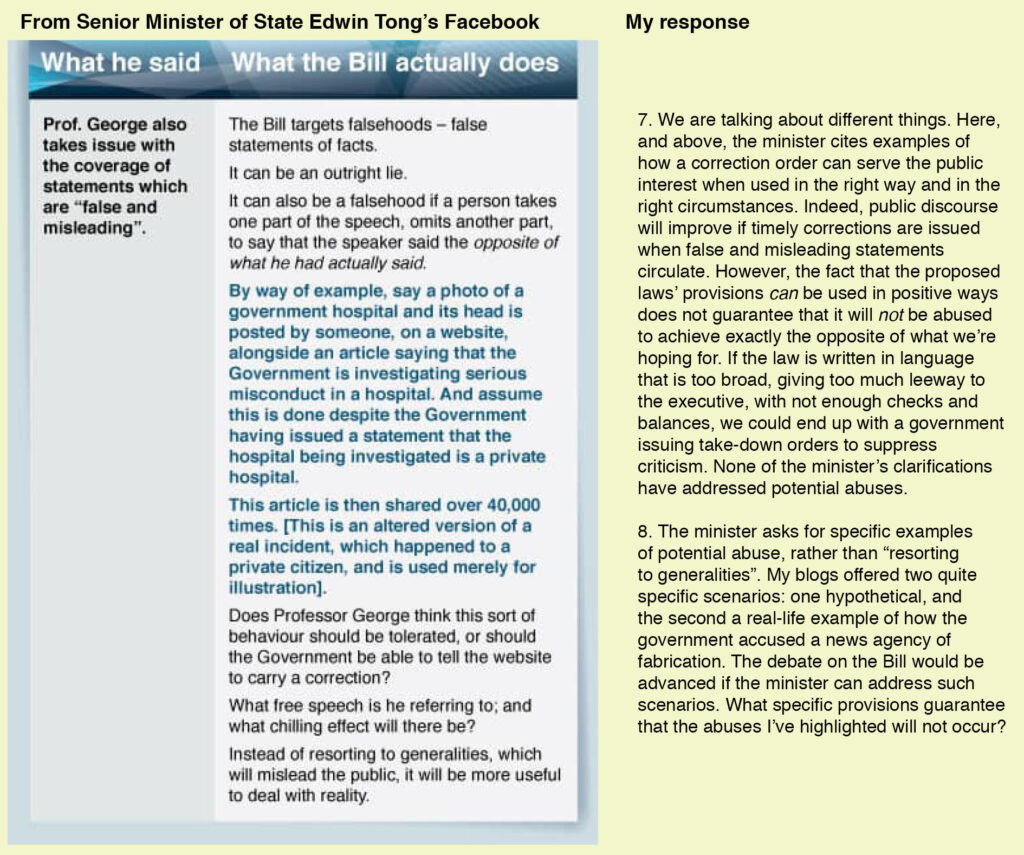
    It is good to see the government engaging citizens regarding our doubts about the Protection from Online Falsehoods and Manipulation Bill, which was tabled in Parliament on 1 April 2019. Senior Minister of State for Law Edwin Tong responded to my earlier blogs on his Facebook. My replies are below.


    My earlier articles

    April 2: Proposed online falsehoods law will help the government deal with dangers, but will it also make the government more dangerous?

    April 3: How would the Online Falsehoods Act affect journalism? This test case could give an answer.

    April 5: Give judges more leeway under fake news laws.


  • How would the Online Falsehoods Act affect journalism? This test case could give an answer.

    How would the Online Falsehoods Act affect journalism? This test case could give an answer.

    By CHERIAN GEORGE

    April 3, 2019

    In selling its new Online Falsehoods Bill, the government says it needs new powers to act against disinformation that could sow division and even incite violence among Singapore’s ethnic groups. This is a risk that most Singaporeans worry about.

    In practice, however, the government’s interventions in media often focus on streamlining coverage of its own words and actions — in news and opinion pieces that have nothing to do with the sensitive issues of race and religion. How would the proposed law apply to such cases? The Bill isn’t limited to disinformation campaigns that undermine race relations or the integrity of elections. It also targets misleading information that could diminish its own standing [see Section 4 (f) of the Bill, or my analysis of key sections here].

    For a complete list of my writings on this topic, please visit my home page.

    A historical test case

    The government’s tiff with a news agency 18 months ago is an interesting real-life test case that can clarify whether and how the Act might affect the work of journalists.

    In October 2017, the government accused Reuters of publishing a “fabricated headline”, adding that the global news agency was irresponsible to “fabricate quotes like this”.

    If Reuters was guilty of fabrication, it can only mean that it was communicating a “false statement of fact”, and deliberately at that, which is precisely what the Act is meant to stop.

    MPs should ask the government to state categorically whether it would have found the news agency in violation of the Act if it had been in force at the time. If so, which specific provision would it have used against the source? A criminal prosecution under Section 7? Or a Part 3 Correction Direction, or a Stop Communication Direction?

    Reuters is a global corporation that can look after its interests without our help. (And its quarrel with Singapore must have been a minor irritation in the larger scheme of things: it was carrying out vital investigative work in Myanmar that would result in the detention of two of its journalists, Wa Lone and Kyaw Soe Oo, six weeks later.)

    But we in Singapore owe it to ourselves to scrutinise the potential scope of the Act, which is why it’s worth revisiting the Reuters incident.

    Here’s the background.

    At a dialogue with foreign correspondents, Sharanjit Leyl of the BBC asked cabinet minister Chan Chun Sing a direct question – whether he would like to be the next Prime Minister.
    591
    His coy answer: “All of us have to be prepared to do the job when called upon.”

    Local media interpreted Chan’s response as a non-answer.

    Reuters interpreted it differently. It ran the story with the headline “Chan Chun Sing says he is prepared to be next Prime Minister when called upon”. The story paraphrased his quote to mean “he is prepared to become next PM if called upon”.

    Logically, Chan had to be part of the “we” that he declared to be prepared to do the job. Since he was asked specifically about himself, it was surely reasonable (even if inaccurate) to assume he was talking about himself, and that he perhaps used “we” self-effacingly, to indicate that he was no different from his peers in this respect.

    If reporters asked Joe Biden today, “Do you want to run for President?” and he replied, “All of us have to be prepared to do the job when called upon”, you can bet that the world’s media would report it within 10 seconds as “Biden says he’s prepared to run” and nobody – least of all Biden – would consider that to be a misinterpretation, let alone a fabrication.

    But the Ministry of Communications and Information (MCI) released a statement to media that very night, saying that the news agency had run “a fabricated headline alleging Minister Chan Chun Sing had said he is prepared to serve as PM”. MCI said Chan had been referring to the entire fourth generation leadership, and not to himself. MCI added: “It is irresponsible of a wire agency like Reuters to fabricate quotes like this.”

    This verdict wasn’t some throwaway remark made in a doorstop interview, but a written statement from the government. The timing is also worth noting. The government had already announced its intention to regulate “fake news”. So it is inconceivable that its accusation was totally unconnected to the government’s concerns about fake news.

    The connection was certainly not lost on the Five Stars and Moon blog, one of the PAP’s online attack-dogs and a good barometer of reactionary sentiment within the PAP. The same day the MCI statement was released, the blog said of the Reuters report: “That’s vague news. That’s as bad as fake news and perhaps even worse because it is evidence of media tampering, bias and agenda. One must then ask what agenda does Reuters and Yahoo have by making employing tactics of Vague news.”

    The next day, Reuters amended its headline to read: “Singapore minister says he, and his colleagues, all prepared to become next PM if called upon”. The lead was rewritten to refer to “he and his colleagues”.

    One local blogger probably had the best interpretation of the kerfuffle:

    “It seems that Mr Chan’s time as an army regular has equipped him with survival skills to navigate the path to be Singapore’s next Prime Minister. One such skill would be to show interest, but not too much that it appears over-zealous. That’s because when he was asked if he would like to be the next Prime Minister of Singapore, Mr Chan simply turned it into a warning that he and his colleagues have to be ready if they are chosen to lead the country.” – Nevin Khoo

    So the real problem with the Reuters report was that it wasn’t sensitive to the PAP’s corporate culture and Chan’s need to “show interest, but not too much that it appears over-zealous”.

    Taking into account what we know now — that there was internal disagreement about succession — it’s also possible that Chan’s reported response upset colleagues who either felt he was jumping the gun, or that the world’s media were declaring a winner prematurely.

    At worst, Reuters was guilty of not grasping the cultural intricacies of the PAP’s internal politicking.

    Back to the future

    The government now wants the power to punish and/or compel corrections/take-downs of deliberate falsehoods.

    It says that there is a patently clear and obvious distinction between false statements of fact and other types of disagreeable expression that won’t be covered by the law.

    If the distinction is clear, the government should have no trouble stating categorically whether the Reuters headline and quote would have been treated as a false statement of fact (which its statement at the time indicates); and if so, how the Online Falsehoods Act would have been used.

    I hope we get the unambiguous reassurance that such a case would not be subject to the proposed law, and that the Bill will be amended to close any loophole permitting a future government to use it in this way.

    If we can’t get that reassurance, at least we’ll have a better idea about the new limits for journalism in Singapore. Whatever the answer, the question needs to be asked.


    • See my Google Doc on the Bill’s provisions here.
  • Free speech: a selfish and irresponsible right?

    Free speech: a selfish and irresponsible right?

    By CHERIAN GEORGE

    July 5, 2015

    Singapore Advocacy Awards Lecture, 4 July 2015.

    (more…)

  • Before breakfast, how the regulators made a meal of Sintercom

    Before breakfast, how the regulators made a meal of Sintercom

    By CHERIAN GEORGE

    December 20th, 2013

    The closure of Breakfast Network brings to mind the death of Sintercom 12 years ago. Sintercom, a collective started by Stanford student Tan Chong Kee, was the Singapore’s first online magazine. The following article describes Sintercom’s ill-fated dance with the regulators. It refused to register when first asked to in 1996 – and got away with it for five years. But in 2001, the government again instructed it to register. Its owner did so, but then decided to close the site because of the added risk. This account is extracted from my book, Contentious Journalism and the Internet, published in 2006.

    The Regulators Strike

    The internet free-for-all ended one and a half years after Sintercom’s launch, when the Singapore Broadcasting Authority instituted new rules for the medium. The July 1996 announcement stated that websites that sought public attention and dealt with more sensitive areas, principally religion and politics, would have to register with the SBA. Sintercom was named as one of those affected.

    Among other things, registration required the editors and publishers of a political or religious website to sign a declaration accepting “full responsibility for the contents of [the] website, including contents of discussion groups carried on it.” Holding those in charge of websites accountable for comments other people posted on it would make it impossible for sites such as Sintercom to carry on as before.

    The reaction to the SBA announcement was revealing. It showed, first, the power of the internet as a mobilizing tool; and, second, the strong feeling among users at the time that the internet should remain free. Harish Pillay, a Sintercom editor, chronicled the episode on his own home page, starting with this entry:

    July 12th 1996: I am pissed off at the SBA and send an e-mail to the morning rag, Straits Times.

    July 13th 1996: I am very surprised that the morning rag did print my letter and verbatim at that — they did introduce a typo though.

    Pillay’s letter to The Straits Times was less colorful, but no less clear:

    As a Singaporean, I cannot understand why there has to be this high level of distrust that the Government has of its people… We do not need such draconian guidelines, even if the SBA says that they will be interpreted gently.

    This was only the opening salvo in a long and vociferous campaign against the regulations mounted by individuals associated with Sintercom. Tan Chong Kee discussed the matter with his fellow editors, but — not surprisingly for a committee of some 20 individuals — they could not agree about what should be done. “I thought it was urgent, so instead of trying to forge any consensus internally, I started campaigning in my personal capacity,” Tan says.

    He wrote a detailed critique of the regulations and posted it on the site. Tan’s analysis quoted the SBA’s reassurances that it wanted to be “light-handed,” and the generally positive responses carried in The Straits Times and Business Times. He proceeded to show how the regulations were not as innocuous as they had been made to sound:

    If the SBA thinks you should be banned, even if the public disagree [sic], you will still be banned. They have not mentioned any avenue of appeal. Does this set up sound ‘light-handed’? Would a disciplinarian who promises to be light-handed request for an iron rod?

    Additionally, Tan wrote e-mail “to everyone I had ever talked to on the net” — about 2,000 people — to raise awareness about the situation. Wynthia Goh, meanwhile, launched a page for feedback, which drew mainly adverse comments from day one. “Many people signed with their real names, which was very encouraging,” Tan recalls.

    Some were spooked by the regulations, seeing in them the specter of government surveillance and censorship. Others were confident that the internet’s resilient architecture would render futile any attempt to control it. A Gerard Lim wrote: “The vagueness and carte-blanche nature of these criteria run counter to the clarity, fairness and transparency that the rule of law is supposed to provide.”

    One Francis Chong called the regulations “just so much legalese to cover what is essentially an exercise of unchecked power.” Those who spoke up even included a junior official from the Ministry of Information and the Arts, the SBA’s parent ministry. The civil servant, Stephanie Sim, wrote:

    laws which cannot be enforced are not relevant or intelligent laws which are arbitrarily enforced are repressive laws which assume that people will never be mature and responsible will create societies which are selfish, childish and petty. yes, we want RESPECT, *NOT* REGULATION.

    Despite such protests, the government was never likely to withdraw the regulations. The most the campaigners could hope for was to embarrass the government, such that it would exercise self-restraint in interpreting and applying its powers. Sintercom’s narrower mission — to evade the registration requirement — was pursued primarily through private negotiations with the authorities. Its ally in the public sector, Philip Yeo of Sembawang Corp, again proved to be a friend in need. He brokered meetings between Sintercom editors and the SBA chief, the chairman of the National Internet Advisory Committee, and the Minister for Information and the Arts.

    The editors told the officials that theirs was not primarily a political site, since it carried everything from jokes to recipes. Its political content was mainly the Singapore Electronic Forum component, which was merely an edited version of the bulletin board soc.culture.singapore. They pointed out that since bulletin boards were not covered by SBA regulations, it was inconsistent to demand that a website carrying one should register.

    However, what clinched the argument may have been Sintercom’s preparedness to pack up and leave Singapore. “I said if SBA finds us too intolerable, we can move overseas again and host it on the servers of Stanford, Yale, Oxford, etc as before. They would look very silly if they blocked these sites,” Tan says. A week after the editors met SBA officials, the regulator wrote to Sintercom, saying:

    Based on our discussion and SBA’s assessment of SInterCom’s current webpage, and your assurance that your editorial group will exercise responsibility, intelligence and maturity in its selection of postings, we wish to confirm that SInterCom will not be required to register with SBA under the Class Licence Scheme.

    Tan suspects that the SBA was under instructions to try to persuade Sintercom to register, but not to insist: the government could live with the website being treated as a special case. Thus, Sintercom survived the new regulations unscathed. Of course, had the site gone beyond the limits of government tolerance, things may have turned out differently. It carried independent and critical commentary, but was not rabidly anti-government.

    Comfort with Sintercom grew. A hotlink to the site was even incorporated on the front page of “Singapore Infomap,” a web window to Singapore maintained by the information ministry. In a speech on civil society in May 1998, the minister, George Yeo, named Sintercom as one of the civic organizations that “encourage us to be more socially conscious.” “Singapore is a heterogeneous society and differences of opinion are natural,” he acknowledged.

    Sintercom carried more critical views than the mainstream media did, but it was not considered extreme. To Stephanie Sim, the young ministry official who had opposed the SBA regulations, Sintercom was little more than a “talk fest,” and not a website that attempted to organize dissent. At the same time, it allowed the government to tell its critics abroad that Singapore respected alternative views. “I think it has become a very safe place which will never be shut down because it’s great PR for the government,” she says.

    The Regulators Strike, Again

    In 2001, the authorities revisited the issue of registration, resulting in the closure of the original site. This turn of events illustrates the fluid nature of political opportunities. Governments’ calculations change with changing circumstances, in turn altering the environment for contention.

    In this case, the Singapore government appeared to be acting in advance of general elections due in late 2001. Although the ruling party does not flagrantly undermine the electoral process by, for example, stuffing ballots or buying votes, it is not above curtailing freedom of speech in order to limit citizens’ access to alternative sources of information and their knowledge of the choices available to them. The mainstream news media are accustomed to feeling the leash get shorter in the run-up to elections.

    This time, Sintercom would feel it too. Whether or not the coming elections were the motivating factor, the SBA wrote to Sintercom in July 2001 asking it to register. Asked to explain its reasons, it reiterated its stand that registration “is used to emphasize the need for content providers to be responsible and transparent when engaging in the propagation, promotion or discussion of political issues relating to Singapore.”

    Sensing that the SBA did not wish to engage Sintercom in further dialogue, Tan filled out and submitted the registration forms, making him formally accountable for the site’s content. In one small act of resistance, however, he modified the registration form, deleting a section that he believed violated his rights.

    Even with this amendment, however, registration placed Sintercom in a dilemma. “I do not want to be in a situation where I could be hauled into court anytime, depending on how someone in power has decided to interpret content in Sintercom,” he wrote in an editorial. At the same time, he did not want to err on the side of caution. “To self-censor now defeats the purpose of our existence,” he said.

    As a compromise, he decided to send all published material on the site to SBA for clearance. This, he felt, should satisfy the broadcasting law, which states that a licensee would be deemed to have used its best efforts to comply with the conditions of the license if it had taken “all reasonable steps in the circumstances.”

    “In this way, we will not self-censor, but we let SBA censor us whenever they like,” Tan said. Using the electronic feedback form on the SBA website, Tan submitted links to all of Sintercom’s existing content, and requested an e-mail address to which he could continue to send published content for clearance.

    SBA replied two days later, saying that it did not pre-censor material. Internet content providers were required to exercise their own judgment and take responsibility for their content, it added. With the affair beginning to receive mainstream media attention, SBA also issued a general news release stating that “registration is a simple administrative procedure” and that there was “no cause for Sintercom to over react over such a simple request.”

    Tan e-mailed SBA again, asking whether its characterization of Sintercom’s response as an overreaction meant that the site’s contents were clearly well within SBA’s limits. The authority again refused to be pinned down, reiterating that it was “unnecessary for Sintercom to seek advice from SBA on its posting.” Feeling that he had run out of options, Tan closed down the Sintercom site, seven years after its launch.

  • Yawning Bread in contempt again? Why blogger Alex Au deserves a break

    Yawning Bread in contempt again? Why blogger Alex Au deserves a break

    by

    CHERIAN GEORGE

    November 26th, 2013

    Alex Au is once again facing the threat of contempt of court charges over his Yawning Bread blog. The High Court will today hear the Attorney-General’s Chambers case for taking action against him.

    Au was accused of contempt last year. He apologised and promised not to do it again. The authorities probably see the latest cases as proof that he is a reckless netizen who hasn’t learnt his lesson. I look at it differently. If Au – one of Singapore’s most conscientious and civic-minded bloggers – cannot avoid the contempt minefield, then perhaps the problem is actually with the law. Is it getting in the way of intelligent critique of important issues?

    The rejoinder would probably be that there are ways to comment without scandalising the court. In theory, perhaps. But again, I would have to ask, if even Alex Au cannot find a safe path, perhaps the terrain is just too treacherous? Au is a meticulous and gifted writer. If he is charged with contempt, there would be a significant chilling effect on other citizens who do not consider themselves anywhere near as polished in their use of words.

    There is another reason why the authorities should be more generous with Au. Both the offending blogs had to do with discrimination against homosexuals. This is an area of the law that has not been satisfactorily settled. By the government’s own admission, Section 377A of the Penal Code, which criminalises sex between men, was retained not because it is just, but because repealing it would upset conservatives.

    The government’s resolution of this issue – to leave the law in the books but not actively use it – was highly unusual, to say the least. Whether or not it did the right thing, the government should acknowledge that it created a grey area that was bound to be passionately debated. Having done so, it seems only right that it allows citizens some latitude to engage in that debate, without having to fear tripping over the law of contempt.

  • SPH vs Yahoo! was about content vs tech, not old media vs new

    by

    CHERIAN GEORGE

    October 2nd, 2013

    The lawsuit that Singapore Press Holdings successfully filed against Yahoo! News has been routinely described as a battle between old media and new media. The subtext: that Yahoo! had been trying to champion the future, against a tired incumbent resistant to change.

    That may not be a wholly inaccurate description of the companies, but it is a misleading way to frame the case. The dispute – over the barely disguised lifting of scores of SPH stories by Yahoo! staff – was really about how commercial media enterprises (new or old) should value the labour of professional journalists.

    Yahoo!’s initial defence amounted to a dismissive negating of journalistic effort, as if stories are just a bunch of facts that fall into place by themselves. If the internet giant had prevailed, the losers wouldn’t just have been SPH, but also Yahoo!’s own journalists, whose original work could then have been ripped off with impunity as well.

    Of course, most of the time, it requires almost superhuman effort to muster sympathy for SPH. It luxuriates over a market protected by the government’s press licensing regime. Even when its papers do good work, many Singaporeans resent the lack of choice. Which is precisely why Yahoo!’s entry into the news business was a breath of fresh air. And why many instinctively rooted for it when SPH sued.

    Yahoo! occasionally tries to be a little edgier than the national media. More importantly, as part of its corporate strategy, it has localised its service and invested in Singapore content. Bear in mind that very few of the global media giants that have set up shop in Singapore have bothered to do this. Singapore taxpayers, through MDA and EDB schemes, have had to subsidise the likes of HBO and National Geographic Channel to induce them to produce local programming. In contrast, Yahoo! has been serving the local market with local content on its own steam (for which they’ve been rewarded with the threat of new government restrictions; go figure).

    But we needn’t exaggerate its underdog status. This is not some non-profit grassroots project we’re talking about, but the arm of a global corporation that made more than US$3 billion in profits last year.

    Because it is not primarily in the business of content creation, it tries to keep its editorial manpower costs subsidise wn. As a result, Yahoo! fields less experienced reporters and editors to compete with SPH and MediaCorp. When Yahoo! is able to hold its own, it’s a testament to the gumption of its newsroom, which has only a fraction of the capacity of The Straits Times, Today and other daily papers. It has young journalists who have risen to the challenge and done the profession proud.

    But there is a limit to how much a company can squeeze its editorial staff before corners are cut and things go horribly wrong. That’s the real lesson of the SPH vs Yahoo! case. The internet company has blamed the fiasco  on “a small number of Yahoo Asia Pacific employees”, who have been duly “disciplined or terminated”. This is too pat. First, it doesn’t explain why Yahoo! initially denied the allegations. The examples that were made public were such glaring cases of wholesale plagiarism that no self-respecting media content company would have tolerated, let alone defended, them.

    Second, it doesn’t address the conditions that the culprits were working under. Such systematic plagiarism is unlikely to have taken place without pressure from the top to pump out content at a rate far in excess of the team’s capacity. This smells of a management failure. Even if the company cannot admit this publicly, I hope that it is reviewing its newsroom staffing and targets – and that it will then invest more heavily in its editorial manpower.

    Whatever criticisms one has of SPH, it at least hasn’t completely forgotten that it is in the content business, and that original content doesn’t come cheap. Its investments in hiring and training journalists are certainly not paltry by global industry standards.

    Yahoo!’s lack of regard for SPH’s intellectual property represented a tech/advertising company trying to hitch a free ride on a content company. If it had been allowed to get away with it, it would have been bad news for journalism, whether in new media or old.

  • Balji in da house: The Independent is now the site to watch

    by

    CHERIAN GEORGE

    August 9th, 2013

    Shortly before the Media Development Authority made The Independent famous by requiring it to register, a friend who heads a successful news site overseas asked me if this was a breakthrough to be taken seriously. Would Singaporeans finally have a professionally-run, independent and financially viable online news site? In other words, would Singapore reach in 2013 the level that Malaysia, Indonesia and many other Asian neighbours crossed – in the 1990s?

    I replied that it depends – on what role Balji would play. P. N. Balji is the former editor of The New Paper and, more significantly, the founding editor-CEO of Today. In the latter capacity, he achieved what nobody had done in a more than a century: take on The Straits Times and survive. Of course, no previous contender had the backing of Temasek Holdings, but that does not diminish his contribution to its success. Most close watchers of Singapore journalism know that Today’s heyday was under his leadership; it has not been the same since he left.

    Balji’s name popped up on The Independent’s “About Us” page, but it wasn’t clear in what capacity. If he was just going to be an adviser and occasional contributor, but stay out of the kitchen, The Independent would probably continue the long tradition of sites that promise more than they deliver. However, if he was prepared to take charge and get his hands dirty, things would get interesting, I told my friend.

    Today marks the official launch of The Independent, and Balji has been named as Editor. It is still a pretty modest site. There is no indication that it is able to enter the business of daily news reporting and become Singapore’s equivalent of Malaysiakini. And unfortunately, one of Singapore’s top publication designers, Edmund Wee of Epigram, seems to be limiting his role to business strategy rather than giving his magic touch to the look and feel of the site, which in its current form does not inspire confidence.

    But I’ll stick to my prediction that this is now the player to watch. It is the first time that a professional news editor/publisher with a proven record in mainstream media is making a serious online foray. As much as citizen journalists like to knock mainstream professionals, the truth is that most high-impact independent news startups in the region have been led by professionals who’ve come from the mainstream – that is true of Malaysiakini in Malaysia, Detik in Indonesia, Tehelka in India, and Rappler in the Philippines.

    The news may deal with generalities, but editing the news is a specialised job; and editing it masterfully requires wisdom and judgment that no app or attitude can compensate for. It requires many years of daily practice to develop a competitive level of competence to make sense of the deluge of information out there, to decide what readers need and want to know even before they ask for it, to bring the best out of reporters and columnists, and to catch enough errors, spin, legal traps and ethical pitfalls before they degrade your journalism.

    These are core competencies required of editors regardless of whether the end product is a mainstream newspaper or an insurgent alternative website. Of course, the latter requires abandoning some bad habits of mainstream journalism – replacing the lecture with the conversation, in the words of citizen journalism guru Dan Gillmor; and coming out of the protective newsroom environment to think more entrepreneurially.

    But, again, while citizen journalists like to cultivate the myth than only those untainted by a mainstream past can absorb the zeitgeist of new media, the truth is that, worldwide, it is often those who’ve succeeded in mainstream journalism who most keenly appreciate what’s special about the internet and what needs to be done to push journalism into the future. That is true of the aforementioned Asian sites and Dan Gillmor (a former technology writer for the San Jose Mercury News), as well as the likes of Rebecca MacKinnon (from CNN to Global Voices Online), Ariana Huffington (from public radio, newspapers and magazines to the Huffington Post), Tina Brown (from Vanity Fair and The New Yorker to the Daily Beast) and Paul Steiger (from Wall Street Journal to ProPublica). Balji has written about his own professional journey; whether he can successfully make the transition – to recycle a journalistic cliché – only time will tell.

    No matter how many good journalists are willing to work for The Independent, though, its success will ultimately depend on reader support. Independent websites do attract a significant minority of the Singapore public on a regular basis. Their fans have been vocal in wanting alternative media, and quick to defend them on forums and Facebook. The big question is whether they are prepared to put their money where their mouths and eyeballs are.

    To build anything close to a Malaysiakini and compete head-on with straitstimes.com or channelnewsasia.com, a site would have to budget something like a million dollars a year just for its editorial department. Since the The Independent is banned from receiving grants and loans from foreign foundations – how most independent news startups in the region were launched – it would need 10,000 subscribers paying $100 a year to sustain its editorial team. Considering how much Singaporeans will be forking out to watch the English Premier League in the coming season, or how much they pay for visits to the cinema each year, this isn’t really a lot. But try telling that to netizens who assume that “free media” should mean free of charge as well as politically free; and who think their job is done when they “like” a site’s Facebook page.

    The biggest obstacle facing The Independent is thus the small effective market for independent local political news and commentary. The potential market is small enough, with less than 3 million adult citizens. And the number who would be interested enough to pay for the service is much smaller still, because Singapore remains a place where most people don’t really feel they need to follow politics, either to get by in life or to feel intelligent. Political uncertainty and instability are the best friends of political journalism, and while the post-2011 landscape is a lot more interesting than in the past, it is still a far cry from the conditions conducive for a commercially viable, standalone and professional political news site.

    I hope Balji and The Independent prove me wrong.

  • Leslie Chew vs his demons, Round One: victory for common sense

    by

    CHERIAN GEORGE

    July 29th, 2013

    UPDATE, 7 August: The government has dropped contempt of court proceedings after Leslie Chew apologised and took down the offending cartoons. See news report.

    The government has announced that it will not charge “Demon-cratic Singapore” cartoonist Leslie Chew with sedition. The decision of the Attorney-General’s Chambers is spot on – notwithstanding the wishes of a grand total of 140 individuals who signed a petition asking the government to throw the book at him. As this blog pleaded three months ago, if the government feared that Chew’s criticism of its race policies would have any traction, it should respond with arguments, not force.

    Chew is not off the hook yet. While the Sedition Act won’t be used against him, he has committed contempt of court, the AGC says. His fate now hinges partly on how the court reads the law on scandalising the judiciary. Singapore has traditionally taken a tough line. Recall how three activists were jailed five years ago for wearing t-shirts emblazoned with kangaroos in judges’ robes.

    Since then, however, the courts’ thinking has evolved. In the Alan Shadrake case, the Court of Appeal applied a more liberal “real risk” test for the first time. Shadrake’s conviction was upheld, so the shift in thinking was barely noticed beyond legal circles. Chew’s lawyers, M. Ravi and Choo Zheng Xi, may ask the court to refine its thinking further and rule that – regardless of how inherently insulting the cartoons may have been – Chew does not merit a jail term or fine.