Category: Journalism.SG

  • When watchdogs bark up the wrong tree, let’s not airbrush the error

    by

    CHERIAN GEORGE

    May 10th, 2013

    UPDATE: New Nation editor Belmont Lay has said sorry to photojournalist Mohd Ishak, with style and humour. It’s a lesson in accountability that even the pro’s can learn from.

    When I was art and photo editor of the Straits Times some 15 years ago, having a team of top-notch photojournalistic talent didn’t stop us from envying The New Paper for having in its ranks one Mohd Ishak. He didn’t just shoot good photos. He was a regular go-to guy for all sorts of assignments that required a level head, not just a sharp eye and a steady hand.

    Over the years, Ishak has covered war zones and disaster areas, collecting multiple national and international awards. He is no celebrity; he is just a skilled and hardworking professional who lets his pictures do the talking. Being in the journalism business, though, his photos don’t please all of the people all of the time – that’s the job of advertising. And so it is that a picture he shot of cyclists along Changi Coast Road has angered some fellow cycling enthusiasts (yes, he is an avid cyclist himself) and sparked anti-mainstream-media netizens into action.

    They alleged that his photo, republished in MyPaper, was Photoshopped – digitally altered to introduce cyclists in the middle of the road, in order to deceive readers about cycling habits on Singapore streets.

    It is hard to think of a more serious allegation to make against newspaper photographers. They do play around with contrast or colours to bring the printed image more in line with what the naked eye had seen. It is also acceptable for non-news pages to use a photo that has been turned into a photo illustration that the reader instantly realises is not meant to depict reality.

    But adding or subtracting content from a photo to convey a meaning that was never there in the first place would be treated as a career-ending act in most professional news organisations. (See, for example, Reuters’ photo guidelines.) So Ishak was basically being accused of a violation that would have caused him to lose his livelihood.

    Some of Singapore’s best-read and most highly regarded alternative media circulated the allegation on their websites or Facebook pages, unleashing a barrage of abuse against Ishak’s organisation.

    But it turns out that the photo was not doctored. The New Paper has proved that beyond reasonable doubt, by releasing the frames Ishak shot before and after the picture that was published. (I say “reasonable” doubt because if TNP staff had the capability to fabricate all of these images, they would be working at DreamWorks in California, not in SPH at Toa Payoh North. As for unreasonable doubt, these still persist, as with any good conspiracy theory.)

    I’ve been curious to see how Ishak’s accusers would react to this turn of events. New Nation, which had earlier stated that the “evidence seems pretty compelling” that a doctored photo had been used to slime cyclists, admitted it had been “wildly inaccurate“, but made light of it. It appeared to congratulate itself on having elicited a “rare” clarification from TNP (which in the past has earned public ire by publishing dubious articles slamming the opposition).

    Others have shifted target, slamming MSM in general. (Some of the new points raised, I agree with. In particular: for such a hot topic as cyclists’ safety, why did MyPaper have to reach for a two-year-old file photo and not caption it as such? It does open the paper to the accusation that it went to some lengths to show that cyclists are guilty of bad habits.) On Facebook, The Online Citizen asked for more evidence that the photo was indeed authentic. Most have simply fallen silent, moving on to the next controversy.

    The moral reasoning behind this range of responses is interesting. The argument seems to be that it is no big deal to circulate an untruth (“Ishak’s photo was a fake”) if it highlights some larger truth (“MSM is unreliable” or “cyclists are victims”) or if the false statement then elicits a correction that sets the record straight (“Contrary to speculation, Ishak’s photo was not a fake”).

    Based on such lines of thinking, it would be fine for me to write, for example, that your father is a child molester, since (a) some fathers are child molesters; (b) my false accusation gives you the opening to tell the world that your father is not in fact a child molester, so you should actually be thanking me for my fine citizen journalism.

    I must stress that I’m not generalising about anti-establishment netizens (and if you think I’m asking for more regulation of freedom of expression, please refer to other articles in this blog). Pro-establishment types are perfectly capable of baseless attacks on individuals.* Wherever one stands politically, our desire to be critical shouldn’t absolve us from responsibility to do the right thing when we are proven wrong.

    The response that would be nice to see is a simple sorry to Ishak. He wasn’t purveying untruths. His critics were.

    I doubt he’s losing sleep waiting for an apology. (I asked him for his response, which is below.)

    I wish people would say sorry not for his sake but for those of us who hope that we as alternative media practitioners will be the change we want to see. Otherwise, one would be left with this uncomfortable conclusion: that, sometimes, when alternative media attack a news organisation’s ethical failures, it’s not because they believe in the high road themselves, but because they think they have exclusive rights to the low.

    MOHD ISHAK IN HIS OWN WORDS

    “Photoshop is a powerful tool. As with all modern professional photographers, we do use Photoshop to do basic corrections to the pictures we shoot, mainly to crop and correct the colour of our photos.

    But as photojournalists our ethical standards are clear; we cannot alter the reality of news pictures we shoot. The damage to our publication and the photographer would be irreversible. Things like adding or removing objects in Photoshop are clear violations in our line of work.

    We came to know of the allegations on May 7 when some colleagues were alerted to Facebook posts, accusing us of using a doctored photo to slam cyclists. In reporting news, we often have to deal with issues that might aggrieve some parties and highlight issues they might not be able to accept. But we do it honestly, in an unbiased manner and professionally.

    Besides ethics, we are also aware that at stake are issues of credibility, reliability and accountability. Unlike some netizens who make wild unsubstantiated claims and walk away unharmed, as professionals we risk paying a heavy price if we were to mirror their practice.

    Photos back up news reports. Yes, sometimes there are black sheep within the local journalism community but they are dealt with severely. People have lost their jobs. Netizens merely move on to the next topic without taking responsibility for the damage they have done.”

    * Just last week, I was the victim of one defender of the status quo: Someone who disagreed with students who are questioning my employers about my status at NTU posted on a popular student site that I should just leave Singapore instead of “disturbing the peace”, suggesting that I was somehow responsible for actions students took on my behalf; the person even went to the trouble of stealing an accountancy student’s identity to post the comment in her name.

  • Sedition charge would send wrong signals about managing race

    by

    CHERIAN GEORGE

    April 25th, 2013

    Race and religion form the third rail of Singapore politics. They lie in the deep, dark recesses of our national life, ready to strike the reckless and the ignorant with an untamable force. Most Singaporeans – even many liberals – believe that freedom of expression should not apply in the vicinity of this third rail. As a result, they not only accept the laws that govern racially or religiously offensive speech, they have even been known to push for strong enforcement.

    Now, a 37-year-old cartoonist Leslie Chew is under investigation for a possible breach of the Sedition Act. One of the cartoons that apparently earned the authorities’ attention attacks the “racist government” of “Demon-cratic Singapore“, including a leader who “abhors Malays”. No reader would have the slightest doubt that this is a criticism of the Singapore government’s race policies, so protestations that this is a purely fictional strip are unlikely to impress any judge.

    However, let’s hope that the case doesn’t get that far. While the law gives the authorities the green light to take forceful action, that does not mean they have to go all the way.

    The test shouldn’t simply be how angry a community feels– or even less how angry government officials feel– about offending words, even if those words are untrue and unfair, and even if the offence is deliberate. There are at least two other commonsense tests that should be applied.

    First, we should ask whether the speaker is in a position of leadership or great influence, which would increase the likelihood that his words would have an effect. Going by this test, a political party office holder or the leader of a religious community would be held to the highest levels of accountability, while a teenaged blogger– or a cartoonist– can usually be ignored.

    Second, we need to assess, case by case, whether there is enough time and opportunity for the allegedly bad speech to be defeated by better speech. If there is, then political debate doesn’t need a lot of help from the law. Instead, reserve the law for volatile situations when a temporary calm needs to be imposed so that society can catch its breath, free from the polluting effect of incendiary speech.

    The Leslie Chew case doesn’t meet either test. First, he has no special influence. Second, his criticism can be countered by the government and other citizens, long before it corrodes our institutions or our ethnic relations, if that is the fear.

    Singapore’s insult laws are often used symbolically, to declare the kind of society we are or want to be. The authorities should be mindful of what signals they’d be sending if they prosecute Chew for sedition instead of simply taking him on politically (or just ignoring him– but it’s too late for that now).

    In effect, legal action would suggest that the government lacks confidence in defending its record in race management. Such a signal would be ludicrously and unnecessarily self-injurious, doing more harm to its reputation than Leslie’s cartoons ever could.

    It is noteworthy that the arrest was made under Section 4(c) of the Sedition Act, and not under the Penal Code. Section 298 of the Penal Code is designed to curb the “deliberate intent to wound the religious or racial feelings of any person” while 298A addresses “promoting enmity between different groups on grounds of religion or race”.

    While these recently enacted provisions are worded too broadly, they are at least an improvement over the archaic Sedition Act. What the Sedition Act contains that Sections 298/298A of the Penal Code does not is a prohibition against actions or expression that have the tendency “to bring into hatred or contempt or to excite disaffection against the Government”.

    Many Singaporeans pragmatically accept the need for tough laws to protect ethnic communities against insult– partly because, rightly or wrongly, they fear that their fellow citizens will run amok if provoked. It is harder to see the need for equally tough laws against insulting the government– it is not as if offended officials will start a riot.

    Eventually, Singapore needs to review its over-broad legislation governing race and religion. The relevant laws need to be more narrowly worded and more precise, to prevent stifling the legitimate airing of important issues, even if those views are expressed in ways deemed offensive or tasteless. In the meantime, though, the authorities should act with more discretion and let Leslie Chew go. Sliding the law back in its sheath would be sign of strength, not weakness.

  • Film censorship: was Porn Masala really too hot to handle?

    by

    CHERIAN GEORGE

    April 20th, 2013

    The government’s well-publicised censorship of the short film, Porn Masala, has provided an opportunity to query Singapore’s arts regulation – an opportunity seized by an excellent panel of speakers at a Tembusu College forum on Thursday.

    Porn Masala was one of three tales in the film, Sex.Violence.FamilyValues, written and directed by Ken Kwek. Although originally passed by the Media Development Authority with an M18 rating, complaints about the online trailer caused it to be referred to the Films Consultative Panel, which recommended a total ban. On appeal, the Films Appeal Committee allowed it under an R21 rating – but with cuts.

    At issue was the film’s depiction of a sleazy Chinese porn filmmaker spouting vile, prejudiced views about Indians to the Indian actor he is directing. Although Kwek’s intent was obviously to ridicule rather than endorse such views, the regulators felt that these “demeaning and offensive” references crossed some line of acceptability.

    The Porn Masala case had been wrapped up and stored away in that overflowing vault in the Singaporean mind reserved for our deepest fears about ethnic conflict. It will be taken out every now and then to illustrate that, beneath our modern, cosmopolitan veneer, there lie deep “fault lines” between ethnic groups, which responsible Singaporeans respectfully recognise.

    This should not be the final word on this episode, and thanks in part to last Thursday’s forum, it won’t be. Predictably, Kwek defended his film, as he has before. More significant were the inputs of three other speakers: Walter Woon (former attorney general and the chairman of the Films Appeal Committee), Arun Mahizhnan (former deputy director of the Institute of Policy Studies and a long-time champion of the arts) and the moderator Tommy Koh (who chaired the groundbreaking 1990 Censorship Review Committee and was the first chairman of the National Arts Council).

    Between them, they probably have a century’s worth of accumulated wisdom in thinking about freedom of expression and its limits. None of them could be accused of being insensitive to Singapore’s special circumstances. But they made clear their doubts about the current approach to censorship.

    Here are three key issues that were raised.

    First, the forum questioned the assumption that the complaints against Porn Masala amounted to a community response. Instead, it had all the markings of a campaign instigated by a very small number of individuals. Their efforts did not appear to gain any traction in the wider Indian community, but that did not stop the censorial instinct.

    Singapore has an extremely low appetite for risk when it comes to ethnic matters. I have argued elsewhere that this well-meaning approach is dangerously misguided, because it encourages political actors to hype up any offence that they feel, usually to further a private political agenda rather than to protect the public. Worse, it feeds into the stereotype that minorities in Singapore are prone to losing their heads at the slightest provocation.

    Second, the panelists suggested that citizen committees can be undermined by members who lose sight of their real responsibility. Too many second-guess what the political masters want to hear – a tendency that was assumed to be limited to civil servants but seems to have infected others outside the public sector who are asked to serve on such committees.

    Committee members also display a patronising attitude towards the wider population: they tend to assert that they themselves are mature enough to handle offensive speech, but the Singaporeans out there are not and need to be protected (a universally observed fallacy known to scholars as the third person effect). Those asked to serve on committees should stop hiding behind what they claim others want to hear and instead vote according to their own values and principles, panelists said.

    Third, denial is not an option when dealing with speech that is deemed offensive. The instinct to block art belongs to a generation when producers did not have the option of routing around censorship by going online. (Indeed, Ken Kwek revealed at the forum that his film would soon be available online in its entirety.)

    This is not to say that even free-to-air TV, which enters living rooms as freely as a family member, should be unregulated; but it is anachronistic to require the government to cut or ban a film that is already subject to classification and that would only be watched by willing, adult viewers. If there is a fear of negative social effects, the answer is to help audiences cope, not rely on censorship, noted Mahizhnan.

    Censoring a film like Kwek’s makes even less sense. The correct response to racism and bigotry is not to let it gain power in the darkness, but to drag it out into the open and mock it, Woon pointed out. That is exactly what Kwek’s film had sought to do.

  • Bloggers are journalists who play by different rules

    April 11th, 2013

    by KIRSTEN HAN

    Reproduced with permission from Kirsten Han’s Spuddings blog. Kirsten is doing her MA in Journalism, Media and Communications at Cardiff University on a Chevening scholarship.

    Whenever discussions over whether bloggers can be considered journalists arise, there are those who will be quick to point out all the differences: while professional journalists have established codes of conduct to adhere to, bloggers are generally not bound to any specific set of ethics that would govern their behaviour (Knight et al. 2008, pp. 122). Bloggers are often painted as freewheeling mavericks untrained – or even uninterested – in the rules governing content production (Lasica 2002, para. 5), while journalists are seen as trained professionals producing accurate reports adhering to a high standard. Another distinction between bloggers and journalists is made by saying that bloggers rarely produce original reporting, seen as “the heart of all journalism” (Blood 2003). By pointing to these differences, it is then proposed that bloggers are not journalists, and should not be considered as such.

    While I do not deny that there are many differences between a blogger and a journalist dealing in hard news, in this essay I argue that the exclusion of bloggers from consideration as journalists fails to recognise different traditions of journalism such as partisan or advocacy journalism where different practices and goals are prioritised. When we recognise that the concept of journalism encapsulates much more than professionals in a newsroom, we begin to see similarities between bloggers and some journalists, and to consider bloggers as a type of journalist. Taking my examples from the Singaporean blogosphere, as well as drawing on my own experience, I will show how bloggers can – and should – be considered journalists, especially in a country where the lack of independent mainstream media leaves a gap in society.

    Of course, one needs to recognise that although there are a huge number of bloggers in Singapore, not every blog is relevant to this essay. Like others have observed with blogs around the world (Andrews 2003; Blood 2003; Domingo and Heinonen 2008), most Singaporean blogs publish non-journalistic content ranging from personal diary entries to lifestyle advertorials to cat pictures. Some of Singapore’s most popular bloggers do not engage in journalism, but nevertheless there are a significant number who can be considered to “commit journalism” (Lasica 2002, para. 34-36). For the purpose of this essay I will be referring to those who write “journalistic blogs”, defined by Domingo and Heinonen as bloggers who provide commentary and analysis on current issues for a large readership (2008).

    The 2012 Press Freedom Index by Freedom House ranked Singapore alongside Qatar and Angola in the 150th position, describing the press as “not free” (Karlekar and Dunham 2012). It was not the first time; Singapore has consistently scored badly in press freedom rankings, having ranked 136th in the Reporters Without Borders Press Freedom Index 2010 (2010) and 135th in 2011/2012 (2012). These reports show that although Singapore is often seen as a success in terms of economy and development, major concerns remain with the state of the press in the island nation.

    Singapore’s mainstream media is either government-owned (as in the case of MediaCorp, which runs the radio and television stations as well as certain print publications) or seen as government-influenced (as in the case of Singapore Press Holdings, which mainly deals with print publications). Legislation such as the Newspaper and Printing Presses Act gives the government the power to issue or revoke licenses for publications and to restrict or influence media ownership and distribution. Defamation suits have also been used against journalists and publications. In his book Freedom From The Press, Cherian George (2012) writes that the methods used by the government to control the media has managed to “distort the relationship between the media and public, making accountability to government more salient than accountability to people in editorial decision-making.” This can be seen in the way the mainstream media often echoes the official line in national issues, even going as far as to edit forum letters to reflect more favourably on the establishment (The Online Citizen 2011).

    What Singapore lacks in free press, it makes up for in terms of connectivity. A Nielsen report (2011) revealed that with 67 per cent Internet penetration and 70 per cent smartphone penetration, Singaporeans are the heaviest users of the Internet in the Southeast Asian region, clocking in an average of 25 hours online per week.

    This connectivity has given Singaporeans opportunities to set up their own platforms and many have seized the chance, either singly or in groups. Socio-political blogs like The Online Citizen (TOC) and TR Emeritus (TRE) are operated by teams of bloggers who provide not only commentary and analysis but also original reporting. Both platforms have cultivated large followings.

    In 2008 TOC published a post (Chan 2008) about the abandonment of 179 Bangladeshi migrant workers, a story that had not received any attention from the mainstream media. They continued to run stories on the exploitation of migrant workers, drawing attention to problems like substandard living conditions (Chok 2009) and the practices of repatriation companies (Wham 2009). The blog has also highlighted issues such as homelessness (Yong 2010), the death penalty (Loh 2010) and the Internal Security Act which allows for detention without trial (Teo 2011). TOC’s work grew to such prominence that it was gazetted as a political association by the Prime Minister’s Office in 2011 because of its ability to “shape political outcomes in Singapore”.

    Outside of group blogs like TOC and TRE, individual bloggers in Singapore have also acted as reporters and watchdogs, monitoring not only the government but also the mainstream media. During the 2011 General Election, bloggers provided their own coverage of events  and kept a close eye on the mainstream media. Yawning Bread, a popular blog run by Alex Au, featured firsthand accounts of procedures at a nomination centre (2011a), commentary on the rhetoric used by the ruling party (2011b) and analysis of election coverage by Singapore’s only English-language broadsheet The Straits Times (2011c).

    I myself have had experience of providing alternative accounts to the mainstream media as a socio-political blogger. Halfway through the 2011 General Election, popular tabloid The New Paper reported that Chee Soon Juan – an opposition politician who had been bankrupted through defamation suits and thus banned from standing in elections – had attempted to start a protest march at his party’s rally. In a country where protests are outlawed, it was a serious allegation and the paper branded him as a “loose cannon”. However, I had been at the same rally as a volunteer photographer for TOC and had seen no such thing. My blog post (2011) with my account of the rally received over 20,000 page views and encouraged more eyewitnesses to come forward to share their versions of the story, which eventually led to The New Paper publishing a clarification explaining their claims. Before the advent of blogging, it would have been very difficult for Singaporeans to find alternative accounts or to rebut stories from the mainstream media, and such a story might have been spread widely without correction or clarification.

    The significance of bloggers and their work has been acknowledged not just by a mainstream media who has had to change the way they cover events (Au, 2011c) but also by the government. In October 2012 the Minister for Information, Communication and the Arts Yaacob Ibrahim said that it was necessary for the government to change the way it communicates to take the new media practitioners like bloggers into account. Ang Peng Hwa, the chair of the Asian Media Information and Communication Centre, then suggested that press accreditation be granted to certain bloggers to gain access to official events (Sreedharan 2012). This had already been demonstrated in some way during the presidential election in August 2012: when Tony Tan (who eventually won the election) held a press conference to announce his candidacy, bloggers were invited to cover the event even as foreign journalists were excluded (George 2011a). All this serves to highlight the impact that bloggers made on society, so much so that establishment figures are beginning to consider them on a level similar to professional journalists.

    That said, there is still much to set bloggers apart from mainstream journalists. A blogger with TOC or TRE is usually a volunteer with a day job, unable to devote his or her full time and attention to news gathering in the same way a journalist from The Straits Times does. Although bloggers do some original reporting, it is only in the odd occasion where they have the time and opportunity to do so. The bulk of the content in blogs are still commentaries, analyses and opinion pieces coming from individuals (even when it comes to group-run blogs). This echoes Andrews’ (2003) point: although bloggers have pushed print journalism towards richer coverage, they lack the training and collaboration with other professionals that many journalists have in the newsroom. Blogging is also usually different from his description of journalism as “a disinterested third party… reporting facts fairly”.

    Objectivity and impartiality are often identified by both scholars and journalists themselves as core principles of journalism and the hallmarks of professionalism (Schudson and Anderson 2009). However, it has been pointed out that this has not always been the case. In fact, partisan journalism has actually had a much longer history than objective journalism (Allan 2004). The concept of objective journalism is also a very Anglo-American-centric one, and does not necessarily relate to traditions of journalism elsewhere in the world where journalists were often also clear advocates of certain issues. George (Knight et al. 2008, pp. 129) observes that Malay-language journalism traditionally saw “little distinction between the journalist, the writer, the poet, the activist and the public intellectual”, and that even Singapore used to have a vibrant media landscape that did not shy away from partisan views.

    When we widen our scope to include different forms of journalism, we begin to find more similarities between bloggers and journalists, and to see a space for bloggers in journalism. We could, for instance, compare blogging to advocacy journalism, and identify shared beliefs and goals.

    Unlike mainstream journalism, advocacy journalism does not make claims to objectivity or neutrality. Rather than assuming the role of the “disinterested third party”, advocacy journalists unabashedly champion causes important to them, seeking to address problems or imbalances in society (Waisbord, 2009). Advocacy journalists believe that their work plays a crucial role in bringing about important changes, and reject the belief that journalism can ever be truly objective (Berman 2004). Instead, they prefer the concept of transparency, and believe in gaining credibility by being open and up front about their views and stances (Careless 2000).

    Like advocacy journalists, bloggers do not pretend their posts are objective – readers are aware that blog posts reflect the views of the blogger. Bloggers also do not shy away from championing causes, arguing their points and seeking to persuade their readers through their posts. Yawning Bread blogger Alex Au is also an advocate for gay rights and labour rights, and writes extensively on these issues. Similarly, TOC has taken a stance on issues such as the mandatory death penalty and the Internal Security Act that allows for detention without trial in Singapore, and has from time to time embraced the label of “blogivist” – bloggers who are also activists.

    Some features and practices of blogging also allow for the transparency valued by advocacy journalists. Blood (2003) refers to the practice of hyperlinking – where bloggers are able to provide links to other content they refer to – as being able to provide “a transparency that is impossible with paper”, while Hermida’s (2009, pp. 278) case study of the BBC adopting blogging highlights the comments feature on blogs as a way for content producers to connect with and be more accountable to their audience. These features, also prevalent in the Singaporean blogosphere, show us how bloggers can be held to account by their readers, and to be transparent about their sources. The personal and subjective nature of blogging also allows readers to get to know the writer and understand his or her stance in a way that is similar to understanding the motivations of an advocacy journalist.

    Scholars have also suggested other terms to describe blogging. Lasica (2003) refers to it as “participatory journalism or journalism from the edges”, highlighting the ability of bloggers to enter a domain previously reserved for mainstream journalists. Wall (2004) invokes economic theory to talk about blogging as “black market journalism”, arguing that bloggers represent an “informal economy” of news where the domination of mainstream journalism is challenged.

    The popularity of blogging has often been seen as a danger to mainstream media. Keen (2006) suggested that the democratisation of media production on the Internet – including, of course, blogging – presents a threat to mainstream media and the work of professionals. Lasica (2003) disagrees with this view, arguing that bloggers can be seen as engaging in journalism of “a different sort” and that the relationship between blogging and mainstream media is “symbiotic”.

    It’s an argument that can be clearly illustrated by Singapore’s situation; the bloggers are unable to compete with the resources (in terms of funding, access and manpower) of the mainstream media, and therefore still rely on newspaper coverage of events like parliamentary sittings and press conferences. However, once the reports are out, Singapore’s bloggers are able to pick up and analyse stories, asking questions that may have been left out from the official narrative, or to even question the professed neutrality of the mainstream media. The expectation that bloggers will replace the mainstream media is unrealistic, but what bloggers can do is provide alternative viewpoints that enhance audience understanding and enrich public discourse. Although the bloggers may sometimes be ideologically opposed to views promoted by the mainstream media, the relationship between bloggers and mainstream journalists in Singapore can also be seen as more complementary than competitive.

    Rejecting many of the practices and rules that form the core of mainstream news production, bloggers have very little interest in becoming identical to mainstream media practitioners, but this is in no way an indication of whether they can or cannot be seen as journalists. As this essay has shown, journalism is not restricted to just one set of rules and practices, but includes a range of journalists adopting different priorities, styles and principles. In this large, complex field, blogging has simply emerged as a new form of journalism, one that borrows the attributes of other forms such as advocacy and partisan journalism and has served to enrich media landscapes previously dominated by mainstream, traditional news production. Using Singapore as an example I have demonstrated how bloggers can make a significant impact by giving the public perspectives beyond that of the establishment-influenced narrative. In this way, bloggers are consistently fulfilling a similar role in society to journalists, even when they refuse to play by mainstream rules.

    After all, as TOC editors Andrew Loh and Joshua Chiang said, “We never claimed to be ‘balanced’. We are the balance.” (George 2011b)

    Reference List

    Allan, S. (2004) News Culture. 2nd ed. Buckingham: Open University Press, p.7-24.

    Andrews, P. (2003) Is blogging journalism?. Nieman Reports, 57 (3), p.63-64.

    Au, A. (2011a) At the Jurong Nomination Centre. Yawning Bread, [blog] 27 April, Available at: http://yawningbread.wordpress.com/2011/04/27/at-the-jurong-nomination-centre/ [Accessed: 12 Nov 2012].

    Au, A. (2011b) Deadlock bogeyman. Yawning Bread, [blog] 21 April, Available at: http://yawningbread.wordpress.com/2011/04/21/deadlock-bogeyman/ [Accessed: 12 Nov 2012].

    Au, A. (2011c) Print media — some things change, some things stay the same. Yawning Bread, [blog] 29 April, Available at: http://yawningbread.wordpress.com/2011/04/29/print-media-some-things-change-some-things-stay-the-same/ [Accessed: 12 Nov 2012].

    Berman, D. (2004) Advocacy Journalism, The Least You Can Do, and The No Confidence Movement. [online] Available at: http://portland.indymedia.org/en/2004/07/292069.shtml [Accessed : 17 Nov 2012].

    Blood, R. (2003) Weblogs and journalism: do they connect?. Nieman Reports, 57 (3), p.61-63.

    Careless, S. (2000) Advocacy Journalism. [online] Available at: http://www.theinterim.com/2000/may/10advocacy.html [Accessed: 17 Nov 2012].

    Chan, B. (2008) 179 foreign workers abandoned by employer. The Online Citizen, [blog] 17 December, Available at: http://theonlinecitizen.com/2008/12/179-foreign-workers-abandoned-by-employer/ [Accessed: 8 Nov 2012].

    Chok, S. (2009) TOC special feature: is Singapore really slum free?. The Online Citizen, [blog] 27 September, Available at: http://theonlinecitizen.com/2009/09/toc-special-feature-is-singapore-really-slum-free/ [Accessed: 14 Nov 2012].

    Domingo, D. and Heinonen, A. (2008) Weblogs and journalism: a typology to explore the blurring boundaries. Nordicom Review, 29 (1), p.3-15.

    George, C. (2011a) Tony Tan engages the blogs: new era in relations with alternative media?. Journalism.sg, [blog] 23 June, Available at: http://journalism.sg/2011/06/23/tony-tan-engages-the-blogs-new-era-in-relations-with-alternative-media/ [Accessed: 29 Nov 2012].

    George, C. (2011b) Diverse strategies in political blogs’ election coverage. Journalism.sg, [blog] 4 October, Available at: http://journalism.sg/2011/10/04/diverse-strategies-in-political-blogs-election-coverage/ [Accessed: 14 Nov 2012].

    George, C. (2012) Freedom From The Press. Singapore: NUS Press.

    Han, K. (2011) Wah lau, TNP, buay pai seh ah?. #spuddings, [blog] 2 May, Available at: http://spuddings.net/2011/05/02/wah-lau-tnp-buay-pai-seh-ah/ [Accessed: 15 Nov 2012].

    Hermida, A. (2009) The blogging BBC. Journalism Practice, 3 (3), p.268-284.

    Karlekar, K. and Dunham, J. (2012) Freedom of the Press 2012. [e-book] Freedom House. Available through: Freedom House http://www.freedomhouse.org/report-types/freedom-press [Accessed: 7 Nov 2012].

    Keen, A. (2006) Web 2.0. The Weekly Standard, [blog] 14 February, Available at: http://weeklystandard.com/Content/Public/Articles/000/000/006/714fjczq.asp?page=3 [Accessed: 17 Nov 2012].

    Knight, A. et al. (2008) Who is a journalist?. Journalism Studies, 9 (1), p.117-131.

    Lasica, J. (2002) When bloggers commit journalism. [online] Available at: http://www.ojr.org/ojr/lasica/1032910520.php [Accessed: 9 Nov 2012].

    Lasica, J. (2003) Blogs and journalism need each other. Nieman Reports, Fall 2003 p.70-74.

    Loh, A. (2010) Vignes Mourthi – seven years on. The Online Citizen, [blog] 29 November, Available at: http://theonlinecitizen.com/2010/11/vignes-mourthi-%E2%80%93-seven-years-on/ [Accessed: 14 Nov 2012].

    Nielsen (2011) Netizens in Singapore spend more than a day a week on internet. [online] Available at: http://www.sg.nielsen.com/site/NewsReleaseNov82011.shtml [Accessed: 14 Nov 2012].

    Reporters Without Borders (2010) Press Freedom Index 2010. [online] Available at: http://en.rsf.org/spip.php?page=classement&id_rubrique=1034 [Accessed: 19 Nov 2012].

    Reporters Without Borders (2012) Press Freedom Index 2011-2012. [online] Available at: http://en.rsf.org/press-freedom-index-2011-2012,1043.html [Accessed: 14 Nov 2012].

    Schudson, M. and Anderson, C. (2009) Objectivity, professionalism, and truth seeking in journalism. In: Wahl-Jorgensen, K. and Hanitzsch, T. eds. (2009) The Handbook of Journalism Studies. 1st ed. New York: Routledge, p.88-101.

    Sreedharan, S. (2012) Engaging bloggers and non-mainstream outlets. TODAYonline, [online] 27 October. Available at: http://www.todayonline.com/Singapore/EDC121027-0000048/Engaging-bloggers-and-non-mainstream-outlets [Accessed: 15 Nov 2012].

    Teo, S. (2011) TOC exclusive: Teo Soh Lung – in her own words (part one). The Online Citizen, [blog] 2 October, Available at: http://theonlinecitizen.com/2011/10/toc-exclusive-teo-soh-lung-%E2%80%93-in-her-own-words-part-one/ [Accessed: 14 Nov 2012].

    Unknown. (2011) Straits Times does hack job on forum letter?. The Online Citizen, [blog] 23 March, Available at: http://theonlinecitizen.com/2011/03/straits-times-does-hack-job-on-forum-letter/ [Accessed: 20 Nov 2012].

    Waisbord, S. (2009) Advocacy journalism in a global context. In: Wahl-Jorgensen, K. and Hanitzsch, T. eds. (2009) The Handbook of Journalism Studies. 1st ed. New York: Routledge, p.371-385.

    Wall, M. (2004) Blogs as black market journalism: a new paradigm for news. [online] Available at: http://bcis.pacificu.edu/journal/article.php?id=369 [Accessed: 12 Nov 2012].

    Wham, J. (2009) TOC expose: repatriation companies. The Online Citizen, [blog] 14 January, Available at: http://theonlinecitizen.com/2009/01/toc-expose-repatriation-companies/ [Accessed: 14 Nov 2012].

    Yong, P. (2010) Homeless due to technicality. The Online Citizen, [blog] 13 April, Available at: http://theonlinecitizen.com/2010/04/homeless-due-to-technicality/ [Accessed: 14 Nov 2012].

  • How a free press can benefit the PAP

    February 24th, 2013

    by GABRIEL WONG HONG ZHE

    Article 19 of the Universal Declaration of Human Rights proclaims in exalting terms: “Everyone has the right to freedom of opinion and expression, this right includes freedom to hold opinions without interference and to seek, receive and impart information and ideas through any media and regardless of frontiers.” Proponents of press freedom have often emphasised its importance in the democratization process: how it serves as a watchdog on the government, as a civic forum to promote informed discourse, and as an agenda-setter to highlight issues of pressing social and public concern. As Amartya Sen famously argued, the Fourth Estate ensures government is accountable and responsive to issue of national exigency as seen in how “no substantial famine has ever occurred in any independent and democratic country with a relatively free press”.

    However, few have explored the benefits of a free press to a government already in power. It is often assumed that a free and aggressive press perpetually airing government follies is incompatible with political longevity. Ruling parties have little to gain from a hostile press, and they often respond with equal hostility, seeking to squash it with whatever the legal tools are at their disposal. In the case of Far Eastern Economic Review V. Lee Hsien Loong (2009), the “Reynolds defense” – a test utilised by the UK House of Lords to protect journalists from defamation suits if they behaved “responsibly” – was thrown out on grounds that “there is no room in our political context for the media to engage in investigative journalism which carries with it a political agenda”.

    Is it however possible that a free press, in addition to serving as a check-and-balance on government, can actually serve as a feedback mechanism to keep the government attuned and adaptable to changing political winds? Could a truly free and independent press, rather than a fawning one, have alerted the government to major policy missteps or miscommunications, such as the recent White Paper on Population, before it is too late to contain swelling public anger? And could a free press possibly help rouse a ruling party when it slumbers dangerously into group-think and potential political suicide?

    The answer is often yes. Firstly, an independent media can provide genuine feedback for policymakers through credible opinion polling, as was the case in United States where an average of all opinion polls was able to predict the popular vote-count of the recently concluded US presidential elections to an accuracy of less than half a percentage point. Such credible polling—unlike the shoddy and much maligned Straits Times straw poll of 50 voters before the Punggol East by–election—allows political parties, especially the ruling party, to calibrate their election campaign to the mood of the electorate and avoid being wrong-footed by shifts in sentiment, which was the case in the Punggol East by-election where PAP activists and political observers alike where shocked by the Workers’ Party’s thumping victory. Credible opinion polling can also highlight public sentiments on key issues, and deliberative opinion polling (which involves polling members of the public before and after they are informed of key arguments for and against a pertinent public policy issue to see how persuaded they are by certain justifications) can help the ruling party craft arguments more likely to strike a chord with Singaporeans.

    Secondly, by providing a genuine forum for public feedback, an independent press keeps the ruling party abreast of alternative viewpoints and allows them to craft effective counter-arguments and rebuttals. This is the case even in sharply partisan new outlets, such as Fox News in America, for even they reflect the views of the segment of the population that regularly tunes into their programmes. By responding to criticism – even those bordering on the absurd – politicians are better able to chisel and craft their pitch to voters. Analysts, in their post-mortem of the US Presidential elections, often note that President Obama would often give interviews on hostile news networks like Fox News; a stark contrast to his opponent Mitt Romney, who would prefer to be treated with kids gloves by friendly journalists. By taking on a hostile media, President Obama was effective in sharpening his arguments towards swing voters with decisive effects on the campaign trail.

    Thirdly, an independent press can effectively counter group-think. The PAP, a successful and homogenous ruling party with candidates of similar elite backgrounds, is highly susceptible to group-think; where surrounded by like-minded individuals, individuals are often unable to consider alternative viewpoints. The White Paper on Population was most probably such an exercise. Heavily slanted towards economics, specifically ensuring continued economic growth, it ignores other sociological and ethical considerations that should also determine public policy. Worse, its writers had the hubris not to cite their sources.

    Often, a truly independent press can provide timely counsel to policy-makers on errors of judgement to prevent embarrassments. This too was pointed out in OB Markers, when Straits Times journalists unsuccessfully tried to persuade Lee Kuan Yew not to publish Chiam See Tong’s dismal O level results. They rightly noted that, rather than discrediting him, it would endear him to the electorate. The PAP refused to listen, and the rest is history. A free press is not just reciprocal with democratisation, but also ensures the ruling party’s continued adroitness. What is more dangerous, however, is not a biased press, but rather, the false belief in an independent press.

    From the onset, Singapore’s media ownership is an international quirk. With the avowed aim of preventing partisan media moguls from hijacking media outlets to propagate political goals (even though a hostile partisan media can have benefits for the ruling party), the ownership of Singapore’s media has been entrusted into the hands in Singapore’s bankers, because they have an interest in Singapore’s “stability” (which some Singaporeans believe is double-speak for PAP longevity, although that is beside the point). Rather, as the financial crisis has shown, bankers on their own accord can have motives far from altruistic. Granting them control of Singapore’s media networks can result in an overtly pro-business slant at the expense of other indicators of social progress.

    Although censorship’s knuckle-duster era is long departed, members of the mainstream media may still seek to ingratiate themselves with the authorities that be, by proffering excessively rose-tinted coverage, for instance, grossly underestimating turnout at Opposition rallies. They may also be inclined to self-censor or censor unfavourable political happenings until cyberspace buzz makes such a position untenable. What results is reporting disguised as balanced coverage which is highly unrepresentative of street sentiment.

    Convinced of an “impartial” mainstream media, policy-makers are highly susceptible to the “confirmation bias”, erroneously interpreting favourable media coverage as indicative of their policies’ success. Given the vitriol that often pervades alternative online media sites, policy-makers and ruling party politicians can often rightly dismiss it as the work of extremists. The resulting lack of proper feedback channels can heighten group-think, creating an illusionary bubble where their policies seem perfect, which can seriously impair their judgements.

    An independent media is thus needed to perform the role of Tang Dynasty courtier Wei Zheng, to adapt Chen Show Mao’s analogy, and warn the government of flawed decisions. Unlike an elected opposition, an independent media would have less of a political agenda, and hence more likely to have the government’s receptive ear.

    Contrary to popular belief, an impartial media can politically benefit the ruling party. The converse is also true. I offer a cautionary tale of trusting a falsely independent media: Following the fall of the Qing Dynasty and establishment of the Republic of China, President and warlord Yuan Shikai was considering declaring himself Emperor. As he vacillated, his sons, with clear interests in succession, decided to give him a nudge, coercing local Beijing newspapers to publish unsubstantiated reports of nation-wide appeals for Yuan to be the monarch which he gullibly believed. The result was unmitigated disaster: not only did widespread rebellions force him to curtail his reign 83 days into ascension, but his ill-considered move irreversibly set back the democratic process in China.

    It is prudent to heed the lessons of history, for unlike the press, they do not add lipsticks to pigs, although that too is a debate for another day.

    – Gabriel Wong is a Year 5 student at Raffles Institution. He has written for Lianhe Zaobao on education and art. Gabriel contributed this article to Journalism.SG.

  • For whom the libel tolls: government loses even as it wins

    by

    CHERIAN GEORGE

    January 4th, 2013

    A week after I expressed my hope that the PAP government would stop using the defamation threat in political arguments, it has used a defamation threat in a political argument. One thing I have learnt from this (not for the first time) is that I have no future as a political consultant, and my fortune telling skills are inferior to Huat The Fish and random green parrots on Little India pavements.

    The wielding of defamation law against unsubstantiated attacks has turned out to be the most significant development over the past year in the evolving relationship between the government and online critics. It used to be that defamation suits were reserved for opposition politicians and major foreign news organisations. The democratisation of criticism (now, anybody can loudly disparage Singapore’s leaders) has resulted in the democratisation of punishment (now, even a one-man-operated blog like Yawning Bread merits the nerve-wracking attention of the Istana and Drew & Napier).

    Defamation law is necessary as a means of protecting people’s reputations against lies. Politicians are people too, and should enjoy the protection that the law provides. “The law of defamation is really about balancing the value of free speech and the value of reputation in a democratic society,” former Chief Justice Chan Sek Keong has pointed out. In the current case, Alex Au has acknowledged that his post and accompanying comments were defamatory. He says he will take down the post and apologise.

    Case closed.

    Or is it?

    Even if the facts are 100% on their side, and even if it is entirely within their rights to sue for defamation, PAP leaders should at some point review whether such a step is a rational and necessary part of their communication strategy in these new times – or if it’s just a case of old habits dying hard.

    The official justification for defamation suits was that it would bring false allegations before the courts, where they could be examined in the open. Lee Kuan Yew used to argue that this was the best way to test attacks that disparaged political leaders. Defamation suits were not meant to discourage all criticism as such, but would rightly keep the lies out of political debate, he said.

    On closer examination, defamation law was never a very convincing test of truth. Under English-style common law, words with defamatory meaning are presumed to be false. This means that the plaintiff does not have to prove that he was innocent of the allegations. It is up to the defendant to prove that his accusations were true – extremely difficult when dealing with the inner workings of government or big business.

    When a defendant loses a defamation suit, it may merely mean that she was unable to substantiate her allegations to the satisfaction of the court – not necessarily that what she said was not true. (This is not a uniquely Singaporean problem. For a fictional Swedish take on the limitations of libel law, watch The Girl With The Dragon Tattoo, which starts with the journalist-hero losing a case even though he was reporting the truth – he just couldn’t prove it.)

    Intelligent Singaporeans are therefore unlikely to make up their minds about the truth or otherwise of an allegation against a public official based solely on the result of a defamation suit. Instead, they will be persuaded by the facts that are laid before them in the course of the public debate.

    To be fair to the government, it has been trying to address the unease over the AIM affair by providing more and more information. There are still questions being asked, and there’s so far no indication that the government will refuse to entertain them. The subtext of the government’s action is that while it will try to answer all questions, it will not tolerate irresponsible and baseless allegations, like calling the Prime Minister corrupt.

    Alex Au himself has set an example by continuing to probe, despite the warning shot – an important message from the man at the centre of all this that Singaporeans should chill, and not be chilled by news of the defamation threat against him.

    It is reasonable for the government to want to set a healthy tone for public debate. But the effectiveness and relevance of defamation suits in that process is doubtful. As part of its pledge to review its communication policies, the government should consider surveying Singaporeans about what defamation suits actually communicate to them – the pursuit of truth, or a signal of intolerance.

    Furthermore, it is not as if defamation suits are the only way to reason with Singapore’s bloggers. In many cases, a polite conversation with a minister’s press secretary – rather a letter from a senior counsel – might be enough to persuade a blogger that he might have crossed a line of civility. Singapore’s most prominent websites have policies stating that if you find something beyond the pale on their sites, you can let the editors know and they will consider taking it down.

    I don’t know if the government tried this with Alex Au before opting for the legal route. If it didn’t, an opportunity was lost for mutual education, and for negligible gain.

  • Media panel decides to let sleeping gods lie

    by

    CHERIAN GEORGE

    November 29th, 2012

    The Media Convergence Review Panel has missed an opportunity to nudge the Government’s regulatory regime into the 21st century. The Panel took on the challenge of recommending how to harmonise rules across platforms, in an age when text, sound and images can flow from one format to another with ease.

    In today’s Singapore, internet freedom coexists with the 19th century colonial phenomenon  in which traditional media publishers are beholden to political leaders for publishing permits. This has created an “unlevel playing field”, the Panel notes:

    “Local media players are increasingly vulnerable to online competition from overseas media service providers who are not subject to local regulatory regimes.”

    The Panel could have argued for licensing and other rules to be significantly modernised in order to help local print and broadcast players compete with freer online media. Instead, the thrust of its report goes in the opposite direction, suggesting that large online players be subject to similar regulations as traditional media.

    The final two paragraphs of its report do point out that “it will grow increasingly untenable for MDA to continue to apply the same regulatory approach as it did in the past” and that regulation alone is not a “magic bullet”. But it has no specific proposals to offer. Rather, its chapter on licensing is about leveling down media freedom instead of leveling it up or even finding a happy compromise.

    It states that it was guided by the principle that “licensing continues to be necessary”, for three reasons: to protect the public interest through obligations imposed on licensees; to set local contents; and as a means of allocating scarce radio frequencies. The report is sprinkled with examples from more democratic settings such as Australia and the European Union.

    Not even the staunchest free speech defenders deny that some regulation of media is necessary. In fact, certain rights are only achievable through state intervention – such as the communication rights of minorities and children, who are often under-served by the free market. International law also requires states to protect minorities against incitement to violence, hatred and discrimination.

    However, what the Panel’s report glosses over is that there are international best practices for media regulation – and that Singapore is far away from them. For one, regulators should be as independent as possible from the government of the day, to ensure that they work in the public interest and don’t become instruments of the ruling party. Second, any licensing system must be transparent and subject to independent review – and not give out or withdraw permits based on political loyalty.

    In these regards, the European and Australian regulators that the Panel cites approvingly are not like Singapore’s MDA. And licensing regimes in freer societies are not like Singapore’s, where it entirely up to Cabinet to decide whether an entity should hold a licence.

    This would not be the first time such harmonisation of regulation has gone in the wrong direction. After the Newspaper and Printing Presses Act of 1974 succeeded in taming local newspapers, offshore magazines like Far Eastern Economic Review and Asiaweek saw the niche to supply Singaporeans with more critical journalism than their local media could offer. The government responded by amending the NPPA in the 1980s to restrict the circulation of offshore publications deemed to be meddling in Singapore politics.

    When global news channels emerged, equivalent instruments were introduced to ensure that the likes of CNN and CNBC would not be able to show up MediaCorp’s news programmes by exploiting the regulatory loophole with impunity. Since pay TV is controlled by GLCs, Al Jazeera English has been kept off Singapore’s TV screens, depriving television audiences here of one of the world’s most respected news providers.

    Now, with the apparent approval of major industry players, Singapore seems to be attempting similar harmonisation for the internet. Yahoo! News, now among the top online news providers in Singapore, is one possible target.

    Surprisingly, Google is among the media giants represented on the panel. Google is a member of the Global Network Initiative, which has pledged itself to resist censorship. It is unclear how Google reconciles its own commitments to internet freedom with the Panel’s recommendations.

    The big loser, though, is not Google or any of the global media entities that regulatory harmonisation is supposed to address. It is really Singapore, including its government. We needed a wake-up call. This high-level panel was in a position to give it. It has instead allowed policymakers to believe that it can be business as usual.

  • Poll: professional journalists need a code more than bloggers do

    by

    CHERIAN GEORGE

    November 26th, 2012

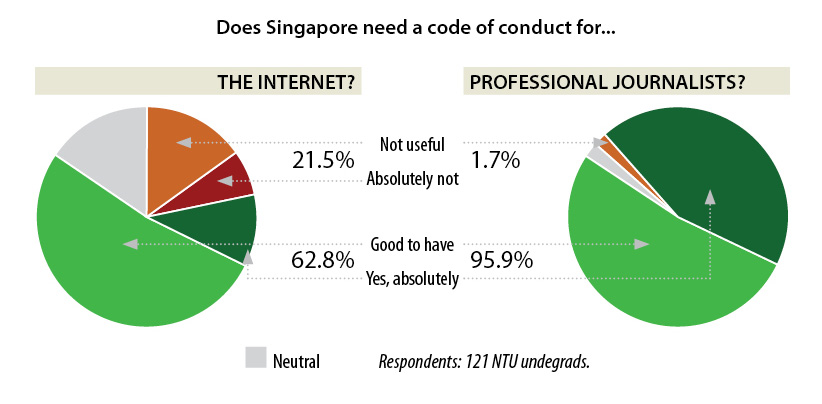
    Most Singapore undergrads favour promoting responsibility among netizens, but they feel even more strongly that professional journalism needs to be accountable to the public. Whichever the medium, though, there is little appetite for official intervention – bloggers, journalists and the public should work towards responsible media without government help.

    These sentiments were expressed in a survey of 121 Nanyang Technological University students this month. My survey took off from a recent poll by the National University of Singapore Students’ Political Association, which found most respondents supportive of the idea of an internet code of conduct. While the NUS survey left it at that, I wanted to ask several additional questions to probe students’ attitudes to various aspects of media accountability.

    Asked if they felt that there was a need for an internet code of conduct, six in 10 of the NTU students said yes, echoing what their NUS counterparts said.

    But although the ethics of blogs and social media has been a hot topic, the NTU survey showed that the students were even more concerned about the responsibility of professional news media. More than nine in 10 felt professional journalists needed a code of practice.

    media-accountability-survey1
    CLICK GRAPHIC TO ENLARGE

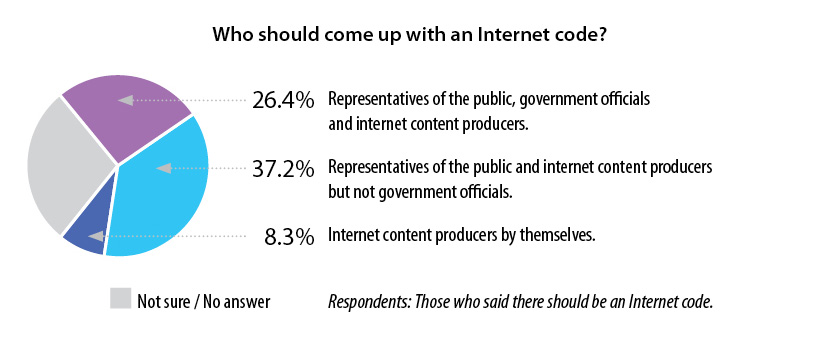
    Among those who agreed with the idea of an internet code, a plurality of almost four in 10 felt that such a code should be developed by internet content producers in consultation with members of the public – but that government officials should not be involved.

    Around one-quarter had no objections to government officials being part of the process, while fewer than one in 10 said that internet content producers should be left alone to do it without consulting the wider public.

    media-accountability-survey3
    CLICK GRAPHIC TO ENLARGE

    The survey results do not reveal why the students felt that professional journalists need a code of ethics even more than netizens do. One possible reason is that the respondents trust mainstream media less than blogs. But although such sentiments are regularly expressed online, previous surveys suggest that it is not a dominant view. A major national post-election survey in 2011 found that, even among young Singaporeans who used blogs and Facebook, traditional media were considered more trustworthy as a source of election news than alternative online media.

    A more likely reason for the NTU students’ response is that they consider traditional news media to have a bigger reach and influence, making them more capable of causing harm and therefore more in need of professional ethics than relatively harmless bloggers and Facebook posters.

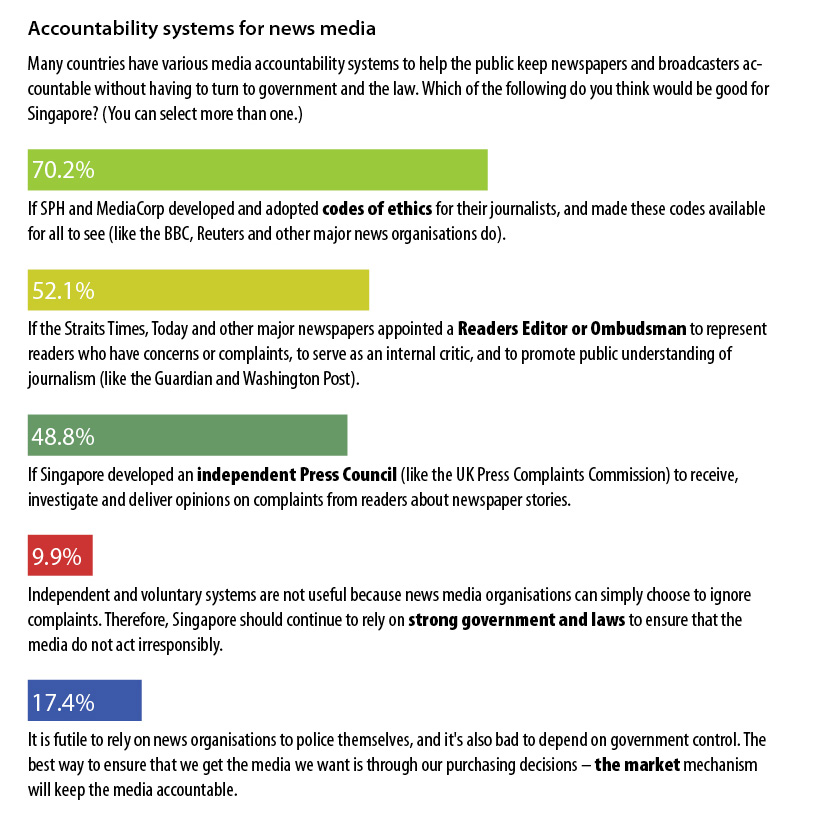
    But only one in 10 believed that Singapore should continue to rely on strong government and laws to ensure that the media do not act irresponsibly.

    There was much greater support for voluntary mechanisms that would allow the Singapore public to hold mainstream media to account. Around seven in 10 felt that Singapore Press Holdings and MediaCorp should adopt journalism codes of ethics and make these codes available for all to see. (Examples of news organisations that do this are the BBC and Reuters.)

    media-accountability-survey2
    CLICK GRAPHIC TO ENLARGE

    The students were from a mix of years and majors, such as business, sociology, linguistics and engineering. They were enrolled in “Introduction to News Media”, a broadening course offered by the Wee Kim Wee School of Communication and Information specially for non-communication majors.

    The course exposed them to various aspects of journalism and its role in society, including the concepts of press freedom and responsibility. The respondents in this survey are therefore probably not typical of Singapore undergrads, since they would have had more opportunity than most to read about and think through media issues. The survey responses were anonymous and ungraded.

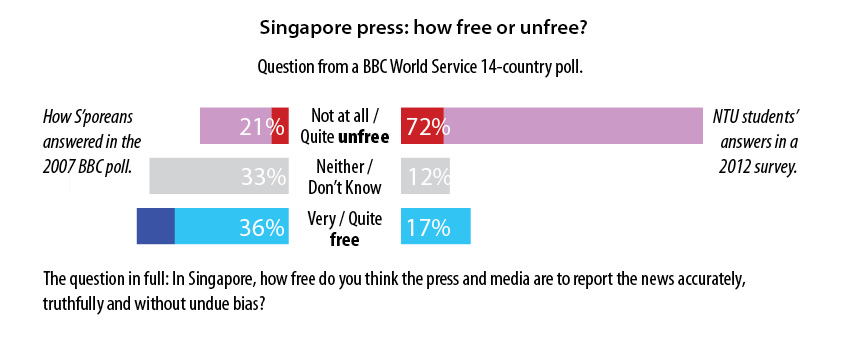
    In an earlier survey with the same group, I posed them the same questions that the BBC used in a multi-country poll in 2007. Compared with how a wider group of Singaporeans responded in the BBC poll, my NTU undergrads were far more likely to say that the Singapore press was unfree.

    media-accountability-survey5
    CLICK GRAPHIC TO ENLARGE

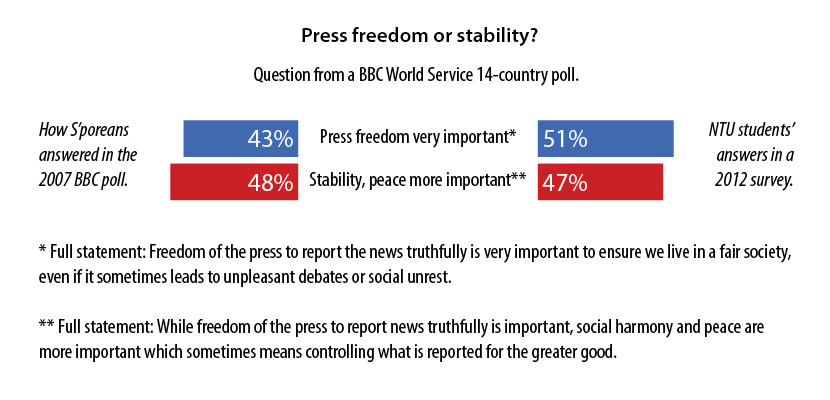
    However, just like the wider public, my students’ opinions were divided between those who wanted more press freedom and those who valued stability more.

    media-accountability-survey4

  • Talking about press freedom – with P. N. Balji

    by

    CHERIAN GEORGE

    November 14th, 2012

    At the Singapore Writers Festival on Saturday 10 November 2012, I spoke about my book Freedom From The Press and Singapore’s media system with P N Balji, former editor of The New Paper and Today. We also talked about OB Markers, the book by retired Straits Times group editor in chief Cheong Yip Seng, who was originally scheduled to speak but had to withdraw. Here is an edited transcript of our dialogue.

    Cherian:

    I’ve been writing about the Singapore press and the need for press freedom for a long time, and I thought that it was probably time to try and bring everything together into some kind of systematic argument. The other reason for this book is the sense that I’ve had for a long time that Singapore could be and should be so much more than it is, in particular in terms of our intellectual and creative life. Many Singaporeans feel that we deserve more than we get in our national press.

    The enigma has always been, how is it that newspapers that are not government owned – and it is a common myth that they are government owned, when the number one shareholder of SPH shares is Citibank followed by HSBC – have been subject to such enduring press controls. I emphasise enduring, because of course it doesn’t take much brains to control anything for a day or a week or a month. But how is it possible for a group of men to have controlled the ideological space for decades with no sign of any erosion of its ability to control that space?

    The PAP has been able to preserve its dominance – which may be fraying at the edges, but by and large preserve its dominance – with diminishing use of power. It is not difficult to preserve dominance if you are willing to ratchet up your abuses every year, applying more and more violence. The mystery in Singapore is that the dominance remains, but the violence has reduced. Which must mean that in place of violence – in place of locking up journalists under the ISA, in place of closing down newspapers – somehow they’ve managed to preserve their dominance in less violent ways. So what are these less violent ways? That’s what my book tries to answer.

    To cut a long story short, it boils down to the replacement of more overt external controls with more behind the scenes controls; economic inducements, for example, that promote a culture of self censorship. That’s one of the answers. My book focuses largely on these more structural reasons; it goes into the laws as well as the non-legal controls.

    One of my regrets about writing my book when I did was that, shortly after, my old boss Cheong Yip Seng came out with his insider account, OB Markers. To be very honest – and as a journalist trained to take myself out of the equation – if you can only afford to buy one book today, and you have a choice between OB Markers and Freedom From The Press, I would say buy OB Markers and not my book.

    One reason is that I’m cheap – anyone who wants to talk to me about the press, I’ll talk to you, just buy my coffee. Cheong Yip Seng is more elusive – so elusive that he didn’t show up today! He’s been an enigma for decades, even to those who worked with him closely. And he reveals things in his book that only he could reveal, because he was really at the frontline where decisions were taken. So, it’s a goldmine for researchers.

    I don’t think there is anything in his book that contradicts my thesis; I see it more as a supplement. Whereas my book looks largely at more structural controls, he looks at the role of individuals in shaping the press. Primarily, Lee Kuan Yew, as well as editors like himself, selected ministers, chairmen of boards and so on. He does, in many cases, explain who did what and why.

    So I thought a good place to start my conversation with Balji is to address this question – whether he believes that, given the structure that we have, the press system that we have, can individuals make a difference? Or, do we just give up?

    Balji:

    Cheong gives insights and inside stories that have never been revealed before. I was quite surprised at some of the details, and the details show the extent to which government interference was applied: even to nitty-gritty issues like stories on stamp collection, stories on selling of carpets, and the most surprising – I only realised it when I read the book – on the use of MSG. The person who intervened was Mr Lee Kuan Yew. So, it does give details that have never been revealed before.

    The editors of Singapore, including me, have this unusual habit of taking their stories to the grave. Cheong has bucked the trend. But having said that, there are also a lot of stories that have not been told, which have been glossed over. So if anybody tells you this is a tell-all book, don’t believe it. It’s a tell-something book…

    Cherian:

    So there’s still a gap waiting for Balji to fill before…

    Balji:

    … Before I go to the grave. Honestly, I have actually thought of writing a book, and I have actually sat down in front of the computer, written the title of the book (Ink in the Blood), written the chapter headlines…. And finally I’ve decided not to write it. If I write a book I want to say everything I know and that would have two problems. One is that a lot of these things happened in confidence, so I would have to break confidence, of good friends; and some of the discussions that happened were very secret discussions.

    The second problem was that of a legal suit. I can go as far as to say that one chapter was titled “The day I said no to Lee Kuan Yew”. There’s no way I can report it. I’ve written the chapter, I’ve edited it, I’ve sent it to a lawyer friend, he says, no, you’ll get into trouble. Anyway, I’ll keep that chapter. After my death – and maybe after somebody else’s death ­– this can be revealed.

    But coming to Cherian’s question. I left mainstream journalism in 2008. Since 2000 or just before that, I’ve always believed that individuals in media, especially the people in the senior levels, can make a difference. I’ve seen that happen, with Cheong Yip Seng’s boss, Mr Peter Lim. He made a difference.

    There are examples in Cheong’s book, and one of them I remember vividly. During an election rally speech at Fullerton Square, Mr Lee Kuan Yew revealed the O-level results of Mr Chiam See Tong and the PAP candidate. He compared the two results. After that speech, Mr Peter Lim had a call to say, please reveal also his detailed results – what did he get for Maths, English, other subjects. Mr Peter Lim resisted, and resisted till the end, and never published those details.

    Peter’s argument was that it was not good for the media to publish this information, because people would wonder where we got the information, and it must be from government. And secondly, it’s also not good for the government, because people would then say, look – to what extent the government goes to demolish opposition figures.

    And it’s not just Peter Lim. There are many others, too, who have tried to make a difference. But what I also notice is that, unfortunately, these people who tried to make a difference didn’t last in the jobs.

    And this comes to the other point that I want to talk about: the biggest sin in Singapore journalism is self-censorship. The title of Mr Cheong’s book is OB Markers. First question is, who sets OB markers. Of course the government sets OB markers. But do OB markers remain? As society changes, as people change, OB markers have to change. But the government that sets the OB markers doesn’t come and tell you that the OB markers have changed. So how do you know that the OB markers have changed? That can only come about if you test the waters.

    That is, you think that is an OB marker, but you test it. No reaction comes, that means the OB marker on this issue has changed. If you don’t test it, you will never know. And I get the sense that the media generally in Singapore is not active in testing the OB markers. In my view, the media and to a certain extent the country, would pay a big price for not doing this.

    Cherian:

    For those in the audience who are not from Singapore, I should explain this acronym: OB markers are out of bounds markers – basically limits of political acceptability. If you cross them, the punishment is not imprisonment or a fine but the loss of political capital. Which is why many bloggers don’t care about OB markers, because they don’t care about getting political capital – it’s not relevant to them.

    But anyone whose job depends in some way on the government, who needs to do business with the government – and this would include many civil society organisations – for them OB markers are relevant because you cannot afford to be blacklisted as an untrustworthy group and deny yourself access to funds, to influence among decision markers, and so on. So even NGOs are subject to OB markers, and certainly press people are, within the mainstream press, because their jobs are ultimately determined by boards of directors who are indirectly but essentially appointed by the government.

    But I agree with you – and I am probably guilty of it myself – we don’t do enough to test those OB markers. Testing the OB markers requires, I think, quite a clinical calculation and ultimately depends on your own values. If the worst they can do to you is maybe impose a glass ceiling on your promotion and you lose the chance to be promoted to a senior position, you calculate and ask yourself, do you want that in the first place.

    So what if you are looked at with a certain amount of distrust, does that mean you can’t put food on the table? Singapore is not that bad, unlike some extremely dictatorial regimes where, if you are blacklisted, it may end your life or end your means of making a living. Here, you can cross OB markers and still put food on the table; it’s just that you have to moderate your ambitions career-wise.

    Balji:

    Or you can leave the profession.

    Cherian:

    But it is very human to just choose the comfortable route where you don’t have to pay the price of losing political capital.

    And that leads me to a second thing I wanted to discuss with you. Since writing my book – and I notice that Cheong got the same reaction – when we present some of these facts of government intervention, and government control, it is of course uncomfortable for those currently in the system, whether it’s civil servants, ministers or journalists. And I’ve noticed one defence mechanism– to say that, well, these books are about the past; things are better now; the knuckleduster era is over, it is much easier to say things, the government is much more accommodating of alternative views.

    I have my doubts about that, whether things are really much better now than before. But I’d love to hear your views, Balji.

    Balji:

    I don’t have doubts – it’s a fact. In my experience, when Mr Lee Kuan Yew was at his rogue best, there were journalists who actually stood up to some of that, and of course to some extent paid the price. Now, there’s a bit more openness, and I would have expected for the testing of waters to be a bit more robust. And I am quite surprised and even shocked that it actually doesn’t happen as much as it should. And this is the time to test it. The mainstream media seems to have gone even more into a shell.

    Cherian:

    Of course, the easy answer to that is that journalists are more lazy now. But I’m very suspicious of these sorts of individual-level explanations. I would rather look for structural explanations before I blame individuals, and I think one structural explanation could be that precisely because the internet has emerged as a platform on which the government gets attacked every day, the government is guarding its control of mainstream media even more jealously.

    There are really two routes that the government could go. One is to say, look, Singapore is changing very fast; the electorate is becoming more demanding; the internet is becoming more vociferous; so the mainstream media better change quickly, otherwise they will lose all credibility and be of no service to us either. I think many of us feel that that is a rational course of action.

    But there’s another policy response which is that, precisely because things are changing so fast, we’d better hold on to the centre. And that centre, ideologically, is the mainstream media; so we’d better supervise it as strictly as ever before because we can’t trust anything else. Everything else is spinning out of control, but we can continue to control the media.

    The other reason is that it’s a moving target. Yes, it is true that things could be said in the Straits Times today that couldn’t be said five or ten years ago. For example, we are much more open now about sexual politics and the mere existence of gays. We are much more open now about criticising unpopular government policies. So in absolute terms, of course there is an opening up. But public expectations have also moved.

    The way the opposition is getting coverage now would have absolutely delighted J B Jeyaretnam 20 years ago, because he did not get that kind of mileage in the press. But expectations have also risen.

    And this is not an accident. The system is designed to ensure that the mainstream press is always slightly behind the curve. It is never an avant garde institution. The whole reason for the press controls is to ensure that the mainstream press is not an unadulterated reflection of popular opinion, and certainly not a vehicle for the most progressive forces in society. The whole intention is to ensure that the mainstream press is largely a centrist, conservative institution. There’s no way we can expect the press to play a leading intellectual role until we look at those press controls.

    Balji:

    I think it’s also natural that once you control something as powerful as media, to give that control up, it goes against nature.

    What I still don’t get is, if the mainstream media continues to be behind the curve, who is the biggest loser? The biggest loser is the government, because the eyeballs will move away from mainstream media. It’s already moving. The Straits Times circulation is dipping. I still remember when Cheong Yip Seng was editor in chief, he would boast we don’t have to worry about circulation as long as there is a housing building programme. Every time there is a new block of HDB flats, our circulation will go up. How things have changed. Now the Straits Times even offers massage chairs in a contest if you become a subscriber.

    And there is no other platform for the government to get across its messages. My guess is that they don’t think they have reached the danger zone yet.

    Audience member:

    As an outsider I’ve been quite surprised to see issues like xenophobia, HIV and gays so openly spoken about. Why is it so important to talk about politics – isn’t it enough to talk about social and health related issues? Some would argue that if you open the social space – that’s what’s needed now?

    Cherian:

    Isn’t it OK, if you have this flowering in different social sectors, for your politics to be controlled? I think at some point all social policies touch on politics. You can pursue certain causes, whether it’s animal rights or workers rights or gay rights up to a point; beyond a certain point, it does threaten government dominance in some way.

    Pursuing animal rights at some point becomes a threat to the economic viability of the Singapore Zoo; so at some point it stops being a soft and fuzzy issue and affects what the government considers to be the bottom line. So I don’t think it’s possible to compartmentalise those issues.

    Audience member:

    Perhaps the majority of people may have made a Faustian pact, that as long as things are OK, we are not concerned about press freedom. As the left wing theorist Gramsci said, there is a cultural superstructure which governs all of us; after a while, we internalise all these things and therefore it becomes naturalised, and we don’t see anymore that we have no press freedom. As long as there is no other issue on which this issue of press freedom can ride on, it will never become a major issue, and therefore the government can calibrate and doesn’t have to use force. Would you agree that it really doesn’t matter to most people?

    Cherian:

    I will keep my answer short – Yes.

    Balji:

    I don’t really agree, Cherian. Since I left my fulltime job four years ago, I have had this great opportunity to meet all kinds of people. If you use the term press freedom, then it becomes very narrow; but if you talk in general terms, in which press freedom is just one aspect of a gamut of issues, then I think it’s not just the upper crust that talk about the issues; a lot of people are very upset about the things they think happen in Singapore. So I am not that convinced that it is only a small group of people.

    Cherian:

    I’m going to do a Mitt Romney and say yes to you, too. I absolutely see where Balji is coming from. If you ask the average Singaporean, whoever that is, do you agree we should have more press freedom and human rights, they will say: I don’t know, we are an Asian society, etc.. It kind of activates certain things we have been brought up to believe. But, if you ask: if there is a disagreement between people like you and the government, do you think newspapers and journalists should side with you or with the government? – I think most ordinary people will say, oh, side with us. What is that, if not press freedom? So I think often it’s the way the question is asked.

  • Singapore’s banning of that anti-Islam video: why it was a mistake

    by

    CHERIAN GEORGE

    September 24th, 2012

    The Singapore government’s order to block the anti-Islam video Innocence of Muslims here has been relatively uncontroversial. Singaporeans are comfortable with the idea that free speech should not be used to insult religions. Internationally, both the video and the mob response to it are so extreme that unusual measures are widely seen as warranted. For a change, Singaporean censorship has not been greeted by Western condescension or consternation – assuming it was even noticed.

    Regardless of the level of support for it, however, the government’s move still needs to be judged in terms of its stated aims and its possible consequences. On that score, the government, to put it bluntly, has made a mistake. Even if inaction was not an option, regulators could have come out with a more calibrated response – one that has less chance of backfiring on Singapore and where precedents set can be defended as policy.

    There are two related but separate reasons why restricting the circulation of a video like Innocence of Muslims might be justified. First, the fear that it would spark immediate violence; and, second, the need to protect a religious community from attack. In certain circumstances, either could be seen as legitimate grounds for restricting free speech – but on closer examination, neither is persuasive in this case.

    Pre-empting violence?

    The fear of violence was the government’s official justification for the move. “The continued circulation of this film is likely to cause disharmony or feelings of ill-will between different groups in Singapore,” the government said. It noted the eruption of riots elsewhere and adding that blocking online access to the film was necessary “to prevent similar violent incidents from taking place here”.

    In my previous post, I argued that the way the move was defended sent the wrong signal to the world and to ourselves – that our public cannot be trusted to behave rationally in the face of religious provocation, and that the government lacks the capacity and moral authority to preserve order.

    No doubt, the video producers had lit a match. But, was it enough to cause an explosion here? Only if you liken Singapore’s Muslim community to a powder keg that is incapable of reason.

    When tackling extreme speech that represents a clear and present danger, timing is a critical factor. Sometimes, good speech may be slow to catch up with bad speech, and by then too much harm may have been done. Therefore, censorship may be warranted to buy the authorities time – time to win the war of ideas.

    However, the timing of Singapore’s move was odd. Overseas, violence erupted on 11 September. Given the extreme uncertainty as to where things were heading, it might have been understandable if the government took pre-emptive measures at that point. Instead, more than a week passed before it stepped in. If the assessment was that the video had lit a slow-burning fuse under Singapore’s Muslim population, then it begs the question why government and community leaders could not use the time lag to ensure that Muslims’ entirely warranted outrage did not express itself in unlawful acts.

    Even if it decided to just play safe – as the Singapore’s paternalistic government is wont to do – it would have been better policy to impose a moratorium rather than an open-ended ban. For example, it could have asked Google to take down the video for a week, or a month, or six. This would have signalled that Singapore does not live in permanent fear of unpleasant ideas – it just needed some time to let things calm down and let the rational voices in Singapore’s Muslim community come to the fore.

    Protecting feelings?

    Of course, many would ask why it is necessary to give such consideration to a video that amounts to a gratuitous attack on a world religion, and has no redeeming artistic merit. If it is simply obliterated, what is the loss?

    This argument is related to the second main justification for censoring the video: to protect the feelings of a religious community in Singapore. This would be in accord with Singapore-style secularism, under which the government is protective of people’s religious identities (even as it disallows those collective identities from being expressed politically).

    Protection of religious feelings is written into the Sedition Act and other laws. Under the Penal Code, any communication “with deliberate intention of wounding the religious or racial feelings of any person” is punishable with up to three years in jail.

    Such laws appear to conform to most Singaporeans’ values. Unlike fiercely secular cultures that are suspicious of religious authority, Singaporeans tend to ring-fence religion from public debate. Whatever the merits of this instinct, though, one should not naively assume that what works for wholesome inter-personal relations should be translated directly into regulation. Civilised people agree that it’s wrong to insult another’s faith; but it does not necessarily follow that banning religious insult is good public policy.

    If it’s intended to show Muslims that the government is sensitive to their feelings, its decision to ban the video can backfire badly. The problem is that religious insult (unlike hate speech that directly instigates others to persecute a religious group) is highly subjective.

    That Innocence of Muslims is intentionally offensive is relatively clear. Things would get trickier if, say, Sunni Muslims claim to be outraged by Shia teachings; or Protestant Christians by Catholicism. (Let’s not forget that much – if not most – religious violence takes place between different denominations or branches within the same broad faith, rather than between entirely separate religions.) If that happens, the government would have little choice but to take the complainant’s word for it – it could not possibly claim authority to adjudicate theological debates.

    Of course, in the current case, the government did not venture into subjective religious arguments. Its decision was based on the objective fact that the insult was great enough to provoke some of its targets to commit deadly violence.

    But this seemingly rational decision makes for dangerously shortsighted policy. If regulators will only take your feelings seriously if you throw a violent tantrum, that’s tantamount to letting the least tolerant, most hardline leaders and followers within each religious community set the tone and the agenda for all. Those who try hard to live by their religions’ peaceloving principles will have every reason to feel cheated – their reward for remaining reasonable and law-abiding is to have their own values ignored.

    In such an environment, we’d have to say goodbye to such precious Singaporean traditions as inter-faith dialogue and the Inter Religious Organisation (the world’s oldest such body) because these would be seen as an affront to those with more exclusive interpretations of what it means to be faithful. (This was the fate that befell inter-faith projects in Malaysia.)

    All signs point to growing religiosity around the world, including the rise of groups within most religions whose answer to a crowded, culturally diverse planet is to retreat into identities that give them a sense of certainty while blaming their problems on those who are different. It is risky for a secular, progressive and multicultural society like Singapore to design media policies that play into the hands of such segments in a culture war that is not about to go away.

    In the long run, there is little option but to shift towards a more liberal media policy, where the state does not set itself up as a protector of people’s religious feelings lest it find itself embroiled in no-win disputes between groups.

    Creative responses

    However, the state need not be totally hands-off either. If inaction is not an option – if for no other reason than that we need to show solidarity with our majority-Muslim neighbours – there may still be alternatives to banning. We should find ways to respond to the likes of Innocence of Muslims that respect freedom of speech while stating powerfully that some speech is better than others.

    One example is the community response in the Netherlands and elsewhere to the similarly provocative video, Fitna. The far-right politician Geert Wilders’ crass attack on Muslims is well known, but what deserves equal attention is the mass campaign that emerged to neutralise it.

    Once people heard about Wilders’ plan, they flooded the internet with their own versions of videos, also embedded with the “fitna” tag. Some were educational films about Islam, many were funny videos and others totally irrelevant to the topic. European Muslims and non-Muslims got into the act. The plan was to drown the Wilders video in alternative content. When his film came out, it was hard to find – and, more importantly, those who opposed it succeeded in making a powerful statement that pushed his hate-filled rhetoric to the margins.

    Unfortunately, Singaporeans’ instinct for self-help is not as evolved as countries with an uninterrupted tradition of civil society mobilisation (PAP’s quashing of civic groups ensured that; but note that, even so, Muslims in Singapore have not been passive – see Mustafa Izzuddin’s comment below). Grassroots, civic responses need to be encouraged.

    In the meantime, the government could use its powers to tilt the playing field in favour of voices of reason. Instead of banning Innocence of Muslims, the authorities could have instead asked Google for the right of reply. The company could have been instructed to ensure that every time Innocence of Muslims appeared on YouTube in Singapore, it would be preceded by a counter-video of equal length, produced by Singaporeans.

    Such a video could have featured local Muslim leaders such as the mufti, other religious leaders, and ordinary Singaporeans talking, singing and rapping in a celebration of everyday tolerance. Knowing the kind of creative talent we have in Singapore, I’ve no doubt that a small group of video students from one of our media schools, together with leading lights from the arts community, could have produced a world-class rejoinder to Innocence within 48 hours.

    Would Google have agreed to such a “must-carry” order? No doubt, forced speech is also a form of restriction. But it is surely less extreme than a take-down order. I can’t see why Google would object. It would be in its interest to promote the idea that the solution to offensive speech is more speech, not less.

    Such a creative response would have been noticed around the world – in a good way. We would have said, loudly and clearly, that Singapore will not take such provocations lying down. But instead of telling the world that we have an untrustworthy, combustible Muslim minority – thus confirming the stereotypes that its enemies are keen to perpetuate – we would be showing confidence in our ability to out-talk, out-reason and outlast the forces of intolerance.

    SELECTED COMMENTS FROM FACEBOOK

    “Cherian’s well-articulated piece could have been strengthened even further had it also looked at and assessed the different ways the Muslim community in Singapore has responded to the controversy. Some of these ways include the op-eds in the mainstream and online media; the sharing of images, articles, and videos made elsewhere; and various Facebook statuses updates and discussions including those which denounced violence. These responses have mostly been tactful, rational and responsible with the common theme being countering bigotry with knowledge, and creating awareness of the true nature of Islam, who the Prophet really was, and how the Prophet defines our identity as Muslims.” – Mustafa Izzuddin