Category: Journalism.SG

  • Papers can’t resist unverified Tiger Woods gossip from dubious sources

    by

    BHAVAN JAIPRAGAS

    December 18th, 2009

    Tiger Wood’s self described “transgressions” have dominated the global news hole since the golfer’s Thanksgiving Day car crash came after tabloid magazine National Enquirer’s scathing report on his adulterous ways two days earlier. The PEW Research Center’s weekly news coverage index found Woods to be the second biggest newsmaker in the United States in the first two weeks of December, second only to President Obama. Woods has been featured in close to 2000 news articles in elite news entities worldwide in the same period.

    Singapore has not been spared from the extensive coverage of the world’s number one golfer’s off-field exploits. Leading English language newspapers The Straits Times and Today have featured Woods on their front and prime pages several times since the story first broke.

    Apart from introducing the world to Wood’s bevy of mistresses, the scandal has also highlighted the growing primacy of celebrity gossip sites like TMZ.com (TMZ) and Perezhilton.com in celebrity news reporting. Lacking the extensive grapevine of these websites in Hollywood, legacy media entities have been forced to take a back seat in reporting the latest celebrity scandals. Instead, they are increasingly relying on these tabloid websites and magazines for their latest leads on scandals, and in some cases cite them as sources.

    The two biggest celebrity scandals of the year, the death of Michael Jackson and the current one encircling Tiger Woods, both had TMZ as the first source breaking the news. In both cases, unnamed informants tipped off TMZ and confirmed the occurrences before legacy media journalists caught a whiff of them.

    Legacy media entities’ growing reliance on the tabloids and the likes of TMZ have major repercussions on existing journalistic standards and norms. While TMZ is owned by the same parent company as CNN (Time Warner), it certainly does not adhere to the professional reporting methods and editorial processes of its sister news organisation. For one, TMZ and several tabloids pay tip fees – payments made to sources in exchange for exclusive information they are privy to. The website has informants throughout West Hollywood, from hospital workers to neighbours of celebrities. There is no way to ascertain if all of TMZ’s anonymous sources have noble motives like Deep Throat in the Watergate scandal, but the monetary rewards offered to them cast doubt on their credibility. Harvey Levin, managing editor of TMZ, argues that this practice of chequebook journalism is perfectly fine, juxtaposing it to American television networks paying guests large sums of money for exclusive interviews. (See his interview with CNN here)

    Elite news organisations have long frowned on such practices. The BBC’s editorial guidelines for example, explicitly state, “payment of a fee will only be approved for a contribution of remarkable importance with a clear public interest”.  The leaked police photograph of pop star Rihanna’s battered face after an altercation with her boyfriend hardly had any “public interest” value, but it cost TMZ $62,500 to publish it. The legality of the website’s informal network is also questionable. Apart from Rihanna’s photograph, which was meant to be used as evidence in court, the website has also published photos of death certificates, traffic summons and sheriff charge reports, in parts or otherwise. The website’s brazen disregard for privacy and the confidentiality of certain documents is particularly worrisome, along with the apparent fact that it has sources within the various public service departments.

    Tabloids and celebrity news websites also put pressure on the legacy media to match their immediacy in reporting events. A substantial number of articles found in websites like TMZ.com and Perezhilton.com have a single, anonymous source cited. Content is put out much faster than in newspapers or television networks, where journalists are required to seek out alternative sources to verify information they gather.

    Despite making breakthroughs in being the first to report celebrity scandals, these celebrity gossip websites also have a tendency to misinform the public as the story develops, as a result of their reporting practices. In wanting to compete with the speed at which these websites publish breaking news developments, elite media entities risk compromising on the quality and accuracy of their content.

    It is highly unlikely that we will see TMZ’s journalistic practices mainstreamed into Singapore’s newspapers and television channels any time soon. For one, Americans’ voracious appetite for the intimate details of celebrities is unmatched here. In reporting celebrity scandals, the local mainstream media have been careful to quote more reliable sources like the wire agencies or other elite news sources even as they quote the new players like TMZ. Chequebook journalism and anonymous sources which are mainstays of the tabloids, have little space in our local media landscape where competition is less cutthroat.

    However, the Tiger Woods coverage shows that for major international celebrity scandals, Singapore’s press is not immune to the trend of allowing pseudo-journalistic sources to set the pace of coverage. Anxious not to left behind just in case the latest juicy detail in TMZ and the tabloids happens to be true, legacy media around the world have been picking up these unverified stories enthusiastically. When this happens, ST and Today have not been able to resist, either.

    In the global context, the tabloids and websites like TMZ are here to stay, along with their unconventional journalistic methods. Harvey Levin summed up the influence of the website he has managed since its inception in December 2005. “We’ve become like the Associated Press in the world we cover”, he told the New York Times in an interview. It is a sign of the rise of these media entities that when Levin visited the world acclaimed Columbia J-school earlier this year, students flocked to give him their resume. Welcome to the future of journalism.

  • Unfazed by brickbats, Temasek Review aims to boldly go where no blog has gone before

    by

    BHAVAN JAIPRAGAS

    December 10th, 2009

    Within Singapore’s increasingly influential new media sphere, Temasek Review (TR) has emerged as one of the more controversial players. With an ambitious mission statement and vision, TR was quickly regarded as a site to watch. In recent months however, it has been mired in controversy. The blogosphere has been set alight with a flurry of discussions about TR, with some netizens expressing a curiosity about its motives while others have openly attacked it.

    TR remains as ambitious as ever. “In ten years’ time, the internet will emerge as the primary source of news for many Singaporeans and we want to be a key player when that happens,” its caretaker manager said in an e-mail interview (full text below). He said the target was to register as a company, earn revenue through advertising and employ full-time journalists – something no socio-political website in Singapore has managed to do. Refusing to divulge more details, he said that the website was still “exploring the best option to take”, citing Malaysiakini and Huffington Post as possible models that his website might want to emulate.

    The representative agreed to the interview on condition of anonymity, saying that this was in line with TR’s policy to “keep a loose structure for the time being” as the website was still finalising its organisational setup. Such coyness is one reason why many netizens are suspicious. Although many sites allow anonymous comments, Singapore’s most influential independent sites have founders who were open about their own identities from day one. These range from the Singapore’s first online magazine, Sintercom (Tan Chong Kee) and the grandfather of blogs, Yawning Bread (Alex Au), to later arrivals such as The Online Citizen (Choo Zheng Xi), Mr Brown (Lee Kim Mun), and even hard-hitting activist sites such as Singapore Rebel (Martyn See).

    In contrast, TR has a page dedicated to the profiles of its columnists, but its leadership remains incognito. Some of its people are from Wayangparty.com, which is now inactive. A significant number of the website’s articles are attributed to nameless “Correspondents”. This shroud of secrecy has led to rampant speculation about TR’s motives, with some suggesting that the website is not quite the “independent, balanced and unbiased” Internet newspaper it has positioned itself to be.

    The caretaker manager who answered our queries was not too fazed by such rumours. He said that “content is more important than the writer”, citing how other news entities like The Economist and Malaysiakini regularly do not attribute articles to any specific writer. He added that many of the website’s writers were not comfortable to reveal their real identities, but the number of hits on their articles showed that readers were not too turned off by their anonymity. Discounting what he called the “traditional view that a site has to be run by credible people”, he said that what was more important for a website like Temasek Review was to build its influence through increased readership even if that meant quality was sometimes compromised.

    TR has also been accused of wanton plagiarism. Recently, an anonymous blogger set up a blog highlighting several instances where content generated by elite news entities like AFP, Voice of America and China’s People Daily were passed of as original content on Temasek Review. The bylines at the beginning of these articles attributed them to TR’s own “Correspondent”.

    The manager of Temasek Review dismissed these allegations, stating that the articles quoted in the blog “all have the sources stated at the bottom which he (the blogger) had deliberately chosen to omit when cropping them”. According to him, such a copy and paste method of news aggregation employed by Temasek Review was justified, considering how mainstream newspapers like The Straits Times regularly republished international news content produced by the wire agencies. He further added that the website could not be faulted “as long as we quote the source of the news” and that “everything posted in the Internet is for sharing under a Common Licensing Scheme unless explicitly stated otherwise”.

    TR states on its site that it is a subscriber to various news sources. However, it may be ignoring the fact that individual subscriptions to news media do not include the right to reproduce their content. Indeed, commercial news media explicit forbid such unlicensed use of their stories and visuals. In this age of news aggregation, most news organisations have allowed news aggregators like The Huffington Post and Google News to carry link headlines and excerpts, as long as the full article remains on the source’s website. TR, however, reproduces others’ articles on its own site. Its sources don’t seem to have taken offence so far, probably because TR is still too small a player to worry about. If TR becomes as big a player as it wants to be, however, its copy-and-paste journalism will probably attract a few lawyers’ letters for copyright infringement.

    Though profits are not the ultimate objective of Temasek Review, the plan is for it to be self-sustaining in the long term. It was revealed to us that the website is currently “fully self-funded”, with the caretaker manager one of the contributors. “It does not cost much to maintain the website at this stage”, he said. Part of the website’s financial strategy is also to have advertisement revenue from its sister website East Asia Review subsidise operating costs.

    The ambitious plans of the website seem to have no place for other players in the local new media scene. When asked about the relationship between Temasek Review and other independent new media entities, its caretaker manager’s answer was curt: “We are not really keen to collaborate with others. We prefer to mind our own business”.

    It remains to be seen how the website can deliver on its plans to become a professionally-run commercial outfit, with only a select few of such websites able to generate enough advertising and subscription revenue to hire journalists and other backroom staff. Temasek Review is still some way off from becoming the fully-fledged online newspaper a la Malaysiakini that its caretaker manager envisions it to be.

    One thing that’s certain is that if it wants to register itself as a firm in Singapore, it will have to change its name. As the old name for Singapore, “Temasek” can’t be used by just anybody. If TR tries to register it at bizfile.gov.sg, it will get the automated reply, “Your name is considered undesirable for use in a business entity.”

    THE FULL INTERVIEW

    On who’s behind Temasek Review

    Your ‘About Us’ page offers readers quite a comprehensive view of TR’s vision as well as a general scope of the type of news you cover. However it does not delve into the origins of the website. What spurred the proprietors and contributors of Wayang Party to set up TR? What was it that you felt a news website could do that a simple blog could not?

    TR is an evolving project and we are still quite far away from our eventual goal of becoming a full-fledged internet newspaper like Malaysiakini. We see a lot of potential in the growth of this industry in the future which TR is already in a pole position to take advantage of it. The print media is a sunset industry. In ten years’ time, the internet will emerge as the primary source of news for many Singaporeans and we want to be a key player when that happens.

    Quite a significant amount of content on TR is attributed to ‘Our Correspondent’. Could you tell us the rationale behind this anonymity? Wouldn’t it be more credible for your writers use their own names?

    The content is more important than the writer. In fact, many established news magazines and websites do not attribute their articles to any particular writer, e.g. the Economist, Malaysiakini, The Malaysian Insider, Asia Sentinel and even the Straits Times. This has been our practice all along and it had not stopped readers from visiting our site. Of course if we have paid journalists on the team one day, they are expected to pen their names down for every article they write. While there will be some readers who are put off by anonymous writers, most will not care a hoot about it.

    TR has no Chief Editor currently. Why is this so? Who then is overall in charge in TR and who is ultimately responsible for the editorial integrity of the website?

    We used to have one managing editor, but she is not doing a good job. Right now, we are still searching for one, preferably a trained journalist who share our vision. It is more important to find the right person rather than just to get somebody to fill the role.

    What roles do Mr Abdul Gafoor and Ms Tashia Dixon play in TR?

    Abdul Gafoor runs his own academic column autonomously on TR as he is a researcher himself. Tashia Dixon is currently taking charge of a project we have spun off. She is not involving in the editorial work.

    TR has a page with the profiles of your writers. Judging from their profiles, your writers seem to come from quite a diverse backgrounds. What is your recruitment process like, how do you assess that the writers have what it takes to write for TR?

    They just simply drop us an email and offer to write for us. We want to have as large a pool of writers as possible from different backgrounds in order to add diversity to the content of the site.

    Could you briefly outline your policy on moderation of comments on TR?

    We have four administrators as of now and each has their own guidelines. In general, all comments touching on race and religion will be censored as well as vulgarities, offensive and potentially defamatory comments.

    Anonymous commentators on the blogosphere have been speculating about the financing of your website. Perhaps you might want to put the rumours to rest. Who are the proprietors of the website and could you outline all of  TR’s sources of revenue?

    We are entirely self-funded and I am one of the contributors. It does not cost much to maintain TR at this stage, but we will need to secure more investments if we are to go further.

    With regards to revenue, I caught a comment by an ‘admin’ that your sister website the East Asia Review is essential in getting advertising revenue for your future company to stay afloat. What is the current status of East Asia Review? How successful has TR and East Asia Review been in attracting advertising revenue?

    As you should know, the revenue from google advertising is pathetic.

    On plagiarism

    There have been accusations of plagiarism. There’s even a website set up to highlight this alleged plagiarism. There seems to be a lack of distinction between news aggregation and actual generation of original content: the ‘By our correspondent’ at the start of these articles has the effect of misleading readers. Your comments?

    All our world articles are aggregated from other sites which we will always publish the source at the bottom like the Straits Times. As for the blogger who took the trouble to set up a blog to accuse us of plagiarism, we must really thank him for the publicity. The “plagiarized” articles he quoted all have the sources stated at the bottom which he had deliberately chose to omit when cropping them. Our regular readers will know that there is absolutely no basis in his allegations at all. For netizens who are not aware of our site, it will only make them more curious to know about us. Readers can judge for themselves whether the articles we produced on TR are plagiarized from elsewhere. They will not be so stupid to believe whatever the site says. We can’t survive for so long on plagiarism alone, can we?

    You seem to be saying that it is OK to copy and paste as long as you credit the source at the bottom. You also use pictures that you don’t have rights to. Is copyright a non-issue to you?

    Of course copyright is an issue to us. Everything posted on the internet is for sharing under a Common Licensing Scheme unless it is explicitly stated otherwise like Asia Times and Financial Times. As long we quote the source of the news, I don’t think anybody can find fault with us. If you look at the Straits Times, most of its world news are republished from AFP and Reuters and they don’t even bother to print the source at the beginning of the article unlike us. South China Morning Post republishes articles on China from Reuters as well. If you check out our featured gallery, you will realize we publish the source of every photos we took from elsewhere.

    On relations with other blogs

    What kind of relationship do you have with other bloggers or news websites like TOC? What kind of relationship do you think exists between independent new media practitioners in Singapore? Is It collaborative or adversarial and why?

    We are not really keen to collaborate with others. We prefer to mind our own business.

    What do you think sets you apart from TOC? Is there a conscious effort on your part to build a comparative advantage over TOC, especially since the your audience is similar to theirs? What is TR’s unique selling point?

    We have never compared ourselves to other sites or set out specifically to build an advantage over them. We are pretty clear about the end-point and everything we do must bring us closer to the eventual goal. The rest doesn’t matter.

    On the tiff with SPH

    Your recent spat with Geoffrey Pereira of SPH regarding the alleged DDOS attacks on TR is an issue of contention in the local new media. Judging from the comments of readers with knowledge about the technicalities, such an allegation by TR was misplaced because it cannot be definitively confirmed. How has TR resolved the issue and do you still stand by your initial allegations?

    We had never accused SPH of attacking our site from the very beginning. It was Geoffrey who chose to obfuscate the matter and turned it into an attack on our credibility. In the end, he still hasn’t answered the key question if SPH has “grabbed” content from our site. We have since banned all SPH IP addresses from accessing TR which will resolve the problem once and for all. As far as we are concerned, the matter is now closed and we don’t see any need to dredge it up again.

    On turning professional

    What are TR’s plans for the future – short term (2010) and long term?

    There will be major changes along the way including a complete revamp of the existing site and the addition of other sister sites. The next step is of course to register a company after which it will make it easier for us to employ journalists. Right now, we are just republishing news from elsewhere. We want to start producing original news of our own. Only then will we be able to take the next leap forward.

    Very few websites, whether news organisations or independent sites, have been able to generate enough advertising or subscription revenue to hire journalists. What’s your strategy to succeed where thousands around the world have failed?

    I can name you three successful websites run by full-time journalists off-hand – Huffington Post, Malaysiakini and Merdeka Review. There are two others which may not be considered as very successful but have managed to keep themselves afloat for quite sometime – Irrawaddy and Asia Sentinel. Right now, we are still exploring the best option to take. We do not really need a large team of journalists like Malaysiakini. Just one or two will be fine. Though profit-making is not our ultimate motive, we do hope to keep the sites self-sustaining in the long run. That’s why we have to get the right people in. If you are in it for the money only, then you are going to get disappointed because there isn’t a lot of money to be made in the first place.

    Although many professional media carry unsigned articles, no professional media hide the identities of their editors and management teams. Some of your leaders, however, prefer to remain in the shadows. In this respect, you behave more like amateur blogs than like professional websites. The way you lift others’ content also makes you more similar to amateur blogs than to professional sites. Yet, you claim that your end-goal is to be a commercially viable internet news site. How do you plan to earn the trust of advertisers and investors if you remain in the shadows?

    Temasek Review is still an amateur blog and we are not afraid to admit that. Because we are amateurs, the standard expected of us is lower than professional sites and we are given plenty of leeway to explore and make mistakes. Mistakes are inevitable in the process without which we cannot identity our weaknesses and rectify them. In a way, TR is an ongoing experiment, it will continue to evolve and develop with time. It is not fair to accuse of us of “lifting” contents from elsewhere. The Straits Times does it everyday. Even some of its opinion pieces are replicated from Project Syndicate, New York Times and other sites while we write our own articles, so do you consider us to be more “professional” than Straits Times in this aspect?

    Our past experience have shown us that the content of a news site is what that matters most, not the identity of its editors or owners. You can have a team of known PhD journalists blogging on a site, but it won’t make it a success. Take for example the P65 site, it was run by the PAP MPs and has the support of the government and mainstream media, but why didn’t it take off?

    We have many freelance columnists who are not comfortable to reveal their identities, but they write very good articles and we often publish them anonymously. Yet these are the articles which attract more hits than those written by known writers on our site.

    The traditional view that a site has to be run by credible known people is grossly outdated. In the online media, readership is what counts – the more readers a site has, the more influential it will become. Quality journalism deserves an audience. Beggars can’t be choosy. TR has to work within its constraints to build up its readership first sometimes at the expense of quality, but without readership, then we can’t even sustain the site in the long run.

    In order to attract advertisers, we need to have a business model in place first to liaise with them which is what we are trying to do now. Of course they will know who they are dealing with. They can’t be talking to “shadows”, can they?

    Finally, any parting comments to your readers with regards to the recent controversies surrounding the website?

    They have already dissipated. We can’t control what other people say about us, we can only concentrate on our work which is to provide an alternative source of news in Singapore. These controversies / speculations will not hurt us a bit. On the contrary, they have helped to boost our readership instead. That’s how the internet works. It is impossible to discredit or demolish anybody or website without giving it free publicity. Tongues may wag for a while, but it will all be forgotten soon. We are quite flattered by the attention given to TR. Nobody will take notice of you if you are just an unknown.

  • IPS report refutes criticisms of Straits Times’ Aware coverage

    December 1st, 2009

    Press coverage of the AWARE saga – probably the biggest media controversy of 2009 – is the subject of a research paper by Tan Tarn How of the Institute of Policy Studies. His report finds that, contrary to critics’ claims, Straits Times coverage was generally “objective, fair and balanced”. While there have been many opinions aired about ST‘s AWARE coverage, even in Parliament, Tan’s report is probably the most detailed analysis to date.

    As for the criticism that the national newspaper over-covered the issue, Tan suggests the opposite. He argues that at least three key issues of great public importance were not given sufficient airing: how different interest groups should engage with one another; democratic decision making in organisations; and the role of religion in public life. “In terms of journalistic professionalism, too much coverage is a problem, but too little is a far greater one,” he writes.

    Tan declares his interest as a former journalist with the Straits Times.

    Download the full report in PDF by clicking here.

  • Pre-election ‘cooling-off’ period should not freeze citizen journalism

    by

    CHERIAN GEORGE

    December 1st, 2009

    The Government’s proposal to introduce a moratorium on campaigning on the eve of Polling Day is sensible, but it will go down badly if it over-regulates what the Prime Minister correctly identifies as the “grey” area of online news.

    Opposition leaders have already criticised the plan as another move to tilt the playing field against them. Few would disagree with their assessment if licensed mainstream media are the only news sources permitted to influence voters during the “cooling-off” period.

    PM Lee Hsien Loong revealed that a Bill is in the works to “extend the period between Nomination Day and Polling Day by one extra day and use that extra day as a cooling off period before polling itself”. At present, campaigning is banned on Polling Day but allowed right up to the previous night.

    The cooling-off day would give voters more time to reflect on the issues without being bombarded by new messages from the candidates, the PM said. The exception would be the party political broadcast, which could air on the eve of Polling Day. These broadcasts comprise free airtime on Singapore TV channels given to the main parties. They are allocated time in proportion to the number of seats they contest.

    Just as news media are now permitted to publish news and opinion on Polling Day, they would also be allowed to do so during the cooling-off day. As for online content from candidates and their parties – “what you are putting out in your own name”, as Lee put it – these fall squarely in the “campaigning” category and would be banned during Polling Day and its Eve.

    Between these two categories is a grey area: online content that is produced by an individual or group that’s neither the internet operation of a licensed news organisation (such as straitstimes.com or channelnewsasia.com, which would get the green light) nor the official website of a candidate or party (such as pap.sg, yoursdp.org or wp.sg, all of which would get the red light).

    In this grey area would be a wide variety of “citizen journalism” sites. Some may be come across as  balanced, while others may be ideologically partisan but without any explicit connection to parties. How will they be treated under the proposed legislation?

    Green light for citizen journalism?

    If Singaporeans are allowed to consume mainstream media reports of the campaign on the cooling-off day and Polling Day, it is difficult to justify denying them the right to read alternative media reports produced by their fellow citizens. This is why citizen journalism should be granted the same “news” exemption as licensed media.

    However, the drafters of the legislation will no doubt worry about the risk that a few of these citizen journalists are actually proxies of political parties. Allowing them to circulate could amount to a large loophole in the law.

    Red light for citizen journalism?

    The Government’s customary way of closing such a loophole is to recognise only licensed news organisations as providers of “news”. This is the approach taken in the new legislation on filming illegal protests: licensed news organisations may cover such events, but citizen journalists may not. (See earlier article on civil disobedience videos.)

    However, it would be a mistake to define “campaigning” so broadly that the cooling-off law bans all news and commentary by non-licensed online news providers and commentators. This would not in fact prevent determined party activists from finding ways to evade the law: they would still get their messages across. The only ones who would be deterred are the more law-abiding and moderate citizen journalists. Thus, cyberspace would be hollowed out of precisely the voices you would want to hear, denying Singaporeans potentially valuable insights that will help them make rational decisions on Polling Day.

    This prospect already has independent bloggers fuming. Gerald Giam says sarcastically, “How nice to know I will have one extra day to clear my mind of the nonsense that opposition candidates were sprouting the previous nine days, and for one full day reflect on the rational and objective rebuttals by the government (but not the PAP, wink, wink) disguised as news the day before Polling Day.”

    Green light, please

    Although surveys show that the mainstream media are overwhelmingly more relied on than the internet as a source of election information, online media play a vital role in providing alternative perspectives.

    Reports on the cooling-off proposal have noted that several other countries, such as Australia and Indonesia, have similar systems. One important difference is that in these countries, unlike Singapore, governments are not allowed to impose discretionary licensing on news media. Therefore, voters can still receive a wide range of perspectives through their traditional media during the cooling-off period. As long as Singapore’s newspaper, tv and radio choices are constrained by licensing, Singapore voters will need alternative online media for a fuller picture.

    But if citizen journalism is banned, the biggest loser would be the Government itself. The move would hand a fresh round of ammunition to those who say that the PAP can only win by denying Singaporeans a plurality of media. Better to live with the loophole, which is practically impossible to close, than to engage in overkill.

    Read the ST article on PM Lee’s remarks here.

  • Malaysiakini turns 10. So where’s Singaporekini?

    by

    CHERIAN GEORGE

    November 26th, 2009

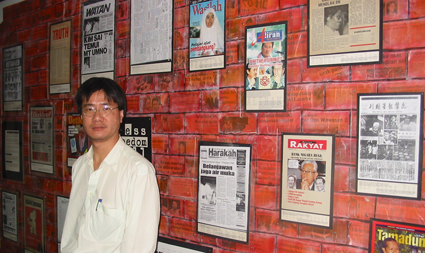
    steven-gan

    Above: Malaysiakini editor Steven Gan with covers of censored Malaysian publications.

    SINGAPOREANS may fancy ourselves the most envied nation in the region, but there are some things across the Causeway that make us wide-eyed with wonderment. Why is it, for example, that the average Malaysian roti canai beats even our most highly-rated prata in taste and texture? How in the world did Malaysia end up with the region’s most charismatic budget airline when we’re supposed to be the transport hub of Asia? And why, as Malaysiakini celebrates its 10th anniversary this weekend in Kuala Lumpur, are we still waiting for a Singaporekini?

    I am not an expert in food or aviation, but I have been following the ups and downs of Malaysia’s leading independent news website over the years and can hazard a few reasons why Singapore has no equivalent. The theory you’ll most commonly hear is that internet laws in Singapore are more restrictive. In fact, the legal minefields in the two countries are basically similar. Indeed, the Malaysian government has been more trigger-happy than its Singapore counterpart with laws such as the Internal Security Act and Sedition Act. What’s more, it would be an insult to Malaysia’s activists to say that they are more active only because they face less risk. The ones I know don’t equate what is permissible with what is possible.

    Instead, there are at least three more credible reasons why, compared with Malaysiakini, Singapore’s alternative media are still so kampung.

    First, Malaysiakini benefits from the country’s more pluralistic politics, including a fractured political elite, strong opposition parties and energetic civil society organisations. These diverse forces ensure that the supply side of political news never runs dry. Their unrestrained, unpredictable contests make political news as gripping as the tautest thriller and as melodramatic as a soap opera. In contrast, a Singaporekini would be, most weeks, about as compelling as a commercial for detergent.

    Second, Malaysiakini has been able to count on both domestic and foreign support that is not available to wannabes in Singapore. Domestically, Malaysiakini is embedded in networks of solidarity with various well-organised pro-democracy groups such as Suaram and the Centre for Independent Journalism. They don’t always see eye to eye, but they do make up a broad social movement that has no equivalent in Singapore. Malaysiakini’s overseas funding would also be tough to replicate in Singapore. Under the Political Donations Act, the government could ban overseas funding for a Singaporekini simply by gazetting it as a political association.

    Third, Malaysiakini’s success has been built mainly on the mainstream media’s failure. Founders Steven Gan and Prem Chandran are not media superstars. They are simply competent, courageous, creative and conscientious journalists like thousands of their fellow professionals around the world. In Malaysia, however, they shine because their peers in the mainstream media are so smothered by government. Singapore’s mainstream media are also subordinate to the government, but there is a difference in degree that produces qualitatively different outcomes. At critical moments in Malaysia, government control did not just strain press credibility, it tore it up, crushed it underfoot and set it on fire for all to see, causing a mass exodus to alternative media. In Singapore, the likes of The Online Citizen might reach the heights of Malaysiakini if The Straits Times were forced to stoop as low as The New Straits Times.

    Could all this change? Could a Singaporekini match Malaysiakini? Anything is possible. But, the odds are slightly higher of our roti prata becoming as good as their roti canai.

    See also: “Malaysiakini is traditional journalism in a new form, says founder”

    – A fuller study of Malaysiakini can be found in Cherian George’s 2006 book, Contentious Journalism and the Internet.

    POSTSCRIPT

    Several readers have expressed their unhappiness with my analysis above, posting comments at The Online Citizen, where my article was reproduced.

    The claim that they find hardest to swallow is my third point, that Singapore’s mainstream press has not been as stifled as Malaysia’s, thus denying Singapore’s alternative media the success that Malaysia’s has enjoyed. One reader counters that the Singapore’s Straits Times is already “nothing more than the apparatus of the state”: “So hasnt it already gone down to the bottom of the barrel? What is a few more inches?”

    Indeed, this issue of credibility is fascinating, and much more complex than it first appears. When I first started thinking critically about the press, I bought into the conventional wisdom that political control and the resulting lack of credibility would be fatal for any country’s media. This is a comforting theory for anyone who cares about freedom of speech (because it basically suggests that the market will rule in our favour), which is why I believed it for a long time. Unfortunately, the evidence has forced me to revise my own thinking.

    There seem to be a few distinct ways of thinking about credibility.

    1. First, there is the kind of credibility enjoyed by fiercely independent media, in contexts where the public depends on journalists to stand up for their rights against powerful interests that are seen as illegitimate. Because of strongly and widely perceived injustice, people’s dependence on “Fourth Estate” media is intense and continuous – which means that many people are willing to pay (real money, not just compliments) for professional journalists to provide that service. The flip side of this coin is that government-controlled media that don’t stand up for the people in such times will be resoundingly rejected. You will see mass campaigns to boycott the media, and even without such campaigns, people will simply refuse to pay for such products (even in highly repressive countries, consumers have the choice not to buy). The net outcome is in line with conventional wisdom: non-credible media don’t survive.
    2. In a second scenario, there’s a kind of credibility that refers more to basic accuracy of most of the content, most of the time, such that consumers are willing to pay for the product. If people are not highly politicised, if the society has very limited political contestation, and if most debates are dealt with as technocratic policy choices and individual economic choices rather than political ones, then pro-government political coverage might not be such a turn-off that it provokes a consumer revolt. Readers may grumble, but they may still pay for the total package of information that the establishment media provides. Indeed, since their own lives are so affected by government policies, they need to know government’s thinking and may be willing to pay for a newspaper precisely because of – rather than inspite of – its reliable coverage of government news. On the flip side, aggressively independent news media may attract a loyal following among government critics, but may find it extremely difficult to persuade even the most vocal supporter of free speech to pay them anything (since many free speech proponents conveniently assume that free speech should be free of charge).
    3. Third, there is a qualitatively different kind of credibility that doesn’t refer to factual accuracy but to authenticity. Some media have poor quality control; their readers know they can’t believe everything they read there, but they may still believe in such media more than they believe in a highly accurate professionally produced medium that lacks the same authenticity. I think this explains why professional mainstream media find it impossible to beat alternative, amateur media. High production values can actually get in the way of an authentic experience – they can distance the media from the public. This is a great opening for alternative media, but unfortunately there’s not much evidence that people are willing to pay for it.

    Back to Malaysia and Singapore. In the 1980s, both Malaysia and Singapore probably belonged in the second category. Since the late 1990s, political instability has pushed Malaysia to the first category, with some mainstream papers losing as much as 30% of their circulation. Singapore has remained in the second category: newspaper circulation declines have been in line with those of countries with a free press and nothing dramatically worse.

    Comparing Malaysia’s press management with Singapore’s is getting harder. In both countries, protests are downplayed or ignored by the mainstream press. But this hurts the Malaysian media’s credibility more than the Singapore media’s, simply because Malaysian protests are so much larger. With or without mainstream coverage, everybody (or at least most urbanites) in Malaysia will be talking about the protest. The gap between what everyone’s talking about and what they see in the papers the next day is what hurts credibility. In Singapore, the gap is small because the protests are tiny.

    The Singapore media usually takes a hit during elections, when that gap widens. But without fail, politics calms down after the elections, leaving the media commercially unscathed.

    As for the third category, many small alternative media in Singapore belong here. Singapore’s mainstream media will never be able to beat them in this regard: they will always lack the authenticity of small alternative media. But, while the mainstream media may lose influence, they may not lose much money to these alternative media.

    The above clarification won’t satisfy readers who still want to hold on to their opinions about media credibility in Singapore. But I’ve yet to see evidence that enough Singaporeans will either reward (financially) the alternative media they say they want or punish (financially) the mainstream media that they claim to detest. Nor are there signs that Singapore will move to the first scenario above, where people will suddenly put their money where their mouths are.

  • Foreign journalist slams Singapore’s soft repression and self censorship

    November 24th, 2009

    BEN BLAND on his year-long sojourn in Singapore:

    While the governments of Burma, China and Iran tend to arrest troublesome foreign reporters or expel them without delay, Singapore’s more media-savvy government prefers a subtler approach to repression. The non-renewal of a work visa is their preferred method for getting rid of foreigners with minimal fuss or attention. Last month, after applying to renew my visa following a successful year in Singapore, I received a one-line letter informing me that my application had been rejected.

    Some news organisations are put off by the government’s bipolar approach to the media. But many are still attracted by the well-developed infrastructure, good transport connections and generous tax breaks and other financial inducements offered by Singapore’s inward investment agency. It is a great testament to the unique brand of soft authoritarianism honed by Lee Kuan Yew and his People’s Action Party that they are able to convince so many journalists and media organisations to slip into voluntary restraints.

    For the full article at Asia Sentinal, click here.

  • PAP harnesses new media at convention

    by

    CHANNEL NEWS ASIA

    November 2nd, 2009

    For the first time, the People’s Action Party (PAP) has employed the use of new media on a large scale. This includes the party’s first political videos since the ban on such films was lifted. There were instant updates on the PAP website, as well as on Facebook and Twitter. It is part of a broader effort to update and refresh the party image and reach out to the wider public.

    Click here for the full report by Channel News Asia.

    Click here for the official PAP Party Convention website.

    Click here for the Young PAP Facebook group, which includes photos and recruitment videos.

    The Films Act

    The Films Act was modified this March, partially lifting a decade-long ban on political films. The first political film to be allowed under the new rules is Martyn See’s ‘Singapore Rebel’, a documentary on Chee Soon Juan.

    Click here for the Straits Times coverage of the amendments to the Films Act.

    Click here for an article by Agence France-Presse on the lifting of the ban.

  • Singapore’s press freedom ranking is “absurd and divorced from reality”

    by

    K. SHANMUGAM

    October 28th, 2009

    Extract from the speech by Minister for Law K Shanmugam at the Opening Cocktail Reception of the Seasonal Meeting of NYSBA International Section, 26 October 2009.

    If you look at Singapore in 1959 when we became a (self-governing) state and in 1965 when we were kicked out of the Federation and became independent, you will see a city that was poor, in the third-world, with no natural resources, surrounded by Malaysia in the north, which had just kicked us out, and Indonesia in the south. What can you do to survive as a city, many people warned us.

    911 is a tragedy but it was never an existential threat for the US. For us, when World War II ended, the communists declared war on us. That involved thousands of highly-trained armed young men and women who were ideologically motivated, financed by communist countries. As many of you would recall, in the 1950s and 60s, there was a time when people thought that a large part of the world could be swept through with Communism. We were at the frontlines. And the British had to deal with that. They put in the predecessor to the Internal Security Act. We inherited it and added to it. There was paranoia, as you can understand, because of the existential threats. The communist threat, the threat of being kicked out of the Federation and the fact that our unemployment was high.

    A large part of our economy was dependent on the British bases here. You can imagine the economic challenges. We needed to move the population from a third-world mindset, with most of the population being people who came here as immigrants with no idea of nationalism, and bringing them forward into the 20th century and developing economically while ensuring security and stability. Those were huge challenges. I invite the audience to think about this point. Name a country that became independent in the 1950s, post-colonial, post-Second World War, name me one country that has done better, better than Singapore, despite the challenges.

    And when you talk about human rights, if you take stability for granted, if you take education, healthcare for granted, if you take economic progress for granted, as the US had taken all these for granted in the 20th century because all the bases for development had been set.

    If you take your own security for granted, then you start thinking forward about the finer aspects of human rights. But first you must secure the base and make sure that the country is safe to move along. That was the part that most countries were involved in, in the third world, post-Second World War, and unfortunately, most of them did not succeed well in that.

    Our success is that we took the institutions that the British gave us and we built upon them. We have a judiciary that is stronger today and more respected. It is a truly great institution that is ranked highly internationally. If you look at the institutions, whether it is civil service or the judiciary, or any other in Singapore, all these are free of corruption and they are efficient. None of this happens by an accident. None of this can take place with an absent rule of law. None of this can take place by controlling people’s minds. We have 115 per cent connectivity and you walk out there and you can get 5,500 international journals, it’s hard to talk about controlling people’s minds. But that is the perception that you might get of Singapore if you have only read certain American newspapers, without having being here.

    If you read about Singapore in some American newspapers, you may not get the picture of prosperous modern city state, with strong adherence to the Rule of Law. Instead if you didn’t know Singapore and only read these journals, you may believe that we are a repressive, state that controls the people’s thoughts (as if that is possible in a modern, successful, wired and internationally connected city like Singapore), and that we unfairly target the press.

    Our approach on press reporting is simple: The press can criticise us, our policies. We do not seek to proscribe that. But we demand the right of response, to be published in the journal that published the original article. We do not accept that they can decide whether to publish our response. That irks the press no end. If the press cross the line from attacking our policies and make allegations of fact against someone – that that person is corrupt or if they make some other personal factual attack is made, then there will be a libel suit – and the factual accusation must be proven. If allegation is proven, the Plaintiff will lose the case and pay legal costs. Otherwise the accuser pays damages and legal costs.

    Likewise in the political arena. We have no problems with tough debate, criticism of policies. But we believe that such debate should avoid untrue and scurrilous personal attacks. Personal reputation is no less valuable than personal property. Public discourse does not have to descend into the gutter.

    If untrue statements are made that a person is corrupt or that he lied, or that he tried to help my family or friends, there will be a suit. Let the accuser prove it. But if it is said that someone is stupid or that policies make no sense and the policies are attacked vigorously, then you can’t sue. There is public prerogative, to comment on policies. In response it will be sensible to defend the policies and ignore the attacks on intellect.

    Over the years this has resulted in the Government and Ministers having several tussles with newspapers – the Wall Street Journal, Far Eastern Economic Review and so on. The press are not used to this anywhere else in the world. And of course it will be no surprise – they don’t like it one bit. So every Law suit is met with the same reaction – we are out to silence the press. That feeling has been pervasive and has, in my view, coloured the general reporting on Singapore. When I was in private practice, I have dealt with some libel cases. I have looked at some of the articles, which were the subject of a law suit: it would have been perfectly possible to have been deeply critical of government policies (often the central thrust of the articles) without the addition of totally unnecessary remarks on some form of corruption.

    How objective is the criticism of Singapore in relation to press freedom? I took some trouble to go through with you how we rank on various economic, governance and quality of life indices. Is it possible to have a modern, successful, open economy if the people are not empowered and educated? I will share with you something that struck me as quite absurd and divorced from reality: there is an organization called Reporters Without Borders. It comes out with a ranking of countries on press freedom. In 2008 they ranked us 144 out of 173 countries, somewhere below Ethiopia, Sudan, Kazahkstan, Venezuela, Guinea, Haiti, and so on.

    Today’s International Herald Tribune had a story on Guinea. The Headlines were “Ousting Guinea’s brutal junta”. The first paragraph read as follows:-

    “One month ago over 150 people were gunned down by soldiers in the West Africa country of Guinea. Women were raped on the streets, and opposition leaders were locked up. This was the response of a brutal military junta to a group of brave citizens who dared to hold a peaceful pro-democracy rally.”

    We are apparently below Guinea on Press Freedom.

    This year, we have behaved better – so we moved up to Rank 133. Below Kenya (which saw riots following a disputed election), and Congo (which continues to struggle with the aftermath of an armed conflict that has claimed more than 5m lives), Venezuela, and so on. But we are ranked above North Korea and Eritrea.

    If you look at a different ranking, the Freedom House rankings for 2009, we are ranked below Haiti, Colombia, Kenya, Moldova, Guinea, Pakistan and so on. We are 151 out of 195. We are ranked together with Iraq.

    These are all countries which are trying to progress. My point is not that we are in any way inherently superior to them – the question is whether a truly objective assessment will give us such a ranking. Our approach has therefore to been to ignore the criticisms which make no sense – and we continue to do better. The people of Singapore also know better. Sixty-five per cent voted for the Government at the last General Elections. And the investors who put in billions every year know better as well. They do not have to come here. We do not have any natural resources. Our main selling point is that there will be good value added when they invest here, their investments will be protected, and that we are a stable democracy.

    For RSF’s Press Freedom Index, click here.

  • Why RSF’s Press Freedom Index is flawed – and why it works

    by

    CHERIAN GEORGE

    October 28th, 2009

    The Press Freedom Index of Reporters Without Borders (RSF) is once again making the news in Singapore, with law minister K Shanmugam dismissing the Republic’s low ranking as “quite absurd and divorced from reality” – even as he stated that the government’s approach has been to ignore criticisms that make no sense.

    Indeed, the wonder is that the RSF rankings get so much airtime in Singapore ministers’ speeches. It is simply not deserved. On past occasions, ministers have referred to the rankings and then gone on to state that there is more to life than press freedom – without questioning the validity of the rankings in the first place. This time, at least, the law minister has questioned whether the rankings make sense. How, for example, could Guinea’s brutal junta rate higher than Singapore? (Another shocker: Indonesia lies at 100, below several Gulf states.)

    The truth is that RSF’s Press Freedom Index is methodologically and conceptually flawed.

    First, it lacks what researchers call “inter-coder reliability”. When surveying anything that’s subjective, you have to make sure that those taking the measurements (the coders) are all applying the same benchmarks. To the best of my knowledge, RSF does no such thing. Instead of using a common pool of rigorously trained assessors, it asks respondents within each country or region to rate the country on various indicators. Their responses help determine where the country ranks.

    That’s like deciding the Miss World beauty pageant by comparing the scores given by the judges in each national competition. In such a system, if Miss Singapore judges gave the winner very high marks – perhaps because they were more easily impressed than, say, the Miss Venezuela competition judges – Miss Singapore could be Miss World faster than Ris Low could say “boomz”.

    RSF’s method means that, at the end of the day, what it gives us is not really a “press freedom index” but a “national perception of press freedom index”. Actually, it’s not even that. Depending on who is asked to fill out the survey, it could really be “national press freedom monitors’ perceptions of press freedom index”. What we can conclude from Singapore’s low ranking is merely that whoever the respondents are for Singapore have a worse opinion of the country’s press freedom than 132 other countries’ respondents have of theirs.

    Note that it would be wrong to blame the respondents for the result. Even though the end product is an international comparison, that’s not what the respondents were asked for. Indeed, the ranking would probably be quite different if the local experts were shown a list of countries and simply asked, “Where do you think Singapore’s level of press freedom places it relative to these 174 other countries?” My guess is that such an approach would cause Singapore to leapfrog over dozens of states in the table and land somewhere in the 50-100 range: a middle-ranking and far-from-ideal state, but hardly an international pariah.

    These, however, are little more than parlour games, because there is a more fundamental conceptual flaw in such rankings. When compiling an index, which is an aggregation of different indicators, the tricky part is what weights to attach to each separate indicator. Nobody has come up with a clear way to compare the different types of violation that are involved in the denial of press freedom.

    For example, which is “worse”: (a) killing a journalist to stop a single story? or (b) giving broadcast licences to only a small number of commercial broadcasters who pump out entertainment, leading to a long-term denial of the public’s need to be informed through news and current affairs?

    To Amnesty International, which exists to focus on individual human rights violations, (a) would certainly be worthy of attention, while (b) would probably not appear in its annual report. Yet, Article 19 of the Universal Declaration of Human Rights upholds the right of the public to receive information they need. If your main concern is the public’s right to know, (b) may be more worthy of attention than (a).

    RSF just ignores this conceptual problem and does not declare the relative weights of different indicators in its index. But, if you read into the results, Singapore’s ranking must mean that RSF considers the Republic’s lack of alternative media and lawsuits against foreign media to be more serious than, say, torture and kidnapping of media workers and blocking of political websites (not practised here, but common in some countries that RSF places higher than Singapore in its rankings).

    This problem is intractable, which is why more credible NGOs such as Amnesty International and Article19 don’t bother to create rankings or ratings. They write detailed reports on each country without attempting to make international comparisons.

    Like many media-savvy organisations, RSF benefits (at least in the short term) from the publicity payoff of publishing annual rankings. Looking at its success in getting noticed in Singapore, who can say they are wrong?

    • For a closer look at the methodology click here.
    • To see the questionnaire used in the study, click here.
  • Chief Justice on Defamation: Court must go by values expressed in law

    October 28th, 2009

    Extract from Chief Justice Chan Sek Keong’s Keynote Address at the New York State Bar Association Seasonal Meeting, 27 October 2009

    … I would like to say something about the law of defamation versus free speech because it is a much misunderstood subject. Here we are not talking about the right of free speech per se, or responsible criticisms or speech. We are talking about irresponsible speech that damages the reputation of other people. At common law, any person is free to do anything or say anything he or she likes, unless prohibited by law. The law of defamation penalizes defamatory speech because it damages a person’s reputation.

    Both the right of free speech and the right to reputation are valuable rights. The law of defamation seeks to balance the right of free speech with the right to reputation, and it does so by providing the defendant with four defences to defamation, viz, justification, fair comment, qualified privilege and absolute privilege. Free speech is restricted to the extent that it is held to be defamatory.

    Our law of defamation is based on the common law of England which was developed over a period of more than 100 years. The law has been expressly continued in the Constitution for the purpose of restricting the right of free speech. Many lawyers do not seem to know the significance of this – that the drafters of the Constitution decided, in their wisdom, to place a higher social value on reputation than on free speech, where they conflict.

    The law of defamation is really about balancing the value of free speech and the value of reputation in a democratic society. How this balance is to be struck depends on the political, social and cultural values of each society as reflected in its laws. These values differ from society to society and at different times of their development.

    For these reasons, the “public figure test” of qualified privilege, laid down in New York Times v Sullivan,25 does not apply in Singapore, or for that matter in any Commonwealth jurisdiction. That test is confined to the United States by virtue of the First Amendment to the US Constitution. In England, the law applies what is called the Reynolds privilege (a form of qualified privilege created from the European Convention for the Protection of Human Rights and Fundamental Freedoms and the Human Rights Act of the United Kingdom) from the case of Reynolds v Times Newspapers Ltd (“Reynolds”), and confers qualified privilege on discussions on matters of public interest. The Australian courts apply a different test. So do the New Zealand courts. Each jurisdiction applies its own test as informed by its own political, social and cultural values. In the case of Reynolds, one of the more eminent law lords said:

    “There are at stake powerful competing arguments of policy. They pull in different directions. It is a hard case in which it is unrealistic to say that there is only one right answer. And in considering the decisions in other jurisdictions it is right to take into account that cultural differences have played an important role.”

    Based on this, it is may be the case that the critics have missed the point, and that criticising the Singapore courts is really criticising them for recognising the political, social and cultural values of Singapore society as expressed in its laws.

    For the full text in PDF, visit the Supreme Court website and click “News” and “Speeches”.