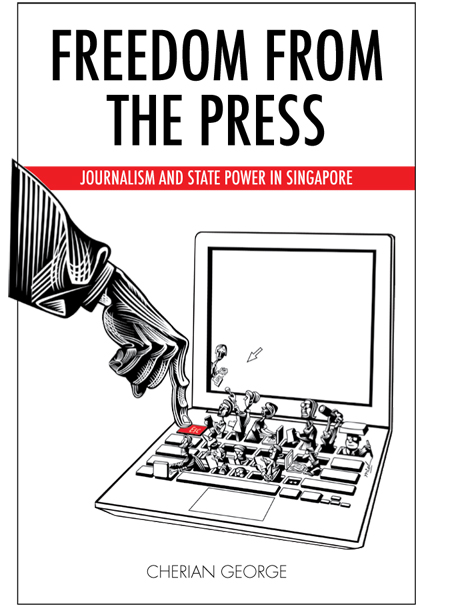
Sharaad Kuttan of Malaysia’s business radio station, BFM, did an interview with me for his programme about the media. The interview starts at the tail end of the first segment of his 16 June 2012 show and continues in the second segment.
Year: 2012
-
Yes, it’s time for an internet code of conduct – for readers
by
CHERIAN GEORGE
June 11th, 2012
Originally published at http://cheriangeorge.tumblr.com/
Singapore sometimes seems like a metropolis in search of a kampung spirit. And I don’t mean in a good way, like being caring and considerate – if you’ve seen how Singaporean drivers respond to an ambulance behind them (they don’t) you’d realise that when Gotong Royong 101 was being taught in kindergarten, they were probably absorbed in mental sums and other essential skills to get ahead of the pack.
No, the kampung spirit that we Singaporeans are cultivating is instead a kaypoh-ish petty-mindedness; a small-town mentality that tells us that no event is too trivial to turn into a national issue.
You may have heard of that classic formulation of headline news: if it bleeds, it leads. But since Singapore is not a particularly violent society, our scandal-seekers have had to make the most of the merely unpleasant. Their twist on the newsman’s mantra is: if it offends, it trends.
And with the internet, there’s no shortage of anti-social words and actions to dissect and discuss if you are so inclined. So, instead of limiting yourself to gossiping about what you saw through the window of your neighbour’s home as you walked by, you can peek at hundreds of thousands of Facebook walls where people obligingly make fools of themselves.
Thus, Singapore – one of the world’s great entrepôts and financial centres, with dreams of being a cosmopolitan world city like New York or London – works itself into a tizzy over inconsequential internet indiscretions of insignificant individuals almost every week.
Our mainstream media are contributing to this provincialism. But independent news websites play the leading role in setting the agenda, bridging the gap between more private sections of the internet and the more public web. Since they do not have the resources to investigate official malfeasance, our citizen reporters seem to have latched onto the formula of doing investigative exposés of individual idiocy.
Readers like me who subscribe (for now) to RSS feeds of the likes of Temasek Times, in the hope that they will tell me something important that the mainstream media aren’t, find ourselves being served a steady diet of news concerning the silly things that random persons happen to be doing online. Welcome to kampung Singapore.
With the F-U-gate scandal, we’ve reached a new low. A 17-year-old junior college kid flames the deputy prime minister and it becomes a national event.
Has our fascination for the frivolous gone too far, I wonder. After this latest controversy, Yahoo! News asked me if it was time for an internet code of ethics. Perhaps it is. But not the kind of code you think. I think it’s time for readers to exercise more responsibility. Here’s the kind of thing that could go into an internet consumer code:
We, as responsible consumers of the internet in Singapore, pledge the following:
- We will finally wake up to the idea that the internet contains all the wonder and weirdness of the world, and we’ll stop reacting to the less pleasant stuff as if it is the end of human civilisation.
- We will remind ourselves that teenagers are – like they always have been and always will be – basically daft. We’ll leave it to their parents, teachers and peers to set them right, and award them amnesty till they are 21. We’ll try not to circulate the stuff that they’ll regret saying and doing when they are adults, and we’ll certainly avoid publicising their names.
- We won’t exploit private individuals’ online mistakes as ammunition in our battles against groups we don’t like. Whether we want to prove that the internet should be censored, or to embarrass the political party that they belong to, or to tarnish the immigration policies that brought them here, or to show how intolerant some religious groups are, or how immoral some sub-cultures are, we won’t crucify random chaps who did something silly online.
- If we think there’s nothing good on the internet, we will go read a book. If we think there’s both good and bad, we’ll try to help the good go viral and let the bad sink into oblivion – instead of the reverse.
- We will use our smarts to decide what we really need to get worked up about. We’ll treat trolleys on buses as entertaining trivia; and focus more attention on climate change and Millennium Development Goals, on Syria, Sudan… and, all right, Euro 2012.
-
Mightier than the pen: Remembering ISA detentions of writers
by
CHERIAN GEORGE
June 2nd, 2012
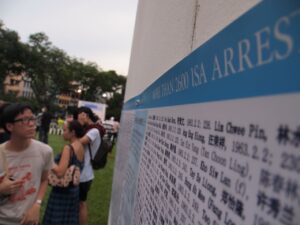
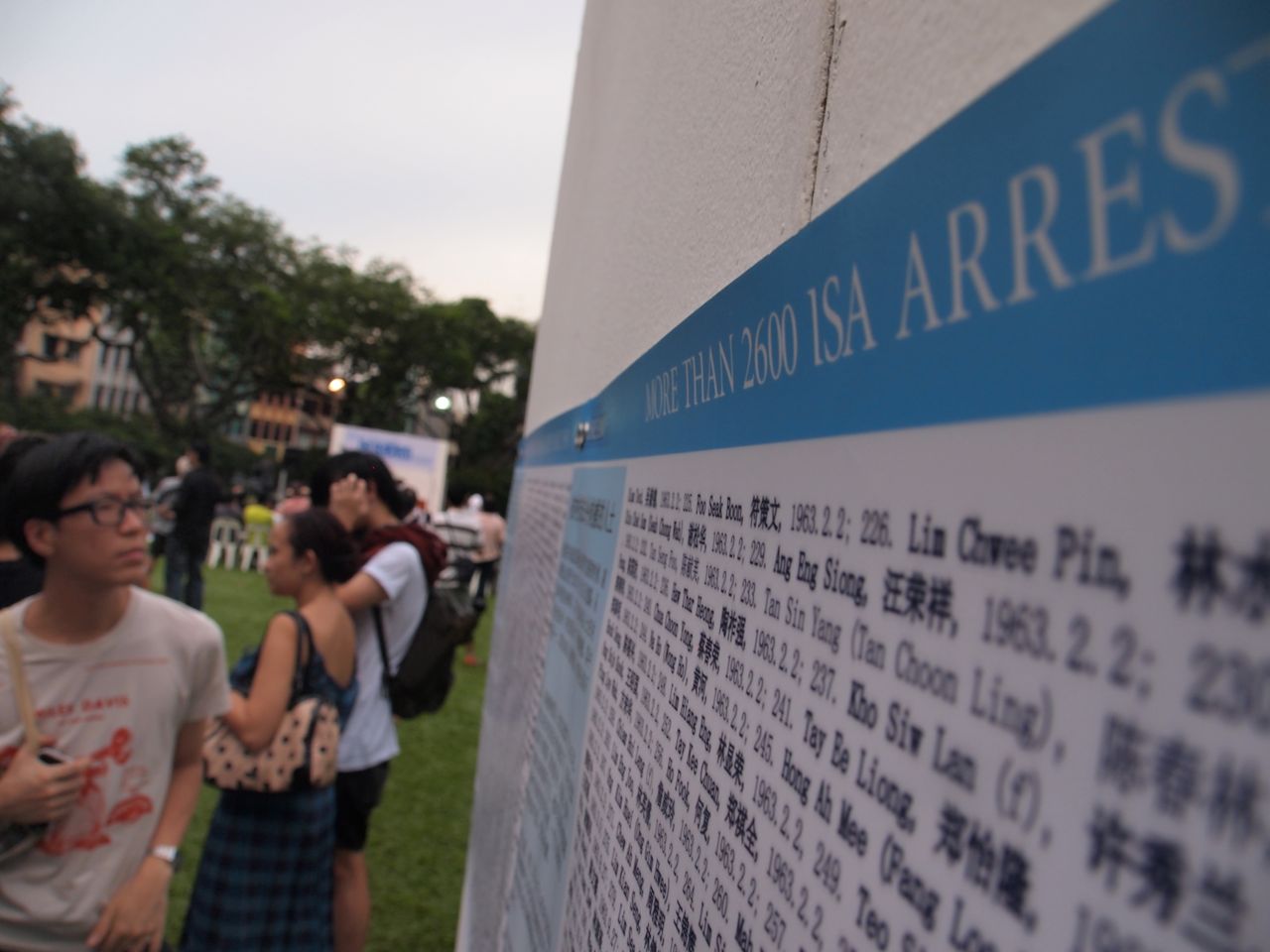
Above: This afternoon’s event at Hong Lim Park commemorated the 25th anniversary of Operation Spectrum. It was organised by Maruah and Function 8. Read Yawning Bread’s report of the event.
This year marks the 25th anniversary of Operation Spectrum, the arrests under the Internal Security Act of young Singaporean activists who were labelled Marxist conspirators. The use of the ISA as a means to tame the media is described in my book, Freedom From The Press. Here is an extract from the book.
The list of individuals detained since the PAP came to power in 1959 includes several who were involved in media, although many of them were hauled up not for their media work as such, but for their activities in opposition parties, trade unions and other organisations. Targets of the 1963 crackdown included Singapore National Union of Journalists secretary general A. Mahadeva of The Straits Times and committee member James Fu Chiao Sian of Nanyang Siang Pau (who would later become press secretary to Prime Minister Lee Kuan Yew). Others such as Poh Soo Kai and Tan Jing Quee were involved with the left-wing undergraduate magazine Fajar. Said Zahari, jailed for 17 years, was editor of the opposition Barisan Sosialis party’s Malay newsletter, Rakyat, and before that editor of the Malay daily Utusan Melayu. Lim Hock Siew edited Barisan’s English organ, Plebeian.
In the decade or so after independence, the ISA was used against several individuals working for mainstream Chinese and Malay media organisations. Before the milestone May 1971 crackdown on Nanyang Siang Pau, Ngiam Tong Hai of the same paper (1966) and Julius Yeh Sai Fu of Sin Chew Jit Poh (1971) were detained. Nanyang Siang Pau chairman Lee Eu Seng was detained for five years from 1973. In 1974, three Sin Chew Jit Poh staffers were among 31 people detained as alleged members of the Malayan National Liberation Front. In 1976, Berita Harian editor Hussein Jahidin and assistant editor Nahar Azmi Mahmud were arrested for allegedly sowing discontent and propagating communist thinking among Malays as part of a plot masterminded by the PAP’s left-wing founder member Samad Ismail. In 1977, Min Pao Daily journalist Kwok Chong Kwee was detained for ten days in connection with alleged pro-communist activities. In February 1977, the ISA was directed at the foreign media. Arun Senkuttuvan, who wrote for the Far Eastern Economic Review and other overseas publications, was detained for two months and stripped of his citizenship. Then, in March, the same magazine’s reporter Ho Kwong Ping was detained for seven weeks until 29 April.
Operation Spectrum of 1987 ensnared two individuals who were, among other activities, involved in publishing an underground newsletter that allegedly contained hostile and left-wing views about army life, and two others accused of infiltrating the Workers’ Party organ, Hammer. There were also two subtitling editors with the national broadcaster and a journalist with the Malaysian daily New Straits Times — but these media employees were not accused of using their outlets as part of their Marxist conspiracy. Therefore, Operation Spectrum could not really be characterised as a crackdown on journalism. Instead, the last time the ISA detention was used as an instrument of media regulation was 1977. Ho Kwon Ping, whom the government would appoint 20–30 years later as a statutory board chairman, chairman of the national broadcaster MediaCorp and president of Singapore Management University, would hold the additional distinction of being the last person to suffer ISA detention in the line of professional journalistic duty. Since then, the government has been able to count on the NPPA to create a culture of self-restraint in domestic newspapers. Defamation suits, contempt of court charges, circulation restrictions and work permit controls became the preferred tools for disciplining the foreign media.
There were other signs of a government re-think of its use of the ISA. By the late 1970s, American diplomats were noting that some detainees were being released despite not publicly renouncing communism or armed revolution. Some detainees refused to make such statements on the grounds that this was tantamount to admitting that they had believed in communist revolution in the first place. To break the stalemate, the government was willing to release them with restrictions. As Singapore’s security landscape changed, it may have also occurred to the government that overuse of the ISA would strain credibility. As early as 1977, the US State Department’s human rights report on Singapore registered the fact that the ISA was originally justified in connection with communist insurgency but that the definition of a “security case” was now being extended to include “those who portray Singapore as a state in which individual liberties are curtailed or the Singapore Government as undemocratic, totalitarian, autocratic and ‘oppressive’; and those journalists whose reporting is considered by the Government of Singapore to be slanted and therefore capable of being exploited by communists”.
Operation Spectrum of 1987 dispelled any doubts that a Cabinet made up mainly of second generation leaders had the stomach for using the ISA. In hindsight, though, the swoop could be said to have crossed a threshold — the point of diminishing returns — causing the government to reconsider its menu of coercion. The problem was not the objections from international human rights monitors, the Catholic church or Singapore’s liberals, since the PAP continues to draw a certain macho pride from its immunity to such external pressures. More worryingly, the government was finding it hard to convince even insiders. Goh Chok Tong, who was deputy prime minister at the time, revealed in an interview for the 2009 history of the PAP, Men in White, that his Cabinet colleague S. Dhanabalan “was not fully comfortable with the action which we took”. This, Goh said, was a reason for Dhanabalan’s eventual shock resignation from government. Dhanabalan was no lightweight or liberal: as culture minister, he had banned Cosmopolitan for its permissive values. He had also been named by Lee Kuan Yew as premier-material but for the fact that Singapore’s Chinese majority would not accept an Indian prime minister.
A young civil servant who was questioned as part of the Operation Spectrum investigations, Tharman Shanmugaratnam, voiced his doubts to the press when he was inducted into politics in 2001. “Although I did not have access to the same intelligence as the ISD, basically, those whom I knew had a strong social conscience and did not have a destructive political agenda,” he told The Straits Times in 2001. Tharman would go on to become deputy prime minister. Another establishment figure, legal scholar Walter Woon, who would serve as an ambassador and then briefly as attorney general, expressed his scepticism in 1991. “As far as I am concerned, the government’s case is still not proven. I would not say those fellows were Red, not from the stuff they presented,” he told The Straits Times.
Ironically, the ISA’s obsolescence as a censorship tool was probably sealed in 2001, when it had to be used against a bona fide security threat. The discovery of a Jemaah Islamiyah cell plotting terrorist attacks and with links to Al Qaeda suddenly demanded a more judicious use of the ISA. At all costs, the authorities had to avoid giving Singapore’s Muslims the impression that they were being targeted as a community. Its need for the support and cooperation of the wider Muslim community meant that the government had to act with precision and credibility. It could no longer apply the ISA in as loose and sweeping a fashion as in earlier decades, when anyone critical could be labelled a communist. In the past, it could be said that the government benefited from the climate of fear induced by an ill-defined ISA; post-2001, however, the authorities wanted the ISA to inspire public confidence, not paranoia. After decades of being perceived as a convenient political weapon, it would have to return to its security roots.
Francis Seow’s 1988 detention marked the last fresh arrest of a non-violent political opponent under the ISA. Since then, the Singapore government has honoured an undeclared moratorium on detention orders as a means of controlling dissent. Malaysia provides an interesting contrast. It continued to use the ISA against opposition members and other peaceful activists. As recently as 2008, Malaysia arrested under the ISA a mainstream newspaper journalist for accurately reporting a ruling party politician’s inflammatory outburst. In keeping with the theory of calibrated coercion, Malaysia’s kneejerk use of the law delegitimised the ISA in the eyes of a broad swathe of public opinion and made it a political issue in itself, compelling the Prime Minister Najib Abdul Razak to promise its repeal in 2011 in order to shore up his position. In contrast, Singapore’s human rights activists have had a harder time building up public support against the ISA, which is widely seen as a necessary national security tool.
From:
Freedom From The Press: Journalism and State Power in Singapore, NUS Press, 2012.
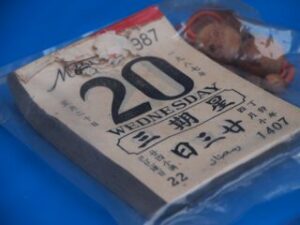
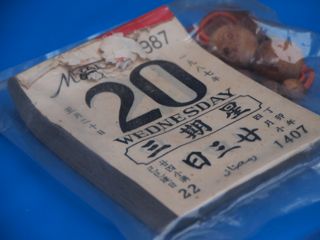
Above: A calendar belonging to lawyer Teo Soh Lung. She never got to tear off this page because life as she knew it ended the next day, when she was arrested and detained under the ISA. The calendar and other poignant artifacts were displayed at the Hong Lim Park event. Singaporean human rights group Maruah is organising a petition for a commission of inquiry into the arrests, “so that the nation can truly begin to heal and put this traumatic event in our history behind us”.
-
Forget turning the other cheek. They pull a knife, you pull a gun. That’s the Xiaxue way.
by
CHERIAN GEORGE
May 25th, 2012
Some internet users are embedded with a special microchip that wirelessly connects their keyboards to the ugliest recesses of their brains – bypassing common sense and conscience. This technology enables superfast uploading of comments, both vile and juvenile. With very little effort, it inflates the user’s ego and gives him an exaggerated sense of accomplishment, making him feel more potent than he is in real life.
Most of the experienced bloggers I know who have been victims of this (anti-)social media phenomenon have opted for the high road. When on the receiving end of crude personal attacks, they stay on the moral high ground. They have learnt to brush aside such flaming as just one of those things – the price we have to pay for freedom of expression on the internet.
Popular blogger Xiaxue has taken a different tack. Incensed at some of the invective scrawled on Temasek Review’s Facebook wall, she has hit back by exposing the individuals responsible.
The thing about the aforementioned software is that it’s not exactly rocket science, so its users have no guarantee that their targets won’t pick it up and use it against them. They are usually counting on the fact that the victim is more civilised (or busier) than they are (both generally safe assumptions), and that he or she therefore won’t descend to an eye-for-an-eye online shootout.
Enter Xiaxue.
I don’t follow her blog, and what little I know of it tends to fill me with despair. This is an admittedly elitist perspective, but the fact that more Singaporeans read her than, say, Yawning Bread, Diary of a Singaporean Mind, Siew Kum Hong or Rambling Librarian doesn’t say much for the discernment of Singaporean internet users.
But there is something to be said for the way Xiaxue handles herself in the rough and tumble of cyberspace.
Temasek Review posted a photo of her and her girlfriends on its Facebook wall, inviting readers to provide captions. Predictably, the exercise generated a number of off-colour remarks at her expense. Less predictably, she reached behind some of the vile comments and plucked out a couple of fine specimens of Singaporean manhood for all to see.
Relying on the men’s own public Facebook profiles, she revealed details like their ages and occupations along with rather unflattering pictures. “I’ve always wondered if people who call me fugly are bloody good looking themselves,” she commented about one. “So I thought you must look like Brad Pitt. But you look more like an armpit.”
Then there was the guy who remarked “pretty and sexy girls which part of geylang do they work?”
Xiaxue shot back by publishing a photo of him, his wife and their two babies. “He is married with two cute kids. I wonder how he will feel like if in future men ask his daughter which part of geylang she works at?”
Another man compared Xiaxue to Geylang prostitutes and underaged hookers, apparently assuming that his comments would remain in the underground world of TR’s Facebook wall. But Xiaxue published his comments together with a family portrait of him, his wife and baby.
The juxtaposition of this image of family bliss (apparently how he would like the world to see him) with evidence of his inner demons must have come as quite a shock for him. Interviewed in today’s Straits Times, the 35-year-old engineer sputtered that she had it coming, because she did not dress conservatively enough. He whined that she should have left his family out of it, and that his wife “feels really bad”.
Pity his belated bout of sensitivity towards family members’ feelings did not extend to Xiaxue’s husband.
Xiaxue’s final shot: “Maybe you will think twice before you call somebody a whore next time, huh?”
The wimp that I am, I would probably still opt for the less gangster-ish approach to online attacks. But perhaps there is a place for Xiaxue’s blazing-guns response in parts of cyberspace where civility cuts no ice. Reading her blog filled me with the same guilty, vicarious pleasure that I get out of a good Mafia movie.
To paraphrase Sean Connery in The Untouchables:
“They pull a knife, you pull a gun. He sends one of yours to the hospital, you send one of his to the morgue.
“That’s the Xiaxue way.”
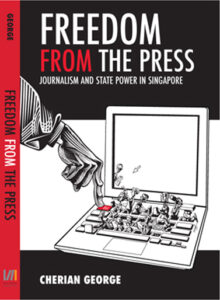
My book, Freedom From The Press, is now available at most bookshops in Singapore. Please visit my book site for more information.
-
Ferrari deaths: Fast and furious response overlooks the role of dream merchants
by
CHERIAN GEORGE
May 18th, 2012
One thing hasn’t changed since a red supercar slammed into a taxi near Bugis Junction last weekend. Ferrari’s showroom on Leng Kee Road is still open for business and its flashy website continues to sell the dream of macho power and unbridled speed.
Anger at the unnecessary deaths has been directed at the rich young Chinese national at the wheel of the 599 GTO that night. When the video surfaced suggesting that he had ignored a red light, Singaporeans’ outrage was matched only by that of people in China who are sick of the class of individuals in their midst who think they can get away with anything (because they often do).
Opponents of gun control in the United States have a famous slogan that says, “Guns don’t kill people, people kill people.” It states the obvious, that unless you inhabit the world of Terminator or the Transformers, humans shouldn’t be blaming machines for their problems.
As obvious, though, is the fact that people can kill people is by failing to control the harm they can inflict with their machines. We already have speed limits, and the government has promised to step up enforcement. But, in this and all other cases of speed-related deaths, we seem to accept without question the right of manufacturers and merchants to sell fast cars that maybe just don’t belong in a crowded city.
The comparison with guns is instructive. The standard defence of gun rights in the US is that guns aren’t used only to commit violent crimes: they can also be used for hunting and self-defence. But then you don’t need a military assault rifle like an AK-47 for such purposes, so these are more tightly regulated.
Cars, similarly, have mostly benign uses. When you think about it, though, it is odd that there are no special restrictions on buying the vehicular equivalents of AK-47s: cars expressly engineered for purposes that would be unsafe anywhere or anytime in Singapore. We have no speed-unlimited autobahns nor a cross-country rally course. Yet, luxury sports models like Ferraris and more-affordable racers such as the Subaru WRX ply our roads freely, packed with the kind of horsepower that has no legal purpose.
True, a Ferrari is a thing of beauty even when it is standing still, so why shouldn’t a car aficionado buy one like it’s a piece of art. However, as last weekend’s crash seemed to demonstrate, a thoroughbred strains to show what it was created for, and the temptation to let it can be irresistible.
(When I last bought a car, I reluctantly decided against the Suzuki Swift Sport – which, while no Ferrari, had won rave reviews for as a hot hatch. Test-driving it along Jurong Island Highway, I admitted to myself that if I owned it, I’d be itching to loosen the leash on this feisty compact. I didn’t trust myself to resist the urge, so I contented myself with its tamer non-Sport twin. Full disclosure: I still managed to accumulate more than 10 demerit points for moderate speeding.)
A prohibition on performance cars, especially luxury sports cars, is practically unthinkable. Singapore has positioned itself as a playground of the rich, and any restriction on supercars would be as good for the country’s image as the ban on chewing gum.
In any case, typecasting certain makes of car would be like assuming that only rottweilers attack. The real problem could be how the private car – any car – has been marketed as an essentially selfish mode of transportation.
Irresponsible advertising is the norm in the auto business. Performance indicators routinely invite drivers to speed. Blithely ignoring the fact that the maximum speed limit in Singapore is 90km/h, makers of even family sedans promise top speeds that are two-three times as fast, cheered on by car reviewers.
Even supposedly eco-friendly models help sell the dream. Infiniti’s M35h Hybrid is an exquisitely sculpted car with lustrous wood finishes and leather as soft as silken tofu. But go to its website and you’ll see it advertised thus: “Lean. Mean. Green. The World’s Fastest Accelerating Hybrid. 0-100km/h in 5.5 seconds.” In other words, no other hybrid can bust Singapore’s speed limit as quickly.
Automotive dreams part ways with urban reality most dramatically in their vision of clear roads and empty pavements. Whether you look at a Toyota Altis brochure or an Audi A7 video, one thing you won’t see is clutter: the clutter of other cars filled with other people; of vulnerable motorcyclists weaving through traffic; of pedestrians whose only protection are the rules of the road.
Media scholars don’t believe that messages, no matter how persuasive, work like injections of mind-altering drugs. People often overestimate the impact of individual stories or advertisements. However, repetitive exposure to the same picture of the world may indeed have a cumulative effect. Researchers of so-called “cultivation theory” have found, for example, that habitual television viewers, exposed to crime-filled news and entertainment, tend to overestimate how mean and violent their society actually is.
Is there a similar process at work in the way automobiles are marketed? After all, for decades, the dream merchants have packaged cars of all sizes, shapes and sticker prices in basically the same way – promising freedom from other road users. Drive this and you own the road, all the images say. It is not far-fetched to think that this incessant message has had an impact on drivers’ attitudes.
On the Ferrari website, one video ends with a cautionary note: “This film shows a fictional situation with professional drivers on closed roads. Ferrari urges you to obey all posted traffic signs and laws.”
This caveat, probably inserted for liability reasons, is unlikely to make a lasting impression. Instead, the lingering memory of this three-minute video is of breathtaking vistas and a machine of heart-stopping beauty. It glides across alpine snow and golden desert, effortlessly inhaling miles and miles of empty road into its bold red snout. The terrain, time and weather change – but it never needs to cross a junction or stop for a pedestrian.
The world in that video is somewhat different from the one that was captured by a passing taxi at 4.09am last Saturday.
We will never know for certain which streetscape filled the mind’s eye of the young Ferrari driver that night. But we can make an educated guess.
-
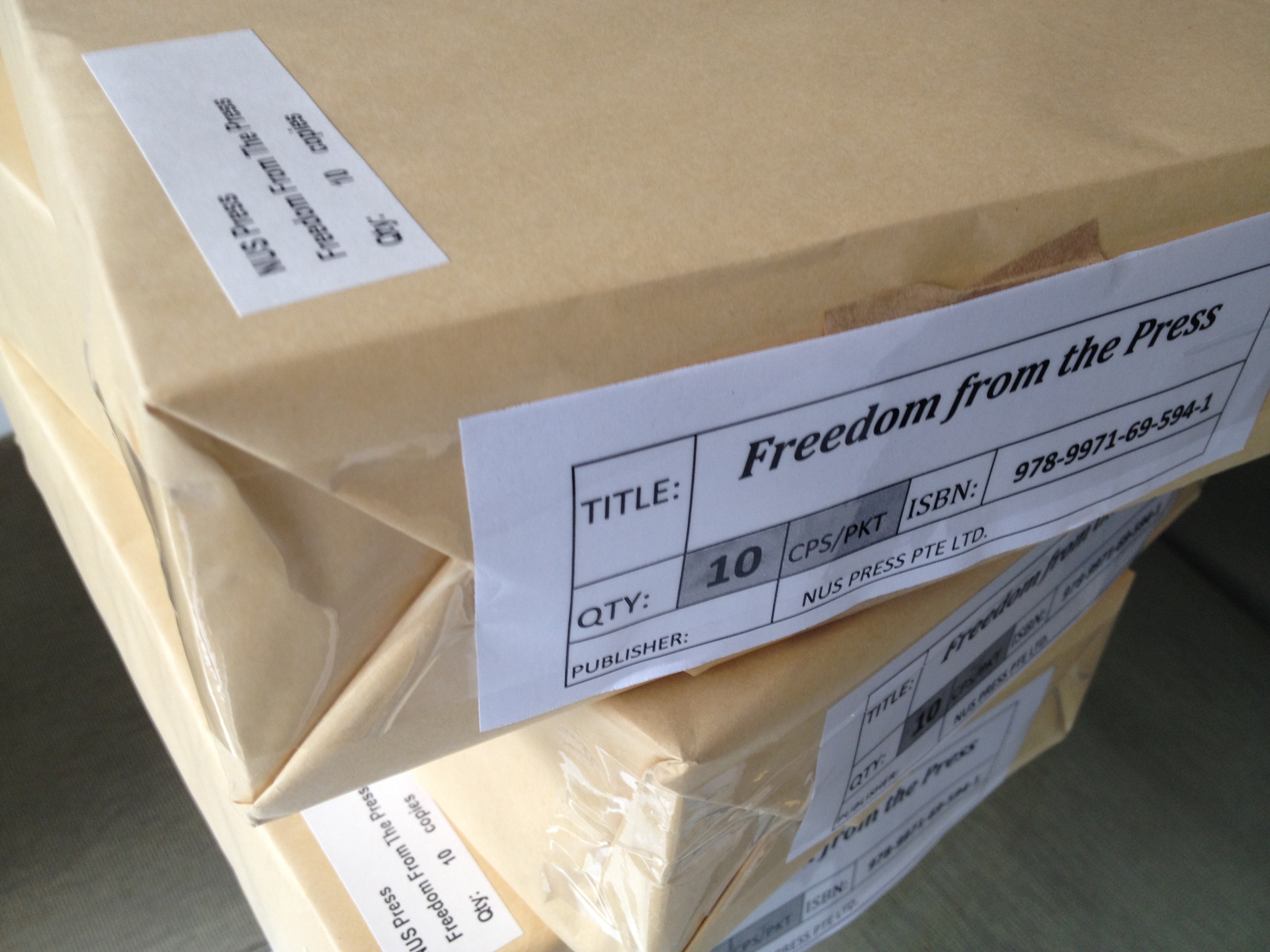
Thank you, NUS Press
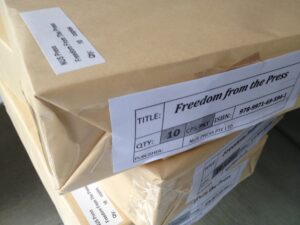
Fresh from the printer. In April 2009, I met NUS Press managing director Paul Kratoska to ask if he would be interested in publishing a book on the Singapore press system. He said yes (subject to the usual review processes) and I set to work. I thought it would take a year, but life got in the way, so it took three.
At last, it is done. On Thursday, I visited Paul’s office to pick up my copies. I’m told Freedom From The Press should be in Singapore bookstores by next weekend, retailing at S$38.
My previous book, Contentious Journalism and the Internet, had also been published by NUS Press, when it was run by Peter Schoppert. Originally called Singapore University Press, NUS Press has a long tradition of academic publishing. But one of the unfortunate side-effects of Singapore universities’ drive for so-called “world class” excellence (the most serious being the devaluation of Singapore studies across the social sciences here) is that many scholars now think that they should target foreign imprints instead of settling for Singapore’s top academic publisher.
Recently, one of my senior colleagues said as much, suggesting that my CV would look better if my book was published by an entity more illustrious than NUS Press.
I knew of this foreign bias within Singapore universities long before I met up with Paul three years ago. Nonetheless, NUS Press was my first stop, and thankfully it was my last. After all, I didn’t write this for my CV. It is a book by a Singaporean writer for a probable readership that is mainly in Singapore, so it made sense to publish it locally. Assuming people buy it, it would be easier for bookstores to replenish their shelves. And it would be more accessible than some excellent academic books on Singapore published in the US and Europe that come with astronomical price tags.
Furthermore, I try to chart my young academic career by the light of living role models, rather than clinical appraisal forms and bureaucratically-derived KPIs. And many of the scholars I most respect – including Wang Gung Wu, Anthony Reid, Chan Heng Chee, Eddie Kuo, Chua Beng Huat, Kwok Kian Woon, Hong Lysa and Huang Jianli – have titles under the SUP or NUS Press imprint. If it was good enough them, it is certainly good enough for me.
So, thanks NUS Press, for helping me get this book out.
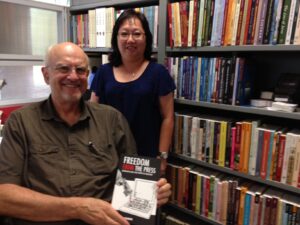
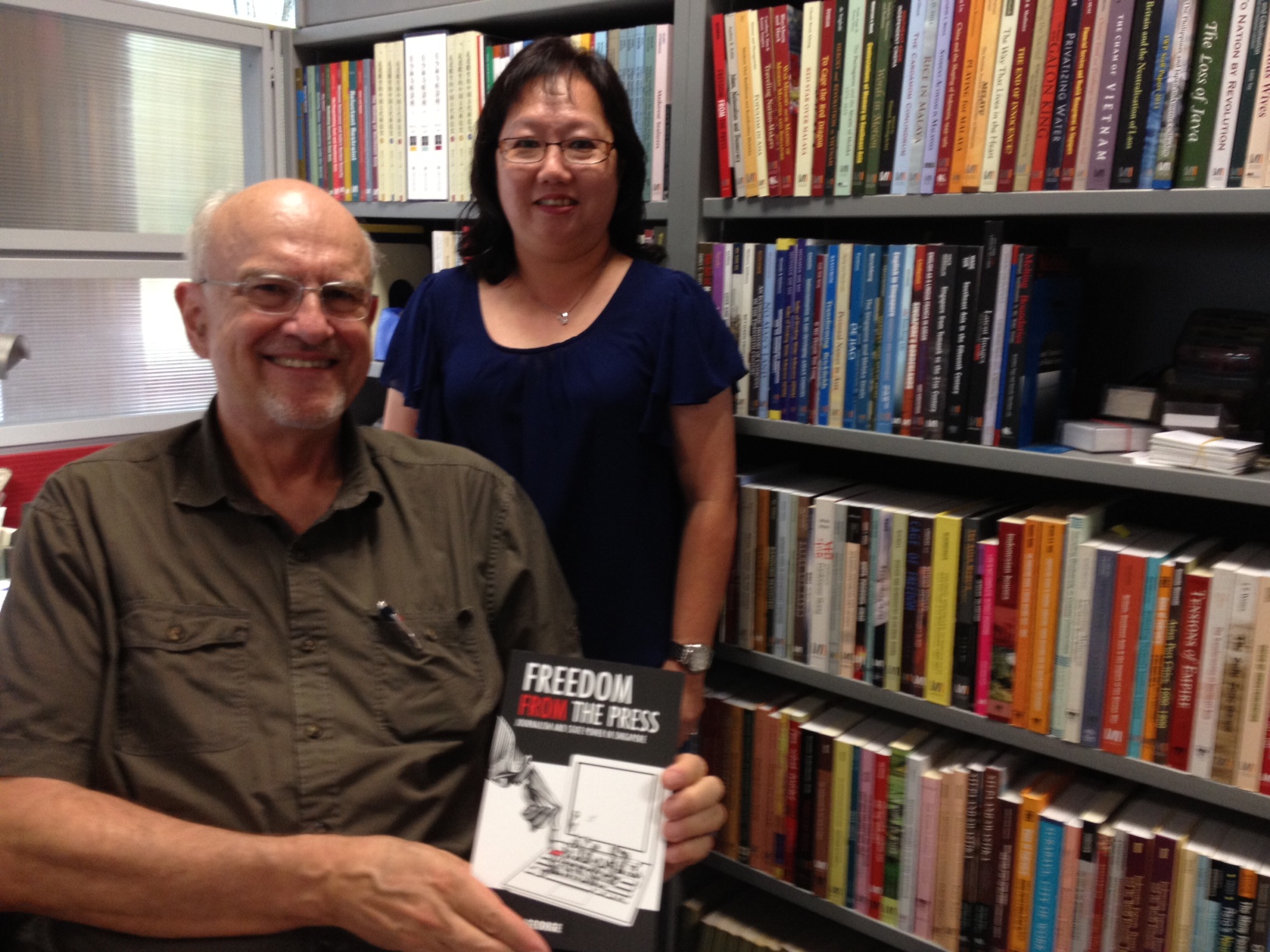
Paul Kratoska and Lena Qua of NUS Press. -
Racial and religious offence: Why censorship doesn’t cut it
by
CHERIAN GEORGE
March 11th, 2012
Edited version of a talk at the Association of Muslim Professionals’ Community In Review seminar 2012 on 10 March. The theme of the seminar was “To Post or Not To Post: Multiculturalism in the Social Media”.
The internet has provided a public platform for the best of human characteristics to be displayed, but also for the worst. We don’t know whether the internet makes things worse by encouraging anti-social speech, or whether it just publicises what used to be said in private. What is clear is that, in the past, gatekeepers of the mainstream media – newspaper editors and broadcast news producers – acted as filters to make sure that any offensive speech from the ground could not reach the wider public. The internet bypasses these gatekeepers, which means that the journey from thought to private utterance to public statement is almost instant.
No matter how hard we work at developing media literacy, we should not expect to be rid of all racially offensive speech online. There are two broad ways to respond to these breaches. We can reach out horizontally and together with our fellow citizens repair the damage by persuading others to reject harmful ideas. Or, we can reach up vertically to government, getting the authorities to act against irresponsible speech by using the law. The advantage of the latter is that it seems more efficient, punishing those who cross the line of acceptability and violate social norms, and deterring others from doing the same. The horizontal approach works through persuasion rather than the law, so it is slower and not foolproof.
All societies use a mix of approaches to address offensive speech. In international law, like at the European court of human rights and more and more jurisdictions, there is growing feeling that the law should really be a last resort and only used for the most extreme speech – speech that incites violence in a very direct way, or that is part of a campaign that violates the rights of minorities to live free of discrimination. In contrast, simply insulting and offending others, even if feelings are very hurt, is not seen as something that should invite a legal response. Using the law to protect feelings is too great an encroachment on freedom of speech.
Singapore draws the line differently. Our laws are written very broadly, such that any sort of offence, even if it does not threaten imminent violence, is seen as deserving of strict regulation. This probably reflects a very strong social consensus that race and religion should be handled delicately. So we tend to rely on strong government. The state protects racial and religious sensibilities from offence, using censorship when there’s a danger of words and actions causing hurt.
Thus, for several years now, we have seen many examples of offensive online speech prompting police investigations. In 2005, three young bloggers were convicted under the Sedition Act for racist comments. There have been other cases since then where the police have been called in to investigate offensive speech.
These cases are striking in two ways. First, it is interesting that in almost all cases, state action was instigated by complaints from members of the public. This is quite unlike political censorship, where action is initiated by the government, often with great resistance and opposition from netizens. In a string of cases involving racial and religious offence, however, it’s the netizens who tend to demand action, sometimes acting like a lynch mob.
Second, it is striking that in many cases, the offensive messages were spread further by those reporting the offence. In one case late last year, a blogger posted a religiously offensive image on his own facebook wall to warn others that this image was making the rounds. One of his so-called friends took offence and circulated it more widely on the internet in addition to making a police report. In the case involving a Christian pastor’s offensive sermon, most Singaporeans who have seen the video did not see it on the church website where the video was originally found, but via Hardware Zone, one of Singapore’s most popular forums. It was put there not by the pastor himself or his church members, but by someone who wanted action taken against the pastor.
This pattern is paradoxical. What is the justification for strong police action against any form of speech? Why do we sometimes feel that it may not be enough to counter bad speech with good speech in free and open debate, and that we must instead use the law to stop the bad speech? Surely, it must be because we think the bad speech is so dangerous that it can cause immediate harm; or because we don’t trust the public to respond rationally, so we don’t know if good speech would indeed triumph in open debate. Usually, if we call in the authorities, it must be because we have a mental picture of offensive speech being like lighting a match in a combustible atmosphere. It is dangerous and there’s no time to debate the merits of that match – we just have to put it out.
The irony of most of the cases that we have seen in the past few years is that the people demanding government action, as if the offensive words were explosive, were also those who helped to spread them. It is like helping to spread a fire while calling for the fire brigade.
Unless these complainants were just plain irrational or irresponsible, which I don’t think they were, their act of spreading the offensive content must mean that they did not actually believe that the expression was really that dangerous in the sense of prompting violence through reprisal attacks or riots. In reposting the offensive words or pictures, they showed that they actually trusted the public enough to respond sympathetically – they had faith that enough people would add their voices to the outrage that they themselves felt when they saw the offensive images or videos or words. And they were right: in every case, when these offensive messages were publicised, the overwhelming sentiment was that these messages were wrong, were anti-Singaporean. People who may have shared those thoughts were quickly reminded that they were not in line with Singaporean norms. The public debate reinforced our multi-racial and multi-religious foundations.
This then raises the question, why the need to involve the police at all? If Singaporeans are grown-up enough to defend their society against offensive speech, why have calls for prosecution and censorship become the automatic response?
I wonder if this is an example of the well-known habit of unthinkingly relying on government to solve all our problems even when, with a little bit of effort in the form of grassroots action can do the job. One problem with the culture of expecting police action whenever we feel insulted or offended is that this mechanism can be overused and abused. Those most likely to complain against any expression are the least tolerant members of each religious or ethnic community. Very quickly, therefore, the most dogmatic and extreme spokesmen set the tone for the rest of society.
Yes, we need to beware of offensive speech that is part of a deliberate campaign of hate-mongering. But let’s not be naïve. It’s not just giving offence, but also taking offence, that can be used as part of a political game. Usually, what looks like spontaneous and visceral reactions to offensive speech – angry demonstrations and so on – are orchestrated by activists who spot a political advantage in an outpouring of anger. In Singapore, I doubt that every netizen who demanded action against this or that offensive message was purely driven by concern for Singapore’s multiracial fabric. I am quite sure that in some cases, they simply saw the opportunity for some kind of political advantage against individuals or groups that they have on-going political feud with.
There is also overwhelming evidence internationally that the effect of outlawing blasphemy – which many well-meaning Singaporeans might intuitively feel is a good idea – backfires by allowing religious majorities to persecute religious minorities. Since offensiveness is subjective, it is possible for the dominant group to claim that its beliefs are being blasphemed by the peaceful religious expressions of a minority group. It can thus use the law to marginalise religious minorities. We see this in Malaysia. In Singapore, it should not be up to the state to decide which religious beliefs or schools of thought within a religion deserve legal protection – possible victims of such a move might include Singapore’s small Shia Muslim minority, which has long felt marginalised by the dominant Sunni school.
Another problem with this vertical approach, reaching up to higher authorities, is that it perpetuates a dependency on government and doesn’t do much for building horizontal trust, that is, trust between citizens. Such trust is ultimately the best defence in a world where we will never be able to control 100% of the messages 100% of the time, even if government regulators were given more powers.
Horizontal trust is important, because that is what helps us put things in perspective when we face provocations. Most offensive messages are not, by themselves, threatening, They are like a lighted a match. Whether there is an explosion depends on the context. It is mistrust that acts like an accelerant, like combustible gas in a confined space. Increasingly, we cannot control the text – the match. But we can influence the context. By building horizontal trust, our society will become more resilient against the inevitable frictions and frustrations of living among people of different cultures.
I believe that in many cases, Singaporeans make police reports when they encounter offensive speech not necessarily because they want the speaker to be punished, but because they want a strong public signal to reaffirm our multi-racial and multi-religious principles. They want reassurance. They want to bring the weight of moderate public opinion to bear on a dispute, plus perhaps a clear signal from the authorities as to what constituted acceptable speech. If so, why not just demand such statements instead of legal action. Even better, why not mobilise and organise civil society against such breaches.
The next time people encounter racist or religiously offensive speech, it would be nice to see swift responses from credible and respected civil society groups, Members of Parliament, and other ordinary citizens. If the speaker doesn’t get the message, organise boycotts, for example, and give him or her the clear message that our society isn’t going to take such offence lying down. The more we can respond ourselves through open debate and grassroots action, without the need to ask law and order to step in, the stronger our society will be.
-
A voluntary code of ethics for blogs: possible but…
by
CHERIAN GEORGE
March 11th, 2012
I was quoted in today’s Today suggesting that prominent independent websites come together to develop a voluntary code of ethics. An equally important point I made to the reporter was not carried in Today‘s article: that there is no need for any tightening of government regulation of online political debate. It’s important to see these as complementary ideas. Bloggers won’t consider voluntarily modulating their voices as long as they feel the government’s hands around their throats.
Substituting government regulation with community moderation is a principle that was contained in the Bloggers 13 proposal, which I co-authored with Choo Zheng Xi of The Online Citizen, Alex Au of Yawning Bread, Gerald Giam and other bloggers. Our report said that bloggers were prepared to take steps towards responsible, accountable blogging. It even proposed an Internet Content Consultative Committee (IC3) as an avenue for community moderation. But this had to be part of comprehensive reforms in which the government would roll back regulation of political debate. Singapore’s laws and regulations on freedom of expression needed to be revised to conform with international norms and best practices, the position paper said.
The more experienced and better-run blogs know that they have nothing to lose, and much to gain, by committing to a voluntary code of ethics – it would help distinguish them from the pack. This applies in mainstream journalism (it is usually highest-quality news outlets – like the New York Times and BBC – that invest the most in accountability mechanisms such as codes of ethics and ombudsmen) and should apply in citizen journalism as well. In a crowded market, organisations can “brand by values“, as some journalism thought leaders have put it.
But any code of ethics or mechanism for community moderation will only take off if it is devised entirely by practitioners, with not even the slightest hint of official influence or control. Even if totally independent, it would be difficult enough for any group of bloggers, no matter how well respected, to persuade others to adopt a code. Herding cats would be simpler. The merest whiff of government involvement would destroy any chance of success – that would be like trying to herd cats while walking a dog.
The best thing the government can do to encourage the process is to provide a clear and unambiguous signal that it will not tighten the regulation of political speech. As Bloggers 13 argued, Singapore needs something like a Malaysian-style “no censorship” guarantee.
So, if bloggers do not respond to the government’s calls to self-regulate, it is not necessarily for want of a sense of social responsibility. It’s more likely to be due to a lack of trust in the government’s commitment to freedom of speech.
-
The cover story, continued
It started with a gimmicky Facebook appeal: which cover design did my Facebook friends prefer? They voted and there was a clear favourite:
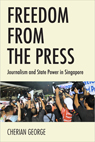
But there was also a strong suggestion that the photo I’d picked for the cover – something from my own collection – was clichéd. The design purists suggested an all-typographical cover. But, those with book-selling experience cautioned that books with pictures on the cover tend to attract more attention. The reply that really caught my attention, though, was one from my artist buddy at the Straits Times, Dengcoy Miel. For some reason he couldn’t see the shortlisted cover design on his computer. I saw my opportunity…
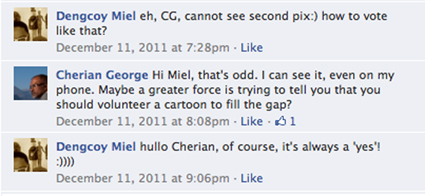
Dengcoy and I have collaborated on various projects inside and outside the Straits Times. I wrote the text for his little book of Singatoons, for example. For me, at least, it was a thrill to work together again (although “work” is probably the wrong verb; it usually feels like play). I gave him a quick synopsis and before long he offered some sketches…
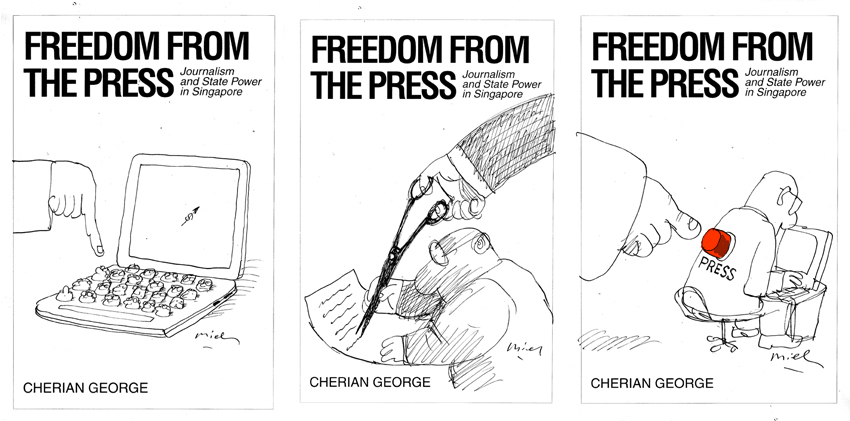
To me, the first one was the most promising. I made a few minor suggestions: “Would it be possible to have the finger reaching for the ESC key? I realise it may be hard to make the key visible. But the reason why this would be a good touch is that it would represent clearly the government’s power to ‘reboot’ the press any time it likes. If the heads represent the press, then can you make half of them women and most of them younger than us? Would it be possible to make it more obvious that they are reporters, by having a few of them hold out mics, a couple hold cameras? Let’s show them at work, rather than looking like robots, because a key point in my book is that journalists try to be professional even if the government has its finger on the ‘esc’ key.”
My other suggestions: “For visual/dramatic interest, I wonder if you should also draw in one small frightened reporter peeking out from behind the screen on the left side, watching at the hand. The politician: most don’t wear suits so he could have a long sleeved white shirt if you like. But I guess suits symbolise power better that shirts do. So I leave that up to you.”
And knowing that I wasn’t going to be able to pay him his worth (if at all) I suggested that he include a self-portrait – a cartoonist with a sketch pad amidst the other journalists.
Since the time we were colleagues in Times House, Miel has gone up in the world. So his moonlighting on this project was interrupted by a trip to Paris to exhibit his works and give talks. Today, at last, his final masterpiece arrived:

Here’s how it could look on the cover:
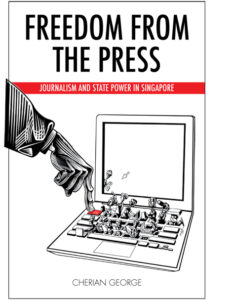
That’s another step closer to publication. Thanks, Miel!
UPDATE
Miel liked the idea of black bands on the cover: “It looks a lot more solid and stable,” he said. The designer at NUS Press gave it the final touch: a blood red back and spine. Here’s what’s going to press:
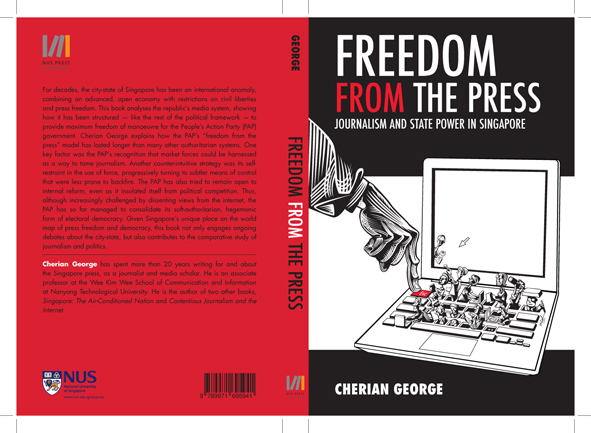
-
TREmeritus’ change of tack and what it means for the blogosphere
by
CHERIAN GEORGE
February 24th, 2012
The rebranding of Singapore’s most-read political blog – greeted almost instantly with defamation threats from members of the establishment – has sparked a debate over the wisdom of its decision to operate more openly. Some of its readers welcome the efforts of TREmeritus.com (TRE) to increase its accountability. Many are scornful, saying that coming out into the open is asking for trouble in a country where freedom of speech is inadequately protected against a government that’s famously intolerant of criticism.
Speaking truth to power: 4 modes
The case illustrates a genuine dilemma: there is no obviously superior way to engage in online criticism. Every strategy involves trade-offs, its benefits accompanied by costs. There are at least four approaches available to those who want to engage in critical commentary.
- Establishment critic
Establishment critics are those who try to stay within Singapore’s informal “OB markers” as well as within the letter and spirit of the law. This is the territory of the Straits Times, Today and Yahoo! (included here because its appetite for publishing articles that cross OB markers is not significantly greater than the mainstream media’s even though its livelier comments give the impression that it is more free-wheeling).
Anyone who wants use these channels to deliver a critical message must learn to say things between the lines, giving face to government and never challenging its authority. The vast majority of vocal netizens are contemptuous of such pussyfooting. But establishment critics recognise – even if they do not like – the dominance of the PAP. They believe that if you want change, you have to get buy-in from government, and that this is only possible if you maintain its trust by staying within OB markers.
- Gadfly
This is the term that Catherine Lim uses to describe her political role, and it’s an apt one to describe the many bloggers who, like her, are happy to cross OB markers. They include The Online Citizen, Alex Au, Ng E-Jay, Martyn See and others. They persistently irritate officialdom, having decided that the governments’ irritability is its own fault and that it needs to grow up and tolerate reasoned criticism, minus any comforting balm. Gadflies buzz about in the open, within slapping distance. They are not deterred by the risk of losing political capital because they do not need it – they tend to be self-employed and not dependent on the government’s blessings.
However, gadfly bloggers try (not always successfully) to remain on the right side of the law – including Defamation (which means refusing to circulate unverifiable rumours) and the Films Act (which is why Martyn See does not post his banned videos). By operating openly, gadfly bloggers can forge strong links with civil society groups and/or opposition parties, since face-to-face communication is still the best way to build trust.
- Guerrilla
By using this label, I’m not suggesting that this category is made up of violent individuals. Guerrilla warfare is a strategy designed to deal with much more powerful adversaries. It involves using non-legal methods to hit the enemy where it hurts, then retreating quickly to safe hideouts. Guerrilla bloggers, similarly, have no regard for either OB markers or the laws restricting expression. While traditional guerrillas hide in jungles, guerrilla bloggers use cyberspace to keep them safe. Most operate anonymously; those who use their real names are physically located outside of Singapore.
Temasek Review used to be the standard bearer of guerrilla blogs. With its change in direction, Sammyboy could be taking over this role. Guerrilla blogs are the natural outlets for whistleblowers. Their weakness, however, is that they unable to forge offline connections. Note that even opposition parties would be reluctant to embrace anti-government individuals who do not have the courage to come out into the open, since such people may not have the stomach or stamina for the kind of fight that the opposition is engaged in.
- Jiujitsu
This term comes from Gene Sharp, who uses it to describe the method of civil disobedience. Like the martial art of jiujitsu, this political tactic involves using the adversary’s superior strength against itself. It was perfected by the leaders of non-violent resistance in nationalist and civil rights struggles of the 20th century.
Jiujitsu politics is about deliberately and non-violently flouting laws that are seen as unjust; inviting and allowing the government to crack down forcefully; ensuring that everything happens in full view of the public; using the imbalance of power to provoke moral outrage; and thus swinging the tide of domestic and international public opinion against the government. Offline, the key Singaporean exponent of this method has been Chee Soon Juan. Online, the best example is Gopalan Nair’s “Here I Am” blog postings in 2008, when he publicly declared that he was defaming PAP leaders and provided his address and phone number so that they could come and get him. Given that the Singapore public has proven notoriously difficult to prod into moral outrage, it is not surprising that jiujitsu blogging is extremely rare.
Border disputes
Although blogs tend to plant themselves squarely in one category or another, there will always be disputes over where exactly the boundaries lie. This doesn’t affect free-floating individual bloggers, but can be a problem for organisations and group blogs. Since OB markers are often only apparent in hindsight, establishment media always face internal debate and dissension over whether a particular columnist is straying out of the establishment critic role and becoming a gadfly.
Gadfly group blogs, meanwhile, may have internal disagreements about legal risks. One example was The Online Citizen’s policy towards Cooling Off Day in last year’s General Election. When I interviewed founding editor Andrew Loh some months earlier, he made it clear that he was inclined to ignore the Cooling Off Day restriction on principle – this was meant to be a ban on campaigning, and he did not see why citizens should be stopped from discussing the campaign. The letter of the law exempts licensed news media from the ban, so it could be argued that the spirit of the law should give citizen media similar leeway. Loh was the editor in charge of TOC’s election coverage, and duly published articles after the guillotine time. He took the calculated risk that TOC could get away with it (which it did). However, I am told that his position was not unanimously supported within TOC – some felt the site should not venture into this grey area. (Ironically, Loh is now being flamed in some sections of cyberspace as a PAP stooge.)
Form versus content
One reason why the choice of strategy can be confusing is that there is no necessary correlation between the political acceptability of the words used and the strength of the criticism that those words contain. Some netizens suspect that if TRE commits to staying within the law, it will be less critical. The truth is, criticism can be insulting, vulgar and defamatory – and still miss the target. Conversely, criticism can be polite and devastating.
Take, for example, Alex Au’s critique of Lee Hsien Loong’s leadership, published in Yawning Bread last May. Alex certainly ignored the OB marker that citizens should criticise policies but not politicians. But his blog did not cross any legal threshold, including defamation. Working in gadfly mode, Alex keeps within the law. The army of anonymous commentators in Singapore’s guerrilla blogs is much less respectful, but I have yet to read anything there that matches the power of Alex’s critique of the PM. Similarly, even establishment critics – take P. N. Balji’s columns in Yahoo!, for example – can deliver more substantial criticism than many netizens, even if the tone is gentler.
TRE’s dilemma
Considering the trade-offs involved in choosing strategies, it’s not surprising that TREmeritus’ change of direction has not been smooth. Moving from guerrilla to gadfly has alienated some of its core supporters. It has also had to scramble to manage comments that were in keeping with its old guerrilla mode, but now threaten its transition to gadfly blogging.
After the PM’s defamation threat, it faced a fork in the road. It could cut off Richard Wan – still the only openly identified editor – and return to guerrilla mode, or clean up and press on. It appears to have done the latter. This seems to have sparked something of a reader revolt: it has been swamped with defamatory comments, probably from those are against its tentative steps towards respectability.
The letter from Lee Hsien Yang’s lawyers opened up another possibility. For a moment, it looked as if TRE might adopt the jiujitsu stance. It appeared that it might rebuff the lawyers’ demands and go to court in order to press home its stand on freedom of expression. In every country, from established democracies like the United States to new democracies like Indonesia, Constitutional liberties have been extended through the slow and tortuous process of challenging government restrictions in court.
That was the significance of TRE’s brief relationship with human rights lawyer M. Ravi. Ravi is one of the only lawyers in Singapore who has adopted the mission of widening legal boundaries by fighting political cases – causes that may seem futile, but may occasionally succeed in generating judgments that produce incremental changes at the margins. However, Ravi and TRE parted ways after less than day. TRE’s editors clearly have no desire to be martyred.
Regulatory implications
Looking at the online landscape in this way also shows why the government’s use of defamation law against TRE can backfire. One would assume that it is in the state’s interests for critics to move from the guerrilla mode to the gadfly category (even if they don’t go all the way into the establishment critic box or the silent bystander territory, which is where most Singaporeans reside).
It is also clear, for reasons stated above, that such migrations involve adjustment pains and a certain amount of culture shock for the blogs concerned. Those in favour of TRE’s shift should be encouraging it – or at least not going out of their way to make the transition more painful. At last week’s public forum, TRE’s editor said they would welcome and publish government replies to their articles. As pointed out by The Online Citizen, the government could have chosen to reply to TRE’s offending article without the backing of a lawyers’ letter.
The defamation threats, issued within days of TRE’s much publicised change of direction, has basically strengthened the argument of the proponents of guerrilla blogging. Even if TRE stays the course and completes its makeover as a “responsible, pro-Singapore” website, there is little doubt that others will fill the space vacated by Temasek Review – and with more determination and drive, now that the defamation threats have galvanised them.
At present, Sammyboy’s political forum is probably the main beneficiary of these developments. I got this SMS yesterday from an old friend: “Quite a few of my friends are now reading Sammyboy regularly…. I knew of the website but never bothered before. I guess that is how website readership works.”
You can’t argue with the numbers. There is obviously an enormous appetite for no-holds-barred, publish-first-think-later commentary – not because people like nonsense, but because they want to decide for themselves what’s nonsense and what isn’t. Even the more responsible gadfly blogs seem to recognise the value of sites that have fewer compunctions about publishing possibly defamatory rumours: at last week’s talk, The Online Citizen’s Ravi Philemon said he passed a story to TRE because it was unverifiable and did not meet TOC’s stricter criteria; presumably, he was hoping that TRE would publish it. With such demand, I have little doubt that within a few months, a full-blown underground website will emerge to play the role of the old Temasek Review.
I assumed above that the government would prefer blogs to move from guerrilla to gadfly modes. But, this is not necessarily true. Many observers have pointed out that there is a certain futility in guerrilla blogging because it is a fundamentally individual enterprise. Sure, the numbers added up might seem impressive, but in the end isolated individuals never produce political change. One of Temasek Review’s little-noticed features was a paucity of hyperlinks to other sites within Singapore’s broad movement for democratic change – it had a big audience, sure, but few partners.
Individuals have to be organised before they are potent. This is the strength of the gadfly blogs. Their numbers may be smaller, but they are capable of getting things going. When they network with civil society groups and opposition parties, in particular, they are far more effective than the likes of Temasek Review. That being the case, cynics might conclude that the strong action by the government was deliberate – that, for all its protestations that it wants more responsible and law-abiding netizens, it is actually happier with guerrilla blogs than a growing swarm of gadflies.
Further reading:
- My article on the different strategies of socio-political blogs in the 2011 general election, for a forthcoming book on the role of new media in the GE.
- My 2006 book on alternative online media, with case studies of Sintercom and Think Centre.