Year: 2012

  • Media panel decides to let sleeping gods lie

    by

    CHERIAN GEORGE

    November 29th, 2012

    The Media Convergence Review Panel has missed an opportunity to nudge the Government’s regulatory regime into the 21st century. The Panel took on the challenge of recommending how to harmonise rules across platforms, in an age when text, sound and images can flow from one format to another with ease.

    In today’s Singapore, internet freedom coexists with the 19th century colonial phenomenon  in which traditional media publishers are beholden to political leaders for publishing permits. This has created an “unlevel playing field”, the Panel notes:

    “Local media players are increasingly vulnerable to online competition from overseas media service providers who are not subject to local regulatory regimes.”

    The Panel could have argued for licensing and other rules to be significantly modernised in order to help local print and broadcast players compete with freer online media. Instead, the thrust of its report goes in the opposite direction, suggesting that large online players be subject to similar regulations as traditional media.

    The final two paragraphs of its report do point out that “it will grow increasingly untenable for MDA to continue to apply the same regulatory approach as it did in the past” and that regulation alone is not a “magic bullet”. But it has no specific proposals to offer. Rather, its chapter on licensing is about leveling down media freedom instead of leveling it up or even finding a happy compromise.

    It states that it was guided by the principle that “licensing continues to be necessary”, for three reasons: to protect the public interest through obligations imposed on licensees; to set local contents; and as a means of allocating scarce radio frequencies. The report is sprinkled with examples from more democratic settings such as Australia and the European Union.

    Not even the staunchest free speech defenders deny that some regulation of media is necessary. In fact, certain rights are only achievable through state intervention – such as the communication rights of minorities and children, who are often under-served by the free market. International law also requires states to protect minorities against incitement to violence, hatred and discrimination.

    However, what the Panel’s report glosses over is that there are international best practices for media regulation – and that Singapore is far away from them. For one, regulators should be as independent as possible from the government of the day, to ensure that they work in the public interest and don’t become instruments of the ruling party. Second, any licensing system must be transparent and subject to independent review – and not give out or withdraw permits based on political loyalty.

    In these regards, the European and Australian regulators that the Panel cites approvingly are not like Singapore’s MDA. And licensing regimes in freer societies are not like Singapore’s, where it entirely up to Cabinet to decide whether an entity should hold a licence.

    This would not be the first time such harmonisation of regulation has gone in the wrong direction. After the Newspaper and Printing Presses Act of 1974 succeeded in taming local newspapers, offshore magazines like Far Eastern Economic Review and Asiaweek saw the niche to supply Singaporeans with more critical journalism than their local media could offer. The government responded by amending the NPPA in the 1980s to restrict the circulation of offshore publications deemed to be meddling in Singapore politics.

    When global news channels emerged, equivalent instruments were introduced to ensure that the likes of CNN and CNBC would not be able to show up MediaCorp’s news programmes by exploiting the regulatory loophole with impunity. Since pay TV is controlled by GLCs, Al Jazeera English has been kept off Singapore’s TV screens, depriving television audiences here of one of the world’s most respected news providers.

    Now, with the apparent approval of major industry players, Singapore seems to be attempting similar harmonisation for the internet. Yahoo! News, now among the top online news providers in Singapore, is one possible target.

    Surprisingly, Google is among the media giants represented on the panel. Google is a member of the Global Network Initiative, which has pledged itself to resist censorship. It is unclear how Google reconciles its own commitments to internet freedom with the Panel’s recommendations.

    The big loser, though, is not Google or any of the global media entities that regulatory harmonisation is supposed to address. It is really Singapore, including its government. We needed a wake-up call. This high-level panel was in a position to give it. It has instead allowed policymakers to believe that it can be business as usual.

  • Poll: professional journalists need a code more than bloggers do

    by

    CHERIAN GEORGE

    November 26th, 2012

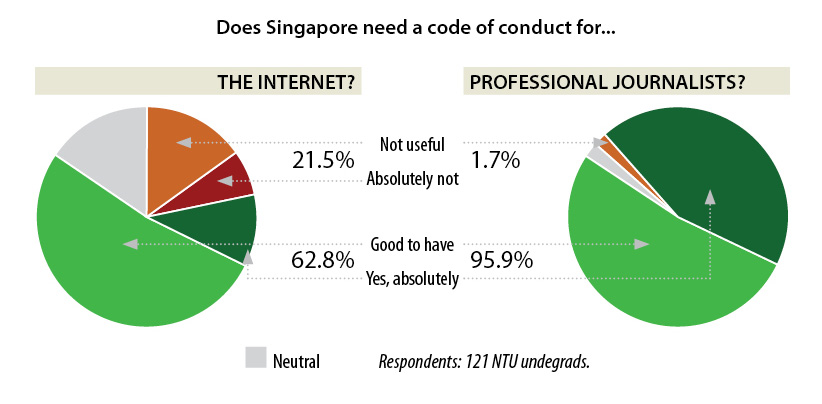
    Most Singapore undergrads favour promoting responsibility among netizens, but they feel even more strongly that professional journalism needs to be accountable to the public. Whichever the medium, though, there is little appetite for official intervention – bloggers, journalists and the public should work towards responsible media without government help.

    These sentiments were expressed in a survey of 121 Nanyang Technological University students this month. My survey took off from a recent poll by the National University of Singapore Students’ Political Association, which found most respondents supportive of the idea of an internet code of conduct. While the NUS survey left it at that, I wanted to ask several additional questions to probe students’ attitudes to various aspects of media accountability.

    Asked if they felt that there was a need for an internet code of conduct, six in 10 of the NTU students said yes, echoing what their NUS counterparts said.

    But although the ethics of blogs and social media has been a hot topic, the NTU survey showed that the students were even more concerned about the responsibility of professional news media. More than nine in 10 felt professional journalists needed a code of practice.

    media-accountability-survey1
    CLICK GRAPHIC TO ENLARGE

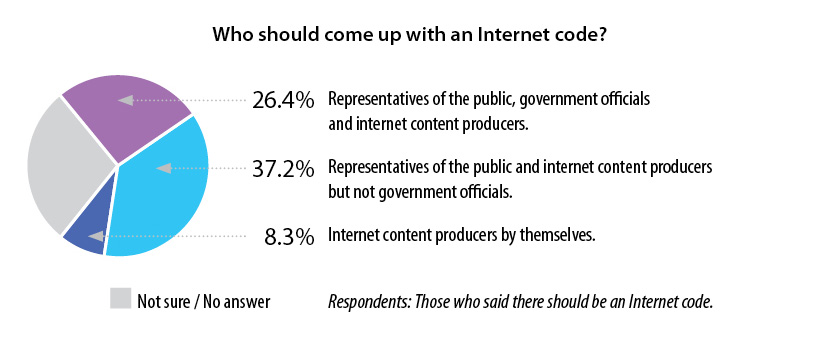
    Among those who agreed with the idea of an internet code, a plurality of almost four in 10 felt that such a code should be developed by internet content producers in consultation with members of the public – but that government officials should not be involved.

    Around one-quarter had no objections to government officials being part of the process, while fewer than one in 10 said that internet content producers should be left alone to do it without consulting the wider public.

    media-accountability-survey3
    CLICK GRAPHIC TO ENLARGE

    The survey results do not reveal why the students felt that professional journalists need a code of ethics even more than netizens do. One possible reason is that the respondents trust mainstream media less than blogs. But although such sentiments are regularly expressed online, previous surveys suggest that it is not a dominant view. A major national post-election survey in 2011 found that, even among young Singaporeans who used blogs and Facebook, traditional media were considered more trustworthy as a source of election news than alternative online media.

    A more likely reason for the NTU students’ response is that they consider traditional news media to have a bigger reach and influence, making them more capable of causing harm and therefore more in need of professional ethics than relatively harmless bloggers and Facebook posters.

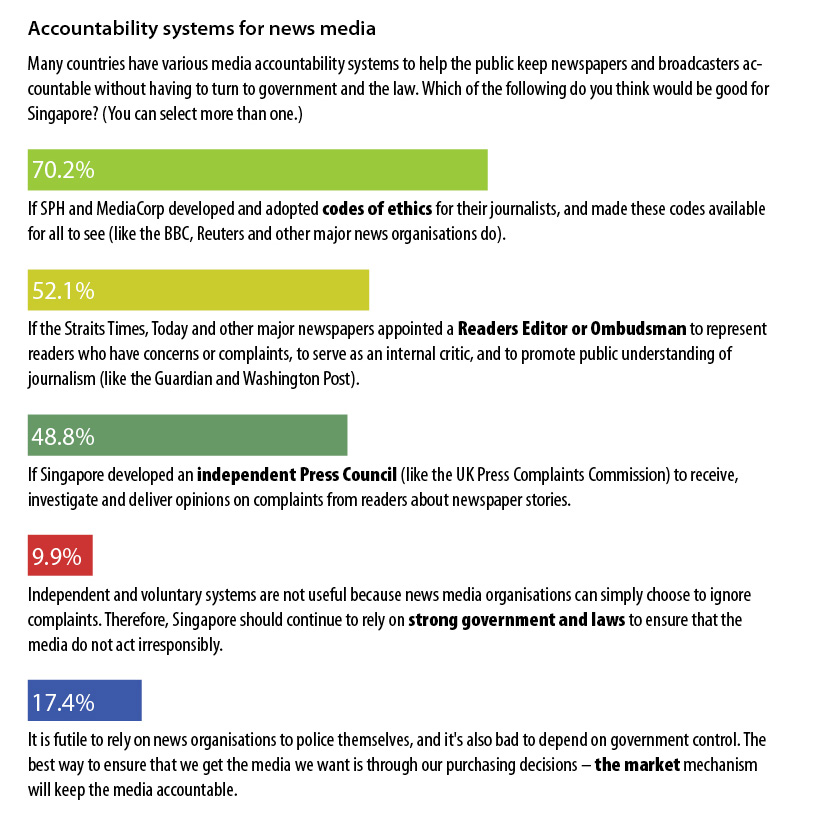
    But only one in 10 believed that Singapore should continue to rely on strong government and laws to ensure that the media do not act irresponsibly.

    There was much greater support for voluntary mechanisms that would allow the Singapore public to hold mainstream media to account. Around seven in 10 felt that Singapore Press Holdings and MediaCorp should adopt journalism codes of ethics and make these codes available for all to see. (Examples of news organisations that do this are the BBC and Reuters.)

    media-accountability-survey2
    CLICK GRAPHIC TO ENLARGE

    The students were from a mix of years and majors, such as business, sociology, linguistics and engineering. They were enrolled in “Introduction to News Media”, a broadening course offered by the Wee Kim Wee School of Communication and Information specially for non-communication majors.

    The course exposed them to various aspects of journalism and its role in society, including the concepts of press freedom and responsibility. The respondents in this survey are therefore probably not typical of Singapore undergrads, since they would have had more opportunity than most to read about and think through media issues. The survey responses were anonymous and ungraded.

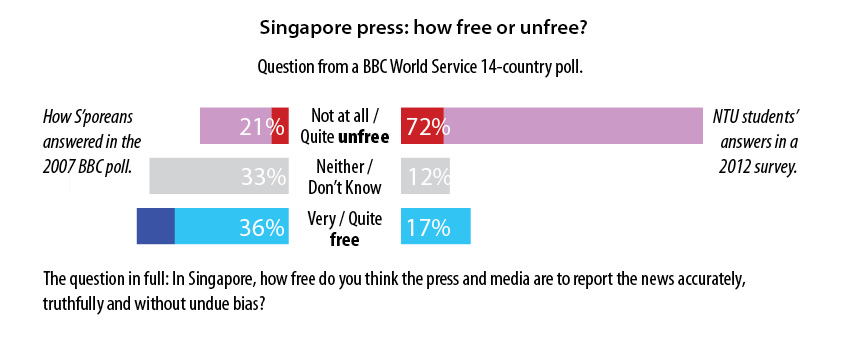
    In an earlier survey with the same group, I posed them the same questions that the BBC used in a multi-country poll in 2007. Compared with how a wider group of Singaporeans responded in the BBC poll, my NTU undergrads were far more likely to say that the Singapore press was unfree.

    media-accountability-survey5
    CLICK GRAPHIC TO ENLARGE

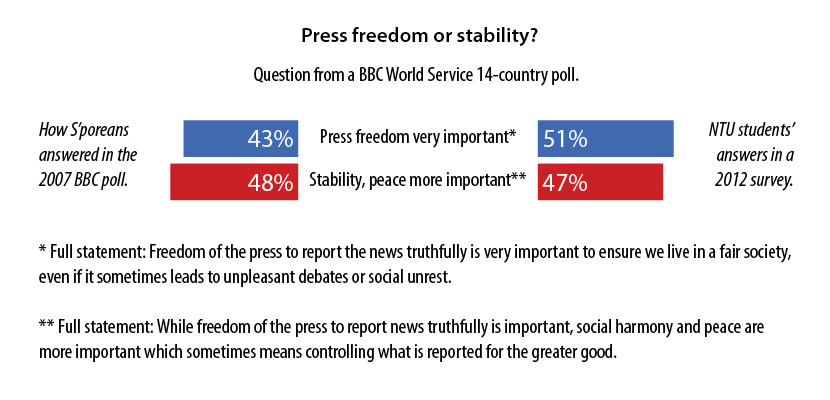
    However, just like the wider public, my students’ opinions were divided between those who wanted more press freedom and those who valued stability more.

    media-accountability-survey4

  • Talking about press freedom – with P. N. Balji

    by

    CHERIAN GEORGE

    November 14th, 2012

    At the Singapore Writers Festival on Saturday 10 November 2012, I spoke about my book Freedom From The Press and Singapore’s media system with P N Balji, former editor of The New Paper and Today. We also talked about OB Markers, the book by retired Straits Times group editor in chief Cheong Yip Seng, who was originally scheduled to speak but had to withdraw. Here is an edited transcript of our dialogue.

    Cherian:

    I’ve been writing about the Singapore press and the need for press freedom for a long time, and I thought that it was probably time to try and bring everything together into some kind of systematic argument. The other reason for this book is the sense that I’ve had for a long time that Singapore could be and should be so much more than it is, in particular in terms of our intellectual and creative life. Many Singaporeans feel that we deserve more than we get in our national press.

    The enigma has always been, how is it that newspapers that are not government owned – and it is a common myth that they are government owned, when the number one shareholder of SPH shares is Citibank followed by HSBC – have been subject to such enduring press controls. I emphasise enduring, because of course it doesn’t take much brains to control anything for a day or a week or a month. But how is it possible for a group of men to have controlled the ideological space for decades with no sign of any erosion of its ability to control that space?

    The PAP has been able to preserve its dominance – which may be fraying at the edges, but by and large preserve its dominance – with diminishing use of power. It is not difficult to preserve dominance if you are willing to ratchet up your abuses every year, applying more and more violence. The mystery in Singapore is that the dominance remains, but the violence has reduced. Which must mean that in place of violence – in place of locking up journalists under the ISA, in place of closing down newspapers – somehow they’ve managed to preserve their dominance in less violent ways. So what are these less violent ways? That’s what my book tries to answer.

    To cut a long story short, it boils down to the replacement of more overt external controls with more behind the scenes controls; economic inducements, for example, that promote a culture of self censorship. That’s one of the answers. My book focuses largely on these more structural reasons; it goes into the laws as well as the non-legal controls.

    One of my regrets about writing my book when I did was that, shortly after, my old boss Cheong Yip Seng came out with his insider account, OB Markers. To be very honest – and as a journalist trained to take myself out of the equation – if you can only afford to buy one book today, and you have a choice between OB Markers and Freedom From The Press, I would say buy OB Markers and not my book.

    One reason is that I’m cheap – anyone who wants to talk to me about the press, I’ll talk to you, just buy my coffee. Cheong Yip Seng is more elusive – so elusive that he didn’t show up today! He’s been an enigma for decades, even to those who worked with him closely. And he reveals things in his book that only he could reveal, because he was really at the frontline where decisions were taken. So, it’s a goldmine for researchers.

    I don’t think there is anything in his book that contradicts my thesis; I see it more as a supplement. Whereas my book looks largely at more structural controls, he looks at the role of individuals in shaping the press. Primarily, Lee Kuan Yew, as well as editors like himself, selected ministers, chairmen of boards and so on. He does, in many cases, explain who did what and why.

    So I thought a good place to start my conversation with Balji is to address this question – whether he believes that, given the structure that we have, the press system that we have, can individuals make a difference? Or, do we just give up?

    Balji:

    Cheong gives insights and inside stories that have never been revealed before. I was quite surprised at some of the details, and the details show the extent to which government interference was applied: even to nitty-gritty issues like stories on stamp collection, stories on selling of carpets, and the most surprising – I only realised it when I read the book – on the use of MSG. The person who intervened was Mr Lee Kuan Yew. So, it does give details that have never been revealed before.

    The editors of Singapore, including me, have this unusual habit of taking their stories to the grave. Cheong has bucked the trend. But having said that, there are also a lot of stories that have not been told, which have been glossed over. So if anybody tells you this is a tell-all book, don’t believe it. It’s a tell-something book…

    Cherian:

    So there’s still a gap waiting for Balji to fill before…

    Balji:

    … Before I go to the grave. Honestly, I have actually thought of writing a book, and I have actually sat down in front of the computer, written the title of the book (Ink in the Blood), written the chapter headlines…. And finally I’ve decided not to write it. If I write a book I want to say everything I know and that would have two problems. One is that a lot of these things happened in confidence, so I would have to break confidence, of good friends; and some of the discussions that happened were very secret discussions.

    The second problem was that of a legal suit. I can go as far as to say that one chapter was titled “The day I said no to Lee Kuan Yew”. There’s no way I can report it. I’ve written the chapter, I’ve edited it, I’ve sent it to a lawyer friend, he says, no, you’ll get into trouble. Anyway, I’ll keep that chapter. After my death – and maybe after somebody else’s death ­– this can be revealed.

    But coming to Cherian’s question. I left mainstream journalism in 2008. Since 2000 or just before that, I’ve always believed that individuals in media, especially the people in the senior levels, can make a difference. I’ve seen that happen, with Cheong Yip Seng’s boss, Mr Peter Lim. He made a difference.

    There are examples in Cheong’s book, and one of them I remember vividly. During an election rally speech at Fullerton Square, Mr Lee Kuan Yew revealed the O-level results of Mr Chiam See Tong and the PAP candidate. He compared the two results. After that speech, Mr Peter Lim had a call to say, please reveal also his detailed results – what did he get for Maths, English, other subjects. Mr Peter Lim resisted, and resisted till the end, and never published those details.

    Peter’s argument was that it was not good for the media to publish this information, because people would wonder where we got the information, and it must be from government. And secondly, it’s also not good for the government, because people would then say, look – to what extent the government goes to demolish opposition figures.

    And it’s not just Peter Lim. There are many others, too, who have tried to make a difference. But what I also notice is that, unfortunately, these people who tried to make a difference didn’t last in the jobs.

    And this comes to the other point that I want to talk about: the biggest sin in Singapore journalism is self-censorship. The title of Mr Cheong’s book is OB Markers. First question is, who sets OB markers. Of course the government sets OB markers. But do OB markers remain? As society changes, as people change, OB markers have to change. But the government that sets the OB markers doesn’t come and tell you that the OB markers have changed. So how do you know that the OB markers have changed? That can only come about if you test the waters.

    That is, you think that is an OB marker, but you test it. No reaction comes, that means the OB marker on this issue has changed. If you don’t test it, you will never know. And I get the sense that the media generally in Singapore is not active in testing the OB markers. In my view, the media and to a certain extent the country, would pay a big price for not doing this.

    Cherian:

    For those in the audience who are not from Singapore, I should explain this acronym: OB markers are out of bounds markers – basically limits of political acceptability. If you cross them, the punishment is not imprisonment or a fine but the loss of political capital. Which is why many bloggers don’t care about OB markers, because they don’t care about getting political capital – it’s not relevant to them.

    But anyone whose job depends in some way on the government, who needs to do business with the government – and this would include many civil society organisations – for them OB markers are relevant because you cannot afford to be blacklisted as an untrustworthy group and deny yourself access to funds, to influence among decision markers, and so on. So even NGOs are subject to OB markers, and certainly press people are, within the mainstream press, because their jobs are ultimately determined by boards of directors who are indirectly but essentially appointed by the government.

    But I agree with you – and I am probably guilty of it myself – we don’t do enough to test those OB markers. Testing the OB markers requires, I think, quite a clinical calculation and ultimately depends on your own values. If the worst they can do to you is maybe impose a glass ceiling on your promotion and you lose the chance to be promoted to a senior position, you calculate and ask yourself, do you want that in the first place.

    So what if you are looked at with a certain amount of distrust, does that mean you can’t put food on the table? Singapore is not that bad, unlike some extremely dictatorial regimes where, if you are blacklisted, it may end your life or end your means of making a living. Here, you can cross OB markers and still put food on the table; it’s just that you have to moderate your ambitions career-wise.

    Balji:

    Or you can leave the profession.

    Cherian:

    But it is very human to just choose the comfortable route where you don’t have to pay the price of losing political capital.

    And that leads me to a second thing I wanted to discuss with you. Since writing my book – and I notice that Cheong got the same reaction – when we present some of these facts of government intervention, and government control, it is of course uncomfortable for those currently in the system, whether it’s civil servants, ministers or journalists. And I’ve noticed one defence mechanism– to say that, well, these books are about the past; things are better now; the knuckleduster era is over, it is much easier to say things, the government is much more accommodating of alternative views.

    I have my doubts about that, whether things are really much better now than before. But I’d love to hear your views, Balji.

    Balji:

    I don’t have doubts – it’s a fact. In my experience, when Mr Lee Kuan Yew was at his rogue best, there were journalists who actually stood up to some of that, and of course to some extent paid the price. Now, there’s a bit more openness, and I would have expected for the testing of waters to be a bit more robust. And I am quite surprised and even shocked that it actually doesn’t happen as much as it should. And this is the time to test it. The mainstream media seems to have gone even more into a shell.

    Cherian:

    Of course, the easy answer to that is that journalists are more lazy now. But I’m very suspicious of these sorts of individual-level explanations. I would rather look for structural explanations before I blame individuals, and I think one structural explanation could be that precisely because the internet has emerged as a platform on which the government gets attacked every day, the government is guarding its control of mainstream media even more jealously.

    There are really two routes that the government could go. One is to say, look, Singapore is changing very fast; the electorate is becoming more demanding; the internet is becoming more vociferous; so the mainstream media better change quickly, otherwise they will lose all credibility and be of no service to us either. I think many of us feel that that is a rational course of action.

    But there’s another policy response which is that, precisely because things are changing so fast, we’d better hold on to the centre. And that centre, ideologically, is the mainstream media; so we’d better supervise it as strictly as ever before because we can’t trust anything else. Everything else is spinning out of control, but we can continue to control the media.

    The other reason is that it’s a moving target. Yes, it is true that things could be said in the Straits Times today that couldn’t be said five or ten years ago. For example, we are much more open now about sexual politics and the mere existence of gays. We are much more open now about criticising unpopular government policies. So in absolute terms, of course there is an opening up. But public expectations have also moved.

    The way the opposition is getting coverage now would have absolutely delighted J B Jeyaretnam 20 years ago, because he did not get that kind of mileage in the press. But expectations have also risen.

    And this is not an accident. The system is designed to ensure that the mainstream press is always slightly behind the curve. It is never an avant garde institution. The whole reason for the press controls is to ensure that the mainstream press is not an unadulterated reflection of popular opinion, and certainly not a vehicle for the most progressive forces in society. The whole intention is to ensure that the mainstream press is largely a centrist, conservative institution. There’s no way we can expect the press to play a leading intellectual role until we look at those press controls.

    Balji:

    I think it’s also natural that once you control something as powerful as media, to give that control up, it goes against nature.

    What I still don’t get is, if the mainstream media continues to be behind the curve, who is the biggest loser? The biggest loser is the government, because the eyeballs will move away from mainstream media. It’s already moving. The Straits Times circulation is dipping. I still remember when Cheong Yip Seng was editor in chief, he would boast we don’t have to worry about circulation as long as there is a housing building programme. Every time there is a new block of HDB flats, our circulation will go up. How things have changed. Now the Straits Times even offers massage chairs in a contest if you become a subscriber.

    And there is no other platform for the government to get across its messages. My guess is that they don’t think they have reached the danger zone yet.

    Audience member:

    As an outsider I’ve been quite surprised to see issues like xenophobia, HIV and gays so openly spoken about. Why is it so important to talk about politics – isn’t it enough to talk about social and health related issues? Some would argue that if you open the social space – that’s what’s needed now?

    Cherian:

    Isn’t it OK, if you have this flowering in different social sectors, for your politics to be controlled? I think at some point all social policies touch on politics. You can pursue certain causes, whether it’s animal rights or workers rights or gay rights up to a point; beyond a certain point, it does threaten government dominance in some way.

    Pursuing animal rights at some point becomes a threat to the economic viability of the Singapore Zoo; so at some point it stops being a soft and fuzzy issue and affects what the government considers to be the bottom line. So I don’t think it’s possible to compartmentalise those issues.

    Audience member:

    Perhaps the majority of people may have made a Faustian pact, that as long as things are OK, we are not concerned about press freedom. As the left wing theorist Gramsci said, there is a cultural superstructure which governs all of us; after a while, we internalise all these things and therefore it becomes naturalised, and we don’t see anymore that we have no press freedom. As long as there is no other issue on which this issue of press freedom can ride on, it will never become a major issue, and therefore the government can calibrate and doesn’t have to use force. Would you agree that it really doesn’t matter to most people?

    Cherian:

    I will keep my answer short – Yes.

    Balji:

    I don’t really agree, Cherian. Since I left my fulltime job four years ago, I have had this great opportunity to meet all kinds of people. If you use the term press freedom, then it becomes very narrow; but if you talk in general terms, in which press freedom is just one aspect of a gamut of issues, then I think it’s not just the upper crust that talk about the issues; a lot of people are very upset about the things they think happen in Singapore. So I am not that convinced that it is only a small group of people.

    Cherian:

    I’m going to do a Mitt Romney and say yes to you, too. I absolutely see where Balji is coming from. If you ask the average Singaporean, whoever that is, do you agree we should have more press freedom and human rights, they will say: I don’t know, we are an Asian society, etc.. It kind of activates certain things we have been brought up to believe. But, if you ask: if there is a disagreement between people like you and the government, do you think newspapers and journalists should side with you or with the government? – I think most ordinary people will say, oh, side with us. What is that, if not press freedom? So I think often it’s the way the question is asked.

  • Singapore’s banning of that anti-Islam video: why it was a mistake

    by

    CHERIAN GEORGE

    September 24th, 2012

    The Singapore government’s order to block the anti-Islam video Innocence of Muslims here has been relatively uncontroversial. Singaporeans are comfortable with the idea that free speech should not be used to insult religions. Internationally, both the video and the mob response to it are so extreme that unusual measures are widely seen as warranted. For a change, Singaporean censorship has not been greeted by Western condescension or consternation – assuming it was even noticed.

    Regardless of the level of support for it, however, the government’s move still needs to be judged in terms of its stated aims and its possible consequences. On that score, the government, to put it bluntly, has made a mistake. Even if inaction was not an option, regulators could have come out with a more calibrated response – one that has less chance of backfiring on Singapore and where precedents set can be defended as policy.

    There are two related but separate reasons why restricting the circulation of a video like Innocence of Muslims might be justified. First, the fear that it would spark immediate violence; and, second, the need to protect a religious community from attack. In certain circumstances, either could be seen as legitimate grounds for restricting free speech – but on closer examination, neither is persuasive in this case.

    Pre-empting violence?

    The fear of violence was the government’s official justification for the move. “The continued circulation of this film is likely to cause disharmony or feelings of ill-will between different groups in Singapore,” the government said. It noted the eruption of riots elsewhere and adding that blocking online access to the film was necessary “to prevent similar violent incidents from taking place here”.

    In my previous post, I argued that the way the move was defended sent the wrong signal to the world and to ourselves – that our public cannot be trusted to behave rationally in the face of religious provocation, and that the government lacks the capacity and moral authority to preserve order.

    No doubt, the video producers had lit a match. But, was it enough to cause an explosion here? Only if you liken Singapore’s Muslim community to a powder keg that is incapable of reason.

    When tackling extreme speech that represents a clear and present danger, timing is a critical factor. Sometimes, good speech may be slow to catch up with bad speech, and by then too much harm may have been done. Therefore, censorship may be warranted to buy the authorities time – time to win the war of ideas.

    However, the timing of Singapore’s move was odd. Overseas, violence erupted on 11 September. Given the extreme uncertainty as to where things were heading, it might have been understandable if the government took pre-emptive measures at that point. Instead, more than a week passed before it stepped in. If the assessment was that the video had lit a slow-burning fuse under Singapore’s Muslim population, then it begs the question why government and community leaders could not use the time lag to ensure that Muslims’ entirely warranted outrage did not express itself in unlawful acts.

    Even if it decided to just play safe – as the Singapore’s paternalistic government is wont to do – it would have been better policy to impose a moratorium rather than an open-ended ban. For example, it could have asked Google to take down the video for a week, or a month, or six. This would have signalled that Singapore does not live in permanent fear of unpleasant ideas – it just needed some time to let things calm down and let the rational voices in Singapore’s Muslim community come to the fore.

    Protecting feelings?

    Of course, many would ask why it is necessary to give such consideration to a video that amounts to a gratuitous attack on a world religion, and has no redeeming artistic merit. If it is simply obliterated, what is the loss?

    This argument is related to the second main justification for censoring the video: to protect the feelings of a religious community in Singapore. This would be in accord with Singapore-style secularism, under which the government is protective of people’s religious identities (even as it disallows those collective identities from being expressed politically).

    Protection of religious feelings is written into the Sedition Act and other laws. Under the Penal Code, any communication “with deliberate intention of wounding the religious or racial feelings of any person” is punishable with up to three years in jail.

    Such laws appear to conform to most Singaporeans’ values. Unlike fiercely secular cultures that are suspicious of religious authority, Singaporeans tend to ring-fence religion from public debate. Whatever the merits of this instinct, though, one should not naively assume that what works for wholesome inter-personal relations should be translated directly into regulation. Civilised people agree that it’s wrong to insult another’s faith; but it does not necessarily follow that banning religious insult is good public policy.

    If it’s intended to show Muslims that the government is sensitive to their feelings, its decision to ban the video can backfire badly. The problem is that religious insult (unlike hate speech that directly instigates others to persecute a religious group) is highly subjective.

    That Innocence of Muslims is intentionally offensive is relatively clear. Things would get trickier if, say, Sunni Muslims claim to be outraged by Shia teachings; or Protestant Christians by Catholicism. (Let’s not forget that much – if not most – religious violence takes place between different denominations or branches within the same broad faith, rather than between entirely separate religions.) If that happens, the government would have little choice but to take the complainant’s word for it – it could not possibly claim authority to adjudicate theological debates.

    Of course, in the current case, the government did not venture into subjective religious arguments. Its decision was based on the objective fact that the insult was great enough to provoke some of its targets to commit deadly violence.

    But this seemingly rational decision makes for dangerously shortsighted policy. If regulators will only take your feelings seriously if you throw a violent tantrum, that’s tantamount to letting the least tolerant, most hardline leaders and followers within each religious community set the tone and the agenda for all. Those who try hard to live by their religions’ peaceloving principles will have every reason to feel cheated – their reward for remaining reasonable and law-abiding is to have their own values ignored.

    In such an environment, we’d have to say goodbye to such precious Singaporean traditions as inter-faith dialogue and the Inter Religious Organisation (the world’s oldest such body) because these would be seen as an affront to those with more exclusive interpretations of what it means to be faithful. (This was the fate that befell inter-faith projects in Malaysia.)

    All signs point to growing religiosity around the world, including the rise of groups within most religions whose answer to a crowded, culturally diverse planet is to retreat into identities that give them a sense of certainty while blaming their problems on those who are different. It is risky for a secular, progressive and multicultural society like Singapore to design media policies that play into the hands of such segments in a culture war that is not about to go away.

    In the long run, there is little option but to shift towards a more liberal media policy, where the state does not set itself up as a protector of people’s religious feelings lest it find itself embroiled in no-win disputes between groups.

    Creative responses

    However, the state need not be totally hands-off either. If inaction is not an option – if for no other reason than that we need to show solidarity with our majority-Muslim neighbours – there may still be alternatives to banning. We should find ways to respond to the likes of Innocence of Muslims that respect freedom of speech while stating powerfully that some speech is better than others.

    One example is the community response in the Netherlands and elsewhere to the similarly provocative video, Fitna. The far-right politician Geert Wilders’ crass attack on Muslims is well known, but what deserves equal attention is the mass campaign that emerged to neutralise it.

    Once people heard about Wilders’ plan, they flooded the internet with their own versions of videos, also embedded with the “fitna” tag. Some were educational films about Islam, many were funny videos and others totally irrelevant to the topic. European Muslims and non-Muslims got into the act. The plan was to drown the Wilders video in alternative content. When his film came out, it was hard to find – and, more importantly, those who opposed it succeeded in making a powerful statement that pushed his hate-filled rhetoric to the margins.

    Unfortunately, Singaporeans’ instinct for self-help is not as evolved as countries with an uninterrupted tradition of civil society mobilisation (PAP’s quashing of civic groups ensured that; but note that, even so, Muslims in Singapore have not been passive – see Mustafa Izzuddin’s comment below). Grassroots, civic responses need to be encouraged.

    In the meantime, the government could use its powers to tilt the playing field in favour of voices of reason. Instead of banning Innocence of Muslims, the authorities could have instead asked Google for the right of reply. The company could have been instructed to ensure that every time Innocence of Muslims appeared on YouTube in Singapore, it would be preceded by a counter-video of equal length, produced by Singaporeans.

    Such a video could have featured local Muslim leaders such as the mufti, other religious leaders, and ordinary Singaporeans talking, singing and rapping in a celebration of everyday tolerance. Knowing the kind of creative talent we have in Singapore, I’ve no doubt that a small group of video students from one of our media schools, together with leading lights from the arts community, could have produced a world-class rejoinder to Innocence within 48 hours.

    Would Google have agreed to such a “must-carry” order? No doubt, forced speech is also a form of restriction. But it is surely less extreme than a take-down order. I can’t see why Google would object. It would be in its interest to promote the idea that the solution to offensive speech is more speech, not less.

    Such a creative response would have been noticed around the world – in a good way. We would have said, loudly and clearly, that Singapore will not take such provocations lying down. But instead of telling the world that we have an untrustworthy, combustible Muslim minority – thus confirming the stereotypes that its enemies are keen to perpetuate – we would be showing confidence in our ability to out-talk, out-reason and outlast the forces of intolerance.

    SELECTED COMMENTS FROM FACEBOOK

    “Cherian’s well-articulated piece could have been strengthened even further had it also looked at and assessed the different ways the Muslim community in Singapore has responded to the controversy. Some of these ways include the op-eds in the mainstream and online media; the sharing of images, articles, and videos made elsewhere; and various Facebook statuses updates and discussions including those which denounced violence. These responses have mostly been tactful, rational and responsible with the common theme being countering bigotry with knowledge, and creating awareness of the true nature of Islam, who the Prophet really was, and how the Prophet defines our identity as Muslims.” – Mustafa Izzuddin

  • [ROCK] Singapore, Google and Extreme Videos [HARD PLACE]

    by

    CHERIAN GEORGE

    September 20th, 2012

    The Singapore Government’s order that Google block YouTube viewers here from watching an extreme anti-Islam video is a case of several wrongs not making a right. It also shows, yet again, why dealing with hateful speech is probably the single most fraught dilemma facing diverse societies that aspire to be open and progressive.

    It’s obvious to most that Innocence of Muslims is a gratuitous attack on a religion, with no redeeming artistic, scientific or intellectual merit.

    It is also clear that the film was cited as the reason for enraged mobs taking violent and deadly retribution against the culture that produced it.

    While there’s little disagreement over these two separate statements, things get foggy when you try to add them up. Suddenly, one plus one seems to result in anything but two.

    In Singapore, the fog has resulted in the Government – which normally prides itself in consistency – coming out with two contradictory statements in the space of five days.

    On 14 September, Singapore’s security czar and deputy prime minister Teo Chee Hean said: “I am confident that Singaporeans will react to this film in the same rational and calm manner as they have done previously.”

    But on 19 September, his Home Affairs Ministry said this: “The continued circulation of this film is likely to cause disharmony or feelings of ill-will between different groups in Singapore.”

    In between the two statements, Prime Minister Lee Hsien Loong had, on 15 September, urged Singaporeans to stay calm. “It doesn’t matter what happens elsewhere in the world. … These are not our quarrels and we should continue living peacefully, harmoniously together, among ourselves and nurture and preserve our harmony.”

    From a position of confidence in the resilience and good sense of Singaporeans, and despite the PM exercising timely moral leadership, the Government has now declared that the film was likely to cause (not “might cause”) ill effects.

    The move could lead outsiders who don’t know the country well to conclude that Singapore is no more stable than others that saw it necessary to ban the film.

    Worse, it once again puts Muslim Singaporeans on the defensive. Already tired of being stereotyped as people who lose their heads over religion, Singapore Muslims will once again feel pressured to explain that, no, there is nothing in our religion that predisposes us to violence; the scenes you see in the Middle East are really about geopolitics, political opportunism, poverty and ignorance – not religion. It is difficult to persuade others of that when the Government now says that it needed to take the “pre-emptive measure of asking MDA to make the request to Google to block online access to the film to prevent similar violent incidents from taking place here”.

    Of course, many Singaporeans will feel that banning the film was the right thing to do – and express disappointment that Google did not remove it of its own volition. The majority will also probably feel that it is better to be safe than sorry.

    The fact that Singapore’s neighbours banned it might have been a factor as well. If so, perhaps the Government should have invoked the “Zoolander Principle” instead of claiming that Singapore’s inter-religious harmony is too weak to withstand this provocation.

    Zoolander, you may recall, was the Ben Stiller comedy that was banned here in 2002. Although the censors never explicitly said so, the move was probably an expression of solidarity with Malaysia – which had banned the film because it cast a fictitious Malaysian prime minister as a crook.

    A show of solidarity with other countries concerned about gratuitous attacks on religion would have been easier to swallow than a statement that expresses doubt in Singaporeans’ ability to react in a “rational and calm” manner to hateful speech. Declaring a lack of trust in the public is hardly the way to build that trust – which is ultimately Singapore’s most powerful defence against global forces that seek to tear societies apart.

  • Sticks, stones and violent words: bones of contention

    by

    CHERIAN GEORGE

    September 15th, 2012

    In sending a man to jail for violence-ridden Facebook posts, Singapore’s High Court has drawn a line around extreme speech that is more restrictive of political expression than what is widely considered as best practice. The decision reflects Singapore’s well-established preference for public order over free expression.

    In 2010, engineer Gary Yue Mun Yew posted a link to a video clip the assassination of Egyptian President Anwar Sadat while viewing a parade. “We should re-enact a live version of this on our grandstand during our national’s parade!!!!!!” he said. On his own Facebook page, he posted a classic Vietnam War photo of an execution, but with cabinet minister Wong Kan Seng’s head superimposed.

    In March, Yue was fined S$8,500 by a district judge. The judge ruled that while the post contained an incitement to violence, Yue had not intended to incite violence: he had been driven by “angst” and a desire for attention.

    The prosecution appealed. According to CNA, High Court Judge Quentin Loh said he could not see the distinction drawn by the lower court. Justice Loh said he found “direct and undisputed evidence” that Yue “intended to incite violence”. Yue has been sentenced to two months’ jail – a “stiff sentence” intended to deter “behaviour which has the potential to be injurious to public order and safety”.

    Under international human rights law, incitement to violence is not protected by the right to freedom of expression. One of the most horrific of such cases involved the radio station that instigated and helped organise the genocide in Rwanda. Its leaders were convicted by an international tribunal – a decision welcomed by human rights defenders.

    Words, in turns out, can indeed move sticks and stones to break one’s bones.

    However, courts worldwide have recognised that concerns about public order and safety need to be balanced with people’s need to participate in political debate. And it is widely accepted that democratic debate must give some latitude to speech that most consider offensive or distasteful (as Yue’s postings certainly were).

    To strike this balance, one group of legal experts came up with the so-called “Johannesburg Principles” (download PDF here). Among other things, the 1995 document states that if a government wants to prosecute speech as a threat to national security, it must prove that:

    1. a) the expression is intended to incite imminent violence;
    2. b) it is likely to incite such violence; and
    3. c) there is a direct and immediate connection between the expression and the likelihood or occurrence of such violence.

    Similar principles have been applied by the European Court of Human Rights. This Court has occasionally been asked to judge whether governments’ actions violate Article 10 of the European Convention on Human Rights (ECHR), which protects freedom of expression. A couple of contrasting cases involving Turkey illustrate how the Court tries to strike a balance.

    In one 1997 case, Zana v. Turkey, the European Court was asked to examine the Turkish authorities’ decision to imprison a former mayor for what he said in an interview. The accused had said he supported the PKK guerrilla movement; and that while he was “not in favour of massacres”, “anyone can make mistakes, and the PKK kill women and children by mistake.”

    Looking at the context of the extreme tension in Southeastern Turkey at that time, the European Court decided in favour of the government. It said that the words of a former mayor of the most important city in that region, carried in a major daily newspaper, “had to be regarded as likely to exacerbate an already explosive situation”. The Turkish authorities had therefore not transgressed Article 10, the Court found.

    In contrast, the European Court in Karata v. Turkey found that the authorities had violated a Kurdish poet’s free speech rights under Article 10 when the government imprisoned him. Karata’s collection of poetry included lines that called for violence in aggressive tones. However, the Court said, “the fact that they were artistic in nature and of limited impact made them less a call to an uprising than an expression of deep distress in the face of a difficult political situation”.

    As such cases build up in Europe, Latin America and Africa, a pattern emerges that is consistent with the Johannesburg Principles. Jurisdictions that want to provide space for free speech while protecting public order and people’s safety will not convict individuals just because they have used expressions that, at face value, condone violence or even murder. There must be a specific intent to incite violence, and a concrete danger of violent acts being committed as a result.

    Based on this principle, courts treat what politicians and other influential speakers say more seriously than unknown individuals; and also consider whether the pre-existing social context is one where listeners are likely to act on the offending words.

    As Gary Yue has discovered to his cost and others should take note, Singapore applies a different standard.

    Further reading

    • Organization for Security and Co-operation in Europe, Background Paper, “Human Rights Considerations in Combating Incitement to Terrorism and Related Offences” (2006) Download PDF here.
    • Council of Europe, Manual on Hate Speech by Anne Weber (2009) Download PDF here.
  • Press controls and the myth of the online bypass

    Text of a talk at the Singapore Management University law school, 3 September 2012.

    When I started writing about press freedom issues more than 25 years ago, most Singaporeans seemed to believe that independent media might actually cause more harm than good in a country that was already pretty well governed. It wasn’t that they believed that their press was free. They just didn’t care that it wasn’t.

    Today, most Singaporeans seem equally unconvinced that press freedom is an important issue. However, the reasons have changed. Singaporeans no longer take good governance for granted and they are much more prepared to speak up on national issues. It’s just that they don’t feel they need the press to magnify their voices.

    Today’s internet-enabled citizens feel empowered to say almost anything, whenever, however and to whomever they wish. Seized by this new sense of efficacy, many critical Singaporeans feel they have outgrown the national media. They opine that if the mainstream press is government-controlled, it can go to hell (netizens not being known for polite euphemisms).

    This confidence is based on the assumption that if the main arteries feeding information and ideas to the country’s democratic heart are politically clogged, we can still rely on a free-flowing online bypass.

    This confidence is misplaced. Yes, blogs and online forums add precious diversity to the media landscape in Singapore, just as alternative media do in every society. But alternative media, while necessary, are not sufficient. And mainstream media, while not sufficient, are still necessary.

    Therefore, Singaporeans who care about our democratic development still need to be concerned about restrictions that handicap traditional news organisations in fulfilling their professional roles.

    Restrictions

    Before I explain why, let’s be clear about the extent of those restrictions. Media freedom is not absolute anywhere in the world, either in practice or in principle. So the problem is not that Singapore’s media are regulated as such, but that the manner of regulation is not in keeping with what is currently regarded as international best practice.

    International human rights law has worked out certain principles for balancing rights and responsibilities. The proper balance will differ from country to country, but there are certain “out of bounds” markers that governments should not cross when they regulate freedom of speech. Courts elsewhere increasingly apply a so-called “three-part test” to judge whether a government is crossing the OB markers.

    First, any restrictions should be done according to written laws – laws that are precise, clear and predictable. We are certainly not as bad as dictatorships where strongmen rule by edict and impose arbitrary, whimsical punishments. However, Singapore fails this first test by having a number of restrictions that are vaguely worded, and that are effected administratively at the discretion of officials and without judicial review. The executive can, for example, revoke or deny a publishing permit at any time and is under no legal obligation to give any reasons.

    The second part of the three-part test is that any limitation on freedom of expression must be for a legitimate purpose. In international law, the only legitimate aims are to protect the rights or reputations of others, national security or public order, or public health or morals. What is absolutely rejected as a legitimate aim of censorship is to make the government’s job easier. Singapore crosses this OB marker as well – the government has been quite forthright in claiming the authority to set the national agenda and to govern decisively, even if it means restricting the press.

    The third part of the test is that any restriction must be necessary and proportionate, and not engage in overkill. The proscription must match the supposed threat to society. Singapore again fails on this score. For example, the preservation of multi-racial, multi-religious peace is the most commonly cited reason why our press needs close supervision – but it has never been adequately explained why, in order to achieve this, it has been necessary for the chairmen of Singapore Press Holdings to be former Cabinet ministers, as if other able Singaporeans lack the instincts to protect national interests.

    The net effect of the government’s press policy is that when covering controversial issues where there is a significant divergence between government positions and public opinion, newspapers are expected to educate the public at the expense of reflecting ground sentiment – even if journalists themselves are not persuaded. As government policy states unequivocally, press freedom must be “subordinate to the primacy of purpose of an elected government” in such instances.

    The government wants the space to effect unpopular policies that are beneficial for the country in the long term – not a bad thing – but it may end up protecting itself from the kind of accountability that would keep it honest and responsive to the public. And without open debate, it is too easy to slip from the former to the latter.

    The online option

    Many bloggers and online commentators are motivated by the desire to use the relative freedom of the internet to make up for traditional media’s democratic deficiencies. And certainly, alternative online media are a vital complement to mainstream media. As I argued in my 2006 book, Contentious Journalism, they enable access for voices and interests that, for a mix of reasons, are marginalised by professional, commercial and licensed media sector.

    The question is whether they can not only supplement but also substitute for mainstream journalism.

    Doubts have been expressed for decades about the power of digital media, some less credible than others. One early question was whether electronic platforms could ever be as practical as ink on paper. Newspapers, it was said, passed the toilet test with flying colours: you can even carry them into the loo with you. IPads and 3G phones have closed that gap, and fewer people make the argument that newspapers are inherently more convenient.

    What continues to be taken seriously, though, is the argument that newspapers, for all their faults, are still required for gathering the public in a collective dialogue about matters of public interest. This is the so-called “public sphere” function of the press. The internet as a whole may approximate a public sphere, but the problem is that we don’t engage with the internet as a whole. We visit specific websites and forums, most of which are self-selecting and narrower in their constituencies than national newspapers.

    Democracy requires the right to speak, and this is where the internet has come to the fore. But democracy also expects of citizens that we listen, to hear views different from our own, to negotiate and, if necessary, compromise. We need spaces for such deliberation and social conciliation.

    The evidence from internet research so far is mixed, with some studies pointing to an echo chamber effect, while others claim that the internet introduces people to a wider range of views than mainstream media do. While there is some evidence that the internet allows people to engage more meaningfully in public life, there are also studies that say that new media equally allow people to distract themselves from public affairs.

    But, all said and done, it is probably the case that if newspapers were to die tomorrow, it would be fairly easy for one or more internet sites to fill the void as a space for a national conversation.

    Professional journalism

    There is, however, a third role that newspapers play that online media show no signs of taking on. As much as our blogs claim to be monitoring the powerful, the reality is that their capacity is extremely limited. One limitation is their lack of training and experience, in making ethical judgment calls and in separating reliable information from gossip. This gap may be overstated. Journalism is not rocket science and I think it is possible for bloggers to develop professional journalism skills.

    However, there is a bigger – and so far unbridgeable – gap that we need to take far more seriously. This is the gap between what can be accomplished by large teams of professional, full-time journalists versus small collectives of part-time amateurs. No matter how intelligent, talented and sincere the latter are, there are simply practical limits to what they can accomplish without sufficient time and the organisational back-up.

    Yes, they may occasionally cover certain issues comprehensively and thoroughly. When certain events are exciting enough, they may be able to crowd-source investigative reports from an army of committed volunteers. But providing sustained, daily, disciplined monitoring of trends and institutions is beyond them.

    Singapore is not a kampong. We are a thriving metropolis of 5 million people with economic activities on a scale that surpasses most countries. Monitoring the opportunities and threats within our country (and beyond our shores) is a prerequisite for individual, household and corporate survival. We can’t do this ourselves (even in partnership with our Facebook friends). And it is also fanciful to imagine that we can delegate the job entirely to amateur, part-time, unpaid citizen reporters.

    To reiterate, citizen reporting and alternative media are a vital supplement – but they cannot meet all our democratic needs.

    Too much of society’s business takes place during office hours, when our bloggers are busy with their day jobs or in school. And a lot of what needs to be kept track of – meetings, press conferences, reports, community events, business deals – is, quite frankly, so boring that no volunteer would be willing to do it for us. We actually need to pay someone to do it – sit through meetings, read reports cover to cover and so on – to find those bits of information that are relevant and important for the public, and then to connect the dots.

    Often, of course, you can find experts in a given field who know a subject better than the most seasoned beat correspondent in a newspaper. No doubt, there are educationists who know their subject better than the education correspondents of the Straits Times, and law professors who understand their subject better than any legal affairs or crime reporter. When such experts blog, they certainly contribute to our collective enlightenment. And they may make us wonder if we need professional journalists any more to analyse things for us.

    Again, though, we need to be more circumspect about whether experts turned amateur journalists can actually replace professional journalists entirely. Like other bloggers, these experts tend to be sporadic in their contribution.

    But, more importantly, they tend to be embedded in professions and organisations and may feel no responsibility to escape their vested interests. In contrast, journalism as a profession accepts as its core mission (even if it doesn’t always achieve this) circulating information that helps citizens make sense of change and take part in democratic life. No other group claims to want to fill this social role and can be held up to that standard.

    No online business model yet

    What I’ve been stressing so far is the unique and indispensable function of professional journalism. In theory of course, there is no reason why professional journalism can only take place in newspapers.

    In practice, though, newspapers have always provided and continue to provide the most hospitable business model for sustaining professional newsrooms.

    Investigation, fact-checking and sense-making for a large, diverse population in a complex, fast-moving society is a resource intensive enterprise. It just cannot be done solely by small teams of part-timers and volunteers. You need newsrooms of 30 to 300 full-time professional journalists.

    Can online media sustain such newsrooms? The closest we have to that is Yahoo! News, but although it is the country’s number one online news source, it is obvious that its capacity to generate original content is extremely limited. Regardless of how the ongoing copyright suit filed by SPH against Yahoo! is decided, it is noteworthy that even Yahoo! isn’t claiming that its reporting was original – it is merely claiming that it had a right to crib.

    As for our amateur socio-political blogs, some have explored possible revenue streams, but I know of no blog that any longer has pretentions of becoming Singapore’s Malaysiakini (which has daily output in four languages produced by a full-time team of 70).

    If a business model can be found for independent online journalism in Singapore, it would be a huge step forward for democratic communication. It would combine the value of professional journalism with the relative freedom of the internet.

    But there is no sign that this will arrive soon. Until then, those who believe that greater freedom of expression is necessary for Singapore’s democratic progress should understand that newspapers must be part of the solution. And if Singaporeans feel that the press system is underperforming, they need to reform it – not ignore it.

  • Press controls and the myth of the online bypass

    by

    CHERIAN GEORGE

    September 4th, 2012

    Text of a talk delivered at the Singapore Management University law school on 3 September.

    When I started writing about press freedom issues more than 25 years ago, most Singaporeans seemed to believe that independent media might actually cause more harm than good in a country that was already pretty well governed. It wasn’t that they believed that their press was free. They just didn’t care that it wasn’t.

    Today, most Singaporeans seem equally unconvinced that press freedom is an important issue. However, the reasons have changed. Singaporeans no longer take good governance for granted and they are much more prepared to speak up on national issues. It’s just that they don’t feel they need the press to magnify their voices.

    Today’s internet-enabled citizens feel empowered to say almost anything, whenever, however and to whomever they wish. Seized by this new sense of efficacy, many critical Singaporeans feel they have outgrown the national media. They opine that if the mainstream press is government-controlled, it can go to hell (netizens not being known for polite euphemisms).

    This confidence is based on the assumption that if the main arteries feeding information and ideas to the country’s democratic heart are politically clogged, we can still rely on a free-flowing online bypass.

    This confidence is misplaced. Yes, blogs and online forums add precious diversity to the media landscape in Singapore, just as alternative media do in every society. But alternative media, while necessary, are not sufficient. And mainstream media, while not sufficient, are still necessary.

    Therefore, Singaporeans who care about our democratic development still need to be concerned about restrictions that handicap traditional news organisations in fulfilling their professional roles.

    Restrictions

    Before I explain why, let’s be clear about the extent of those restrictions. Media freedom is not absolute anywhere in the world, either in practice or in principle. So the problem is not that Singapore’s media are regulated as such, but that the manner of regulation is not in keeping with what is currently regarded as international best practice.

    International human rights law has worked out certain principles for balancing rights and responsibilities. The proper balance will differ from country to country, but there are certain “out of bounds” markers that governments should not cross when they regulate freedom of speech. Courts elsewhere increasingly apply a so-called “three-part test” to judge whether a government is crossing the OB markers.

    First, any restrictions should be done according to written laws – laws that are precise, clear and predictable. We are certainly not as bad as dictatorships where strongmen rule by edict and impose arbitrary, whimsical punishments. However, Singapore fails this first test by having a number of restrictions that are vaguely worded, and that are effected administratively at the discretion of officials and without judicial review. The executive can, for example, revoke or deny a publishing permit at any time and is under no legal obligation to give any reasons.

    The second part of the three-part test is that any limitation on freedom of expression must be for a legitimate purpose. In international law, the only legitimate aims are to protect the rights or reputations of others, national security or public order, or public health or morals. What is absolutely rejected as a legitimate aim of censorship is to make the government’s job easier. Singapore crosses this OB marker as well – the government has been quite forthright in claiming the authority to set the national agenda and to govern decisively, even if it means restricting the press.

    The third part of the test is that any restriction must be necessary and proportionate, and not engage in overkill. The proscription must match the supposed threat to society. Singapore again fails on this score. For example, the preservation of multi-racial, multi-religious peace is the most commonly cited reason why our press needs close supervision – but it has never been adequately explained why, in order to achieve this, it has been necessary for the chairmen of Singapore Press Holdings to be former Cabinet ministers, as if other able Singaporeans lack the instincts to protect national interests.

    The net effect of the government’s press policy is that when covering controversial issues where there is a significant divergence between government positions and public opinion, newspapers are expected to educate the public at the expense of reflecting ground sentiment – even if journalists themselves are not persuaded. As government policy states unequivocally, press freedom must be “subordinate to the primacy of purpose of an elected government” in such instances.

    The government wants the space to effect unpopular policies that are beneficial for the country in the long term – not a bad thing – but it may end up protecting itself from the kind of accountability that would keep it honest and responsive to the public. And without open debate, it is too easy to slip from the former to the latter.

    The online option

    Many bloggers and online commentators are motivated by the desire to use the relative freedom of the internet to make up for traditional media’s democratic deficiencies. And certainly, alternative online media are a vital complement to mainstream media. As I argued in my 2006 book, Contentious Journalism, they enable access for voices and interests that, for a mix of reasons, are marginalised by professional, commercial and licensed media sector.

    The question is whether they can not only supplement but also substitute for mainstream journalism.

    Doubts have been expressed for decades about the power of digital media, some less credible than others. One early question was whether electronic platforms could ever be as practical as ink on paper. Newspapers, it was said, passed the toilet test with flying colours: you can even carry them into the loo with you. IPads and 3G phones have closed that gap, and fewer people make the argument that newspapers are inherently more convenient.

    What continues to be taken seriously, though, is the argument that newspapers, for all their faults, are still required for gathering the public in a collective dialogue about matters of public interest. This is the so-called “public sphere” function of the press. The internet as a whole may approximate a public sphere, but the problem is that we don’t engage with the internet as a whole. We visit specific websites and forums, most of which are self-selecting and narrower in their constituencies than national newspapers.

    Democracy requires the right to speak, and this is where the internet has come to the fore. But democracy also expects of citizens that we listen, to hear views different from our own, to negotiate and, if necessary, compromise. We need spaces for such deliberation and social conciliation.

    The evidence from internet research so far is mixed, with some studies pointing to an echo chamber effect, while others claim that the internet introduces people to a wider range of views than mainstream media do. While there is some evidence that the internet allows people to engage more meaningfully in public life, there are also studies that say that new media equally allow people to distract themselves from public affairs.

    But, all said and done, it is probably the case that if newspapers were to die tomorrow, it would be fairly easy for one or more internet sites to fill the void as a space for a national conversation.

    Professional journalism

    There is, however, a third role that newspapers play that online media show no signs of taking on. As much as our blogs claim to be monitoring the powerful, the reality is that their capacity is extremely limited. One limitation is their lack of training and experience, in making ethical judgment calls and in separating reliable information from gossip. This gap may be overstated. Journalism is not rocket science and I think it is possible for bloggers to develop professional journalism skills.

    However, there is a bigger – and so far unbridgeable – gap that we need to take far more seriously. This is the gap between what can be accomplished by large teams of professional, full-time journalists versus small collectives of part-time amateurs. No matter how intelligent, talented and sincere the latter are, there are simply practical limits to what they can accomplish without sufficient time and  organisational back-up.

    Yes, they may occasionally cover certain issues comprehensively and thoroughly. When certain events are exciting enough, they may be able to crowd-source investigative reports from an army of committed volunteers. But providing sustained, daily, disciplined monitoring of trends and institutions is beyond them.

    Singapore is not a kampong. We are a thriving metropolis of 5 million people with economic activities on a scale that surpasses most countries. Monitoring the opportunities and threats within our country (and beyond our shores) is a prerequisite for individual, household and corporate survival. We can’t do this ourselves (even in partnership with our Facebook friends). And it is also fanciful to imagine that we can delegate the job entirely to amateur, part-time, unpaid citizen reporters.

    To reiterate, citizen reporting and alternative media are a vital supplement – but they cannot meet all our democratic needs.

    Too much of society’s business takes place during office hours, when our bloggers are busy with their day jobs or in school. And a lot of what needs to be kept track of – meetings, press conferences, reports, community events, business deals – is, quite frankly, so boring that no volunteer would be willing to do it for us. We actually need to pay someone to do it – sit through meetings, read reports cover to cover and so on – to find those bits of information that are relevant and important for the public, and then to connect the dots.

    Often, of course, you can find experts in a given field who know a subject better than the most seasoned beat correspondent in a newspaper. No doubt, there are educationists who know their subject better than the education correspondents of the Straits Times, and law professors who understand their subject better than any legal affairs or crime reporter. When such experts blog, they certainly contribute to our collective enlightenment. And they may make us wonder if we need professional journalists any more to analyse things for us.

    Again, though, we need to be more circumspect about whether experts turned amateur journalists can actually replace professional journalists entirely. Like other bloggers, these experts tend to be sporadic in their contribution.

    But, more importantly, they tend to be embedded in professions and organisations and may feel no responsibility to escape their vested interests. In contrast, journalism as a profession accepts as its core mission (even if it doesn’t always achieve this) circulating information that helps citizens make sense of change and take part in democratic life. No other group claims to want to fill this social role and can be held up to that standard.

    No online business model yet

    What I’ve been stressing so far is the unique and indispensable function of professional journalism. In theory of course, there is no reason why professional journalism can only take place in newspapers.

    In practice, though, newspapers have always provided and continue to provide the most hospitable business model for sustaining professional newsrooms.

    Investigation, fact-checking and sense-making for a large, diverse population in a complex, fast-moving society is a resource intensive enterprise. It just cannot be done solely by small teams of part-timers and volunteers. You need newsrooms of 30 to 300 full-time professional journalists.

    Can online media sustain such newsrooms? The closest we have to that is Yahoo! News, but although it is the country’s number one online news source, it is obvious that its capacity to generate original content is extremely limited. Regardless of how the ongoing copyright suit filed by SPH against Yahoo! is decided, it is noteworthy that even Yahoo! isn’t claiming that its reporting was original – it is merely claiming that it had a right to crib.

    As for our amateur socio-political blogs, some have explored possible revenue streams, but I know of no blog that any longer has pretentions of becoming Singapore’s Malaysiakini (which has daily output in four languages produced by a full-time team of 70).

    If a business model can be found for independent online journalism in Singapore, it would be a huge step forward for democratic communication. It would combine the value of professional journalism with the relative freedom of the internet.

    But there is no sign that this will arrive soon. Until then, those who believe that greater freedom of expression is necessary for Singapore’s democratic progress should understand that newspapers must be part of the solution. And if Singaporeans feel that the press system is underperforming, they need to reform it – not ignore it.

  • Freedom From The Press reviewed in TOC

    by

    CHERIAN GEORGE

    August 13th, 2012

    One of the biggest challenges I set myself in writing Freedom From The Press was to ensure that an essentially academic monograph would also be accessible by the lay public. To get published by a university press requires a certain theoretical weight that the general audience often finds intolerable. NUS Press was satisfied that I had met its rigorous criteria for scholarship. But, would the book end up as yet another turgid text read only by researchers and reluctant graduate students? I’m happy to note TOC’s reviewerdescribing it as a “largely journalistic narrative”.

    In fact, I may have disguised the academic stuffing too well. Vernon Chan, apparently one of those who believes that a scholarly book must shout its theoretical pretensions in polysyllabic prose, seems to feel cheated that it is not analytical enough. Fortunately for me, NUS Press – one of Asia’s top academic publishers – applied less lofty standards than Chan.

    His review makes a number of other curious claims. One of them is that my account of the PAP’s taming of the press is “mostly sourced from Mary Turnbull’s pro-establishment account of press history”. I make no apologies for drawing on Turnbull, since she is probably the only historian who has had access to newspaper publishers’ files and interviews with their senior management. But Chan’s claim that I’ve relied mostly on her work is demonstrably false. He just had to check the footnotes and count them: five from Turnbull vs. eight from Francis Seow – not exactly a pro-establishment source. I’ve also relied heavily on the accounts of other dissenting Singaporeans from the past (like Said Zahari) and present (like Martyn See and James Gomez), alongside the establishment voices such as S. R. Nathan and of course Lee Kuan Yew.

    Chan also suggests that the book is a “rehash” of existing literature. I’m glad that I have made my debts to past work so clear, for there is a lot to be learnt from previous work. But TOC’s reviewer seems to have missed the fact that my book includes the only published compilation of the use of the Internal Security Act against journalists and writers, the result of painstaking original research by my assistant; and findings from the most representative survey ever done of Singapore journalists, carried out together with my colleague Hao Xiaoming.

    Chan ends by pointing out that “social framing analysis”* is entirely missing from my book. As every experienced hack knows, this is the easiest, laziest way to write a critical review of anything: just attack what the work doesn’t do. (Example: “The Dark Knight’s box office success notwithstanding, it is sorely lacking in catchy musical numbers and original dance routines.”) Framing analysis is one of innumerable approaches to studying media; and it is applied mainly in media effects research – something that my book never claims to be engaged in, any more than Christopher Nolan was targeting Broadway. Freedom From The Press, as the back cover states, studies how the government has tamed the press. I leave what Chan correctly identifies as “pertinent” questions about media effects to other scholars to pursue.

    Chan’s odd interpretation of my research extends to my past work. In his introduction, he claims that I’m known for advocating “fairer and more balanced” blogs that imitate mainstream media. Here, Chan takes us into bizzaro world. My PhD research, resulting in my previous book, Contentious Journalism and the Internet, made exactly the opposite point. It was nothing if not an argument for broadening the definition of journalism to include alternative forms that do not resemble mainstream, professional journalism. Everything substantial about alternative media that I have written in the past 10 years – including drafts that are currently on my computer – is associated with the view that we need media diversity, and not convergence around a false consensus that has been maintained by hegemonic domination of the press. My chapter on citizen media in Freedom From The Press says the opposite of what Chan suggests.

    Perhaps he has not actually read either my past writing or even the whole book that he claims to be reviewing. Or perhaps my academic writing is not as digestible as he suggests or as I would like to believe. There is yet another possible explanation, though. It could just be that Chan is intent on proving that he has a more radical, critical take on Singapore media and politics than I do. I have absolutely no doubt that he does. But I would have learnt more from his review if he had worked harder to show it.


    * Communication students should note that Chan probably means “framing analysis” or “media framing analysis”, and not “social framing analysis”; the term “social framing” isn’t usually used in media studies, and I can’t seem to find any results for “social framing analysis” in any social science database or Google Scholar.