Year: 2011

  • Internet regulation: dark clouds loom over “light touch” approach

    by

    CHERIAN GEORGE

    October 17th, 2011

    After a General Election in which online dissent left PAP politicians smarting, the government is considering new laws for the internet. It has hinted at stiffer regulation in its Addenda to the Presidential Address for the opening of the 12th Parliament.

    The Law Ministry says, “Amongst others, the proliferation of new media has brought about new challenges to the rule of law.  MinLaw will review legislation to deal with harmful and unlawful online conduct.”

    Some changes are probably warranted and overdue. In particular, ordinary citizens have inadequate privacy protection in an age of highly intrusive and omnipresent digital media. Children are also inadequately protected.

    But at issue is whether the intended legislation is instead directed at protecting the government from criticism. This depends on what the government considers “harmful”.

    The Ministry of Information, Communication and the Arts notes, “Operating under a cloak of anonymity, some content creators also resort to lies and misinformation.” While no responsible citizen would want “lies and misinformation” to be circulated, no country has found a way to outlaw these without creating a situation in which the cure is worse than the disease – muffling citizens’ legitimate right and duty to question those in power and to debate national issues.

    For this reason, international best practice outlaws only the most extreme of speech, such as hate speech that incites against racial or religious groups. In dealing with less extreme messages, it’s widely accepted that the best solution is to combat such speech with more truthful information – which an open society is more likely to generate.

    Also mentioned in the MICA addendum is the need for a “code of responsible conduct”. Such a voluntary code can be a positive development for websites that value honesty, transparency and accountability. However, any attempt by government to impose it from above is guaranteed to kill such a process in its tracks.

    Media accountability systems generally get moving when media recognise that the alternative – government regulation – is worse. But they only take off when government stays clear, leaving the media themselves to devise and implement their codes of practice.

  • Speaking at Yale

    Last week was my first opportunity to talk in depth about Freedom From The Press. I was a guest speaker the Yale Law School’s Information Society Project. The entire 90-minute session was video recorded and can be viewed online at yale.edu.

  • Diverse strategies in political blogs’ election coverage

    by

    CHERIAN GEORGE

    October 4th, 2011

    Text of a presentation at the IPS conference on the Impact of New Media on General Election 2011, 4 October 2011.

    One major development facilitated by the internet has been the growth of amateur or “citizen” journalism, marching to the beat of a different drum. Alternative media start from scratch with little institutional baggage and few organisational restraints. With such low barriers to entry, they are able to pick from a wide range of possible strategies.

    My research focussed on the strategic choices made by four prominent websites: The Online Citizen, Temasek Review, Yawning Bread and the Singapore General Election Portal. I was not really motivated by the question of whether the GE was an “internet election”. Rather, the intensity of online activity during the elections made it a great opportunity to observe blogs in action, in order to understand better a phenomenon that is sure to grow in importance.

    I was particularly interested in their policies towards regulatory obstacles, their thinking about fairness and balance, and where they situate themselves in relation to public opinion.

    Responding to regulation

    First, how did the websites respond to regulatory constraints? The rules for online election advertising were significantly liberalised in time for the 2011 election, but there was also a new restriction in the form of Cooling Off Day.

    For bloggers, this was a grey area. The letter of the law exempted only licenced news media – so unlicensed citizen media were presumably covered by the rule. But since citizen journalists consider themselves to be fulfilling the same function as news organisations, it could be argued that they have the same justification as mainstream media to report and comment on the elections.

    So would bloggers choose to observe the letter of the law or take the calculated risk that no action taken against them if they claimed for themselves the same right to publish as mainstream media?

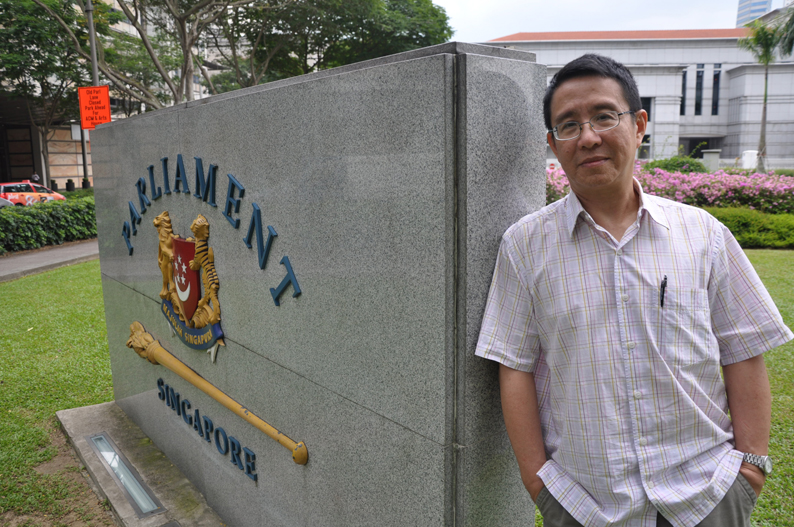
    Well, Tan Kin Lian’s Singapore General Election Portal decided to respect the new restriction and ceased posting at 11pm the night before Cooling Off Day. Yawning Bread’s Alex Au (below) ignored the regulation and published a 1,600-word review and commentary on Cooling Off Day.
    YB-DSC_0004

    When I interviewed him before the GE, Andrew Loh said that he was inclined to challenge the restriction. “On principle, it’s ridiculous that there are media that are not subject to the rule while ordinary citizens are not allowed to speak up,” he told me. Loh managed the GE coverage for TOC and, sure enough, posted one article on Cooling Off Day and another on Polling Day.

    The behaviour of bloggers in 2011 was thus a continuation of what we saw in 2006, when there was some confusion about what exactly was permissible. Most simply ignored what they considered to be unreasonable restrictions and just went ahead. Once again we’ve seen that blanket bans are simply not going to be universally respected.

    More specific legislation such as defamation and contempt of court are a different matter. Those who operate openly and within Singapore’s jurisdiction do not take chances with these laws. The Online Citizen told me that it did receive a lawyer’s letter regarding a posting that defamed a PAP politician. The posting was put up by a reader in the comments section under one of its articles and was duly removed by TOC editors.

    The same comment was apparently circulating in Temasek Review, which is of course harder for regulators or lawyers to reach.

    This raises the question of why more blogs don’t simply go underground the way Temasek Review has. Note that when Sintercom was asked to register before the 2001 election, it chose to wind up and resurfaced overseas. When TOC was asked to register and gazetted as a political association, it responded by throwing a party, to signal to its supporters that it is hear to stay.

    The contrast between the strategies of Temasek Review and The Online Citizen is illuminating. On the one hand, TR’s underground guerilla approach to journalism made it Singapore’s top rumour site. Many seem to value its whistleblower function and are willing to tolerate the fact that it is wrong most of the time if it is right once in a while.

    TOC is more exposed to political risk and has to be more careful. Arguably, however, this limitation is more than outweighed by the benefits of being able to network face to face in Singapore.

    As long as citizen journalism remains a largely voluntaristic enterprise, it will be highly dependent on relationships of trust, and TOC has clearly been able to leverage on that. It has been moderately successful in getting donations and was very effective in drawing volunteers. They have also been able to work with civil society organisations and are playing a leading role in progressive movements.

    The clearest sign of the benefits of TOC’s transparency was its success in organising the pre-election inter-party forum last December, followed by the presidential debate in August.

    Fairness and balance

    Second, how do the blogs interpret the norms of fairness and balance in journalism?

    These principles have been central to professional journalism for around a century. However, their centrality to journalism’s mission has always been somewhat problematic and contested, as there is an even longer tradition of partisan journalism, and questions remain about how balance and independence are to be interpreted.

    The most striking characteristic of Singapore’s political blogs is that they are all on the same side of the ideological fence: all identify with the opposition underdogs and try to level the political playing field.

    “The mainstream media covers more establishment views. We try to balance it with other views,” said SGEP owner Tan Kin Lian (below). Added Gerald Ho, who edited the site day to day, “The field is lopsided. Even if we don’t put out the mainstream media view, you’ll still get to know it.”

    Such blogs are not necessarily pro-opposition by policy, but believe that the best way they can contribute is to provide a platform for such voices that are under-served by mainstream media. Said Andrew Loh, “We are not supportive of any opposition party, but we recognise that they don’t have a platform.”

    These websites do not believe it is their responsibility to aim for balance within their websites, claiming instead to provide a counterweight on an already unbalanced media landscape.

    “We have never claimed to be ‘balanced’,” said Andrew Loh. Joshua Chiang, who was TOC editor shortly before the election, added, “We are the balance.”

    Thus, critics who accuse the blogs of being unfair or one-sided are right, but should realise that their criticism is missing the point and is unlikely to cause bloggers sleepless nights. Their goal is a more balanced media system, not necessarily more balance within their individual blogs.

    Public opinion

    Third, where do they situate themselves in relation to their audience?

    Most journalists will say that their first duty is to the public. And most blogs brand themselves as representing a more authentic discourse than the mainstream media. So one might expect that these political sites position themselves firmly on the side of public opinion.

    While this is probably true of Temasek Review, the editors of all the other sites surprisingly expressed some disappointment with the public.

    They were not comfortable with simply following public opinion because they did not trust prevailing popular sentiments on many of the issues they care about.

    Alex Au put it most candidly: “I’m engaging in a war with my readers. It annoys me to no end.”

    He and other like-minded bloggers, especially in TOC, know from experience that some of the progressive causes that are dear to their hearts – such as gay rights, foreign worker rights and the dealth penality – are not popular with the masses.

    Therefore, the task of winning votes for the opposition was less important than raising the level of political maturity of Singaporeans, including opposition supporters.

    Temasek Review on most days may have more traffic than TOC, Yawning Bread and SGEP, but the latter sites do not think of themselves as taking part in a popularity contest. They of course tracked their page views and unique visitors – and drew immense satisfaction from rising numbers – but they were reluctant to let this dictate their sense of what is important.

    These bloggers I interviewed see themselves in a long-term struggle, in which the quality of the debate matters as much as their outreach or the election outcome. As Gerald Ho put it, “We don’t bother about numbers. Even if it’s just 1%, let’s make that 1% secure.”

    Joshua Chiang (below) said, “It’s pointless to change the government if the people are still the same. It’s not our agenda to change the government. It’s to inform and educate people.”

    Tan Kin Lian, founder of Singapore GE Portal

    The attitude of these editors to mass opinion is most apparent in the policies on reader comments. At one extreme, Temasek Review practices no moderation, while at the other, Alex Au is resolute in his policy of pre-moderation. He is unapologetically elitist as far as the standard of writing goes: comments are only approved if they meet his benchmarks. “I want to raise the IQ level of political discourse,” he said.

    Such diversity in approaches to managing blogs should not be surprising –the distinction between mass market, popular tabloids and the elite press was found in journalism long before the arrival of new media.

    This and the other editorial choices that I have outlined are ultimately dilemmas with no obvious answers. They involve trade-offs, reflecting unresolved tensions in the democratic role of journalism. We can be sure that alternative media will continue to evolve in Singapore, and we can be equally sure that they will not converge around a set of common norms. We can expect them to continue to be fragmented and diverse in their interpretations of their journalistic mission.

  • Covering a changing political landscape: the challenge for national media

    by

    CHERIAN GEORGE

    September 13th, 2011

    pe-toa-payoh-DSC_00111

    This article is based on a talk given at a Singapore Press Club forum on Reporting the 2011 Elections on 13 September 2011 at the SPH Auditorium.

    This year’s elections did not fundamentally alter Singapore’s power structure, but they have transformed the political landscape that the powerful must traverse. The terrain has become more competitive and less predictable.

    This affects our national media in two ways. The good news for professional journalists is that the Singapore story is becoming a lot more interesting. We know that more voices make for a better story and there are certainly more voices to report now.

    Even if not all those voices speak sense, an active conversation is more engaging than a monologue and ultimately more likely to enlighten, especially when facilitated by media that feed that conversation with facts, context, reasoned analysis and thought-provoking commentary. After the Presidential Election, for example, it was widely recognised that the debate had been educational for Singapore’s polity. A more open and inclusive dialogue is good for democracy and good for journalism.

    The second way in which the news media are affected presents more of a challenge. The terrain has changed not just for newsmakers but also for the press as an establishment institution.

    For the national media, it’s not just a question of keeping eyes and ears open to report the changes around them. They also have to decide where to stand and when to move, if they want to play their role effectively without being either swept aside by the tide of change, or run down by conservatives who want to blame the media for their setbacks.

    What won’t change anytime soon is the core principle of Singapore’s media system, that freedom of the press must be subordinate to the needs of governance. Singapore’s licensed news organisations have no choice but to work within these bounds.

    But it’s important to note that the official justification for media subordination was never that leaders have a mandate from heaven or a god-given right to rule. Ever since the principle was articulated by Lee Kuan Yew in 1971, it’s been justified in democratic terms: it is the “purpose of an elected government” that must have primacy over press freedom. Our government is the embodiment of people’s will whereas nobody voted for the press, the theory goes.

    Logically, this principle requires the media to be independent during elections. Since the press is one of the main avenues for political parties to present themselves to voters and for voters to learn about their choices, independent and well functioning media are essential for free and fair elections.

    Therefore, government control of the press, by its own argument, cannot be unlimited. To the extent that government control interferes with the role of the press in connecting candidates to voters, the democratic justification for that control is weakened. True, nobody elected the press, but if this important democratic institution is seriously undermined, the government can’t claim to be freely and fairly elected either.

    This is why even Singaporeans who are not schooled in democratic theory and who show no great appetite for removing the PAP from power are nevertheless sensitive about any unfairness they perceive in election coverage by national newspapers and broadcasters.

    But what does it mean to be fair and balanced in the context of what is, in effect, a dominant party state?

    Does scrupulous fairness demand equal weight for every party, such that the Singapore Democratic Alliance, one of seven groups contesting this year’s GE, gets one-seventh of space and airtime?

    Or perhaps we should base coverage on the number of seats contested. In which case, in the run-up to the Presidential Election, should the media have devoted as much attention to Ooi Boon Ewe and Andrew Kuan as they did to the Tan Quartet?

    Or what if Tan Lead Shake’s Democratic Progressive Party has enough candidates with enough money to contest every seat in the 2016 election. Should the press then give it equal coverage to the PAP – and more than it gives to the Workers’ Party and SDP – just because the DPP has found 87 men and women who are not below 21, not undischarged bankrupts, not declared of unsound mind and not ex-convicts?

    The Elections Department is constitutionally required to preserve the fiction that all candidates are equal. But should the press do so? We would expect journalists to exercise judgment and not be mindlessly balanced.

    Accordingly, the free press in Britain sees no obligation to give equal coverage to the Monster Raving Loony Party, for example. The BBC is mandated to be impartial, but its editorial guidelines say that “impartiality does not necessarily require the range of perspectives or opinions to be covered in equal proportions”.

    “Instead, we should seek to achieve ‘due weight’.  For example, minority views should not necessarily be given equal weight to the prevailing consensus,” it says, adding, “Nevertheless, the omission of an important perspective, in a particular context, may jeopardise perceptions of the BBC’s impartiality.”

    In other words, the media should exercise certain qualitative judgments to provide a diversity of opinion but also ensure that its limited time and space – and more importantly the audience’s limited attention – is not wasted on loony and fringe views.

    The press in free societies also gives less attention to politicians who are unlikely to make a practical difference to people’s lives – even if they have something important to say.

    Green Parties have an important message for the electorate, but the New York Times is less likely to give coverage to the American Green Party than Die Welt gives to the German Green Party, simply because the latter is more likely to be part of a ruling coalition in Germany’s proportional representation system.

    Similarly, the American press treats its Presidential Election as a two-horse race even though Ralph Nader has been contested the last five elections. Conversely, in Britain, policy alternatives mooted by the Shadow Chancellor are given significant coverage because there is a realistic chance in Britain’s two-and-a-half party system that the Shadow Chancellor in this term of Parliament will be the Chancellor in the next.

    In Singapore, no matter how credible the blueprints of the opposition are, we should not be surprised if journalists exercising independent news judgment conclude that any statement from Finance Minister Tharman Shanmugaratnam is more newsworthy than Tan Jee Say’s alternative economic plan. Tan may move hearts, but Tharman moves markets and affects the economic decisions that households and firms make tomorrow.

    Mainstream journalism aims to report the news as it is, not the news as it should be.

    But what are the implications of this fairly universal approach to journalism in a country with a hegemonic, dominant party? By treating alternatives as less newsworthy because there is so little chance of these alternatives becoming reality, is there not a danger of journalism being biased for the status quo and contributing to a self-fulfilling prophecy?

    Absolutely. This is why, as a vital supplement to mainstream journalism, we should value alternative media, including partisan journalism, where what is today’s fringe is given the chance to flower into tomorrow’s mainstream.

    The vibrant alternative online space does not, however, absolve mainstream journalism of grappling seriously with the dilemma of how the establishment press can remain relevant a time of extraordinary change in Singapore’s political culture.

    Journalists will somehow have to keep their feet on the ground and recognise the reality that the PAP government remains the most newsworthy newsmaker for at least another 10 years, while at the same time facilitating discussion of the range of alternative ideas and visions being explored outside of Cabinet – on the fringes of the PAP, within the Opposition, in universities, online forums and in civil society.

    The leading opposition parties in Singapore are, right now, neither as inconsequential as the Monster Raving Loony Party nor as significant as the opposition Labour Party in the UK. They fall somewhere in between. Which end of the spectrum they are closer to, and how much weight they are due, is one of the most important strategic assessments that the national media will have to make in the coming years. Get it wrong and Singapore’s press will – not for the first time – find itself on the wrong side of history.

    Whatever principles and strategies the media settle on to play their role in this evolving landscape, I would urge them to be transparent about it and to be ready to account for it. Gone are the days when the media could simply brush aside critics with stock phrases like “we stand by our coverage” when criticised. The public now demands greater accountability from all establishment institutions, including the press.

    I am hopeful that this is in journalism’s interest: in many cases, more transparency and more communication about why the media do what they do will not only push journalists to improve their quality, but will also earn respect, however grudging, from fair-minded Singaporeans.

  • Media censorship: us versus them?

    by

    CHERIAN GEORGE

    September 11th, 2011

    Singapore was presented with a double bill feature on censorship this month. There was the Wikileaked diplomatic cable reporting that young reporters felt frustrated by newsroom gatekeepers. And there was Tan Tarn How’s play, Fear Of Writing, staged by TheatreWorks. Between the two, I found Tan’s work of fiction truer and more illuminating.

    Although many were gleefully scandalised by the leaked cable, it’s hard to figure out what the fuss was about. I guess the overreaction is partly down to the fact that most people are in workplaces where you can’t criticise your bosses and get away with it; they are not familiar with newsroom culture, where employees speak their mind.

    Perhaps it’s also because some Singaporeans haven’t been paying attention for the last 40 years. That’s how long it has been official and explicit government policy that press freedom in Singapore must be subordinate to the government’s priorities. Under this system – as one of my editors put it simply – news media have to balance political as well as professional journalistic judgments.

    So the only choice for a Singapore newspaper is who must carry out that balancing act, not whether it must be done.

    When I was at ST in the 1990s, the working arrangement was clear. Reporters and columnists like me were to focus on being good journalists, write for our readers, and not try to second-guess what would make the government happy. Instead, our editors would shoulder the burden of making those difficult political judgment calls.

    There were of course times when I thought my editors were too conservative in those judgments, and I regularly joined my peers in that universal pastime of griping about our bosses. The public would routinely pillory the press (“Us Singaporeans love democracy, them journalists don’t.”) and within the press we minions would absolve ourselves of blame by passing the buck (“Us reporters are fine, them editors are the problem.”).

    In more honest moments, though, I admitted to myself that my editors were actually sparing me from the thankless task of appeasing an impossible-to-please government. Yes, to keep within OB markers, they would repair some of my stories. But at least they never tried to repair me. In 10 years at SPH, despite several run-ins with government, not once did an editor tell me that I should take up less of his time and energy than I did.

    The Wikileaked cable, if it is an accurate report of what the journalists intimated, is perhaps a healthy sign that that old division of labour still persists. Reporters report, columnists opine – and editors edit, trying to find that elusive balance between serving a demanding audience and keeping an even more demanding government at bay.

    Given that the PAP government is not going to revise its philosophy on managing the media, the only other politically viable alternative formula would be for the entire newsroom to internalise the PAP’s thinking. That would be the only way to get rid of the frustration in the newsroom, but it would also kill what’s left of journalism.

    On my last day at ST, I told my editor that people would probably speculate that I was leaving because Singapore journalism was too controlled. I wanted him to hear it from me that this was not the case: I was leaving for personal reasons.

    I don’t know if this message registered with my editor, or if he cared. It didn’t matter to me either way, because I brought this up not for his sake but for mine: I felt it was important to be honest with myself and not indulge in a self-constructed myth of martyrdom. I had not liked, but accepted, that the controls were part of the territory: the downside that comes with the privilege of being paid to do something one loves, and in the national newspaper to boot.

    Twelve years on, I’ve tried to capture the nuances and contradictions of the Singapore press system in an academic book that I hope will be published soon. But I have to say that a book that tries to stick to facts and reasoned argument cannot capture the true essence of censorship and self-censorship in a society.

    This is why I think Tan Tarn How’s Fear Of Writing is such an important contribution. He is uncompromisingly critical of government mind-control but also, and more importantly, demands that we take a collective, unflinching gaze into the mirror. We have lost the keys to the empty spaces in our own hearts, he charges.

    It’s unlikely that any other writer could have pulled off this masterly work. Tan has had a uniquely comprehensive tour of duty through the Singapore media: he has been as a reporter, columnist, foreign correspondent and editor with the Straits Times, a scriptwriter for national television, an award-winning playwright, a leading activist with the ArtsEngage movement for artistic freedom, and a media researcher. He is intimately familiar with ways of thinking about media and politics, and how Singaporeans both resist and rationalise the status quo.

    This year’s other big political play, Cooling Off Day by Alfian Saat, was more entertaining and more marketable, milking the immediate post-GE mood. The Wikileaks on the press were good for gossip. But it is Tan’s play that will pass the test of time. He doesn’t cop out by framing the political as us versus them. Ultimately, it is always and only about us.

    Originally posted at journalism.sg

  • Co-founder of The Online Citizen launches new alternative site

    September 1st, 2011

    Andrew Loh, one of the editors of The Online Citizen until just after May’s General Election, has launched a new socio-political website, Public House. The site doesn’t have an “About Us” page yet, but Loh is understood to be one of the site’s founders.

    Loh, who helped to create TOC in 2006, led the site’s GE coverage. He left shortly after. Since then, he has been writing regularly for Yahoo! News. He is known for his passionate writing on social issues and progressive causes. His latest venture continues in that mould: he has an article appealing to new President Tony Tan to save Malaysian death row inmate Yong Vui Kong.

    An article by Eric Tan (presumably the former Workers’ Party CEC member) calls on the transport minister to consider opposition parties’ ideas for improving Singapore’s public transport system.

    It is not yet clear how, if at all, Public House plans to distinguish itself from the more established TOC. But given Loh’s experience in running an alternative group blog, it’s safe to say that Public House is one work in progress that’s worth watching.

  • MediaCorp’s election coverage let off with a light touch

    by

    CHERIAN GEORGE

    September 8th, 2011

    MediaCorp’s controversial television coverage of this year’s general election has been given the gentlest of feedback by a government-appointed consultative panel, the Programme Advisory Committee for English Programmes (PACE).

    MediaCorp had been roundly criticised by the public for excluding the Singapore Democratic Party from a pre-election studio forum that involved the PAP and other opposition parties. Then, on election night, viewers were astounded by MediaCorp’s refusal to report the latest intelligence on the counting, even when confirmed by the candidates and carried by the Straits Times’ digital outlets. Wits started calling CNA “Channel NewsAfter”.

    PACE said in its report:

    “In terms of the coverage of breaking news, PACE commended MediaCorp for its extensive coverage of the General Election held in May 2011 and its round-the-clock updates on the campaign developments. The Committee also observed the effort put in by MediaCorp to provide balanced coverage of the 2011 General Election, which was especially useful with so many political parties contesting. However, the Committee commented that the presentation of election-related news could have been tightened and delivered more smoothly and professionally. Members also commented that while they understood the need for CNA to ensure that the results were verified before they were announced on air, the delay between announcements on other new media platforms such as Facebook and Twitter, and the updates on CNA did not reflect well on the latter as a national news channel.”

    PACE was set up in 1995 to provide feedback on the range and quality of English programming. Members are drawn from a cross section of society, including the arts, sports, academia, nongovernmental organisations and the private sector.

    MediaCorp’s reply, included in an annex to the report, said:

    “CNA noted the comments that the presentation of election-related news could be tightened and delivered in a more professional manner. The channel explained that while viewers have a right to expect more out of presenters for such a high profile programme, the demands from a programme providing “live” coverage of the election results are greater than that of other programmes. The presenters had multiple duties during the programme, including rolling out information as it came in, analysing and interpreting results on the fly while liaising with several key production team members in the control room.

    “CNA added that a key element in the coverage was the lack of predictability, not just of when and what results might be announced, but also the follow-up production treatment of the information, for example, the team had to decide whether the show would be crossing to on-site reporters to field reactions or to another location for other developments. In addition, there was also a need to be mindful of the choice of words, facial expressions and the ideas to be conveyed to viewers.

    “With regard to the “delay between announcements on other new media platforms”, CNA explained that MediaCorp had taken the editorial stand to go with only the official results and Vote 2011 Singapore therefore announced only results announced by the Returning Officer.”

    MediaCorp’s defence of its policy against reporting unconfirmed results remains puzzling. While responsible broadcasters should certainly avoid the kind of fiasco that American networks caused in the 2000 Presidential Election – when they prematurely declared the election over based on inaccurate exit polls –  there are well established ways for news channels to share intelligence with their viewers and listeners, in context and without misleading them.

    The BBC, for example, sometimes prefaces news breaks with such lines as “Reuters is reporting that…”, concluding with “We haven’t been able to independently verify this report.” This indicates to the audience that the news is coming from an ordinarily credible source, but that the BBC is not ready to state it as fact.

    Of course, such a policy requires the broadcaster to be willing to attribute the news break to a competing news organisation. Broadcasters that put their audiences first are willing to do so. The main mental block for MediaCorp on election night was probably not the risk of misleading its audience, but its reluctance to attribute unconfirmed reports to the Straits Times (all of which turned out to be accurate). For several years, Caldecott Hill’s false pride has made MediaCorp allergic to ever mentioning SPH outlets as a news source, despite the latter accounting for the bulk of Singapore’s journalists.

  • Tan Cheng Bock campaign the most net-savvy?

    August 25th, 2011

    An analysis by a public relations consultancy suggests that the Tan Cheng Bock campaign has been the most digitally savvy in the 2011 Presidential Election race, slightly ahead of Tan Jee Say. See its report here.

    However, even if Tan Cheng Bock is campaigning the hardest online, it appears to be Tan Jee Say who appeals most to Singapore’s more critical netizens. Temasek Review endorsed him early in the campaign. Now, the godfather of Singapore’s socio-political bloggers, Alex Au, has come out in support of the former civil servant:

    “He may be a johnny-come-lately, but he really does hold certain deep convictions: about social equity, about the whole purpose of economic development, about the moral responsibility to lead a people in a certain direction that is more constructive than self-destructive, about the importance of respect for human rights and human life. When he speaks about conscience, he means it,” writes Au in his Yawning Bread blog.

    Ng E-Jay of SGPolitics has also endorsed Tan Jee Say: “Mr Tan Jee Say’s political ideals will serve Singapore well. He has a heart for the people. He represents change and progress, and the empowerment of the people.”

    The Online Citizen has not endorsed any candidate. One of its leading lights, Leong Sze Hian, is helping Tan Kin Lian. However, TOC’s readers are most enamoured of Tan Jee Say. Of more than 2,200 people who took part in a TOC survey, Tan Jee Say polled more support than the other three candidates combined.

    So has Tony Tan’s groundbreaking attempt to reach out to bloggers fallen flat? Well, despite the risk of alienating TOC’s base, its editor Ravi Philemon has declared that Tony Tan “may not be half as bad as most of the online world makes him out to be”. In the solidly anti-government online environment, this is about the highest praise that any establishment figure could hope for.

  • PM’s National Day Rally calls for more rational online spaces

    by

    CHERIAN GEORGE

    August 15th, 2011

    Lee Hsien Loong has called for online spaces where Singaporeans and the government can engage in more balanced, open and rational debate on issues. In the Prime Minister’s National Day Rally speech, he noted the prevalence of “cowboy towns” in cyberspace, circulating “ridiculous untruths”.

    “But there must be places… where people recognise … are reliable, where you can have a open debate, where different views are expressed, but it’s balanced, and if you go there you know that, well, to start off with you can assume that it will make some sense,” he said.

    He did not say how such spaces could form, or whether the government intended to create or facilitate such sites. Until recently, it has been pushing its official feedback portal, REACH, as the best place for citizens to engage the government. Last night, however, Lee made no mention of REACH, perhaps acknowledging that no official site can counteract the anti-government storm in cyberspace.

    Mainstream news organisations should have a better chance at creating neutral, moderated forums. They start off with significant advantages, including the largest audience base and the resources to manage such sites professionally. But their success at creating credible online discussion platforms will depend on how much freedom they are granted by the government. Netizens are not likely to forget how Today axed Mr Brown as a columnist after the government voiced its displeasure at one of his pieces.

    The most effective solution would be bottom-up projects, created independently by established bloggers with street-cred. Could Singapore’s socio-political bloggers, for so long seen as a thorn in the government’s side, be the answer to the PM’s prayers?

    The idea is not as far-fetched as it may seem. Privately, several independent bloggers have voiced unease at the ugly mob behaviour that swamped cyberspace during the general election. The experience has sparked internal discussions about how best to manage readers’ comments, in particular, since that’s where irrationality has run riot.

    There are also established bloggers who are no longer content to converse only among the converted. They want to widen the online debate so that it does not attract only anti-government voices. (I’ve made a similar point in an earlier piece.)

    Don’t be surprised, therefore, if you see some of Singapore’s influential independent bloggers creating new platforms for national debate in the coming months, either by developing new websites or by reorienting their existing ones.

    But even if they build them, will government sympathisers and spokesmen come? One thing that will have to change is the PAP’s politics of intolerance, which has contributed to the polarisation of debate in Singapore. Its “with-us-or-against-us” philosophy has kept establishment types away from pluralistic spaces. (The classic illustration was the PAP’s refusal to take part in The Online Citizen’s multi-party forum before the general election.)

    For example, the typical establishment individual would probably refuse to contribute an article to an independent medium that also carries opposition party voices. In Singapore’s political culture, he would assume that any such medium would be blacklisted by people at the top, and that anyone who participates risks being tainted by association. Or, perhaps it is simply that most establishment spokesmen lack the confidence to engage in debate on a truly level playing field.

    So allergic has the establishment been to bloggers that, as recently as 2009, public universities were compelled to distance themselves from a workshop organised to promote responsible blogging, originally planned with their support.

    Thus, PM Lee’s wish for open, balanced and reasonable online spaces requires a cultural change on the part of the establishment as well. The government will need to find within itself the capacity to respect the role of independent websites as convenors of Singapore’s online politics.

    Unedited transcript from PM’s National Day Rally speech:

    Engagement online, I think we need to learn to do it better. It’s not easy to do, but it’s important because the digital media is continuing to grow in importance. Five years ago, Youtube was insignificant. Facebook didn’t exist. All you had was Mr Brown. Today, Mr Brown has a lot of competition. We in government have a lot of competition, and we have to be able to operate in that space.

    It’s not easy because it’s anonymous, it’s chaotic, it’s unfiltered, unmoderated, and so the medium lends itself to many negative views and ridiculous untruths. Any number of them. I won’t repeat one because otherwise you may misunderstand and think it’s true. But if you just open at random you will see them.

    And we have to do our best to counter this, to prevent untruths from circulating and being repeated 5, 10, 20 times, from leading people astray, and after a while, you’ve heard it so often, you can’t remember where you saw it, but it must be true; but it’s not.

    So our ministers have to get better at this and you know many ministers are blogging now, Facebook; and they have to communicate in a different medium, and convey nuance poiicy, intentions, explanations, in a more personal way, engaging people. But it’s not just the ministers, the government as a whole has to be more active and adept, engaging Singaporeans online.

    We can’t be in every corner of cyberspace because there are a lot of cowboy towns out there. But there must be places which grow where people recognise that these are places which are reliable, where you can have a open debate, where different views are expressed, but it’s balanced, and if you go there you know that, well, to start off with you can assume that it will make some sense. Whether it’s right or wrong, we have to consider but it’s not rubbish.

    So we’ve got to get there, be in cyberspace and use it constructively to explain issues, to shape opinions, to rally support, and to make Singapore work better.

  • Legal debate: How sensitive should the Courts be about contempt?

    August 12th, 2011

    The law on contempt of court has been clarified by the Court of Appeal in the recent Alan Shadrake case, according to the July 2011 issue of Inter Se, a publication of the Singapore Academy of Law. One issue that the court discussed is what test to apply when deciding whether there has been contempt.

    The most liberal jurisdictions, such as the United States, use the “clear and present danger” test, which outlaws only the most extreme speech. At the other extreme, judges could apply the “inherent tendency” test, finding someone in contempt even when there is only a remote, fanciful possibility that his words may undermine public confidence in the administration of justice. Until recently, the “inherent tendency” test was used in Singapore.

    Writing in Inter Se, justice law clerks Justin Yeo and Calvin Liang note that in the Shadrake case, the Court of Appeal avoided either extreme and instead went for the “real risk” test, whereby “the court concerned must make an objective decision as to whether or not that particular statement would undermine public confidence in the administration of justice, as assessed by the effect of the impugned statement on the average reasonable person.”

    Shadrake was judged to have scandalised the court in his book, Once a Jolly Hangman. Although the Court of Appeal dismissed his appeal, it differed from some of the High Court’s findings and clarified the “real risk” test.

    Contempt of court is a common law offence, but it is currently being drafted into the statute books. Professor Kevin Tan, interviewed by Inter Se, said that legislation is “a good way to go” and hoped that a “real likelihood” test would be inserted into the Bill: “In other words, the words uttered or written should have a real likelihood of bringing the courts into disrepute or challenging its independence.”

    Contempt of court, together with defamation, are the laws that most frequently ensnare the media and other commentators in Singapore.