Year: 2011

  • Seng Han Thong, alternative media and choosing sides

    by

    CHERIAN GEORGE

    December 24th, 2011

    The Seng Han Thong controversy has produced a flash flood of protest in the midst of a climate already fouled by the SMRT debacle. Such was the interest in the episode that my instant posting on Journalism.SG made it the site’s busiest day ever (which admittedly isn’t saying much – Journalism.SG isn’t exactly on the average netizens’ must-read list). Many readers disagreed with what I had to say. Some of that disagreement is fundamental, and in those cases I don’t expect any meeting of minds. For other readers, though, let me address three separate issues in what, I hope, is my final contribution to this particular debate.

    What verdict on Seng?

    The most important question is, of course, what to make of Seng Han Thong and his words. His intentions were not 100 per cent clear, so individual citizens will have to make up their own minds. Like others who have grown up as a minority in Singapore, I have developed my own personal antenna for detecting prejudice and racism. It’s been tuned by first-hand experience and the experiences of those close to me, plus lots of listening and reading. Lee Kuan Yew’s statements about race and religion through the decades have a special place in my heart – they never let me forget that ethnic stereotyping runs deep within the establishment. Thus, when I read the headline and report in TOC about what Seng said, my antenna triggered a code-red. I was ready to be angry and to classify this as a case of outright racism. But after watching the video, I was not so sure. Definitely another case of a member of the PAP putting his foot in his mouth. But racism? It now registers an “orange” at worst on my personal meter.

    Others will have their own antennae, each tuned differently. The range of views that have been expressed shows not only different interpretations of Seng’s state of mind, but also different degrees of sensitivity towards the offence. Government leaders will have to assess the mood and act accordingly. If they get it wrong, they will pay the price. Looking at what’s at stake, I suspect that the Prime Minister will tick off Seng publicly. Will the PM go further? It is not the PAP’s style to mete out swift punishment in response to public opinion. But there’s supposedly a new normal in town and there is a first time for everything.

    TOC’s report

    A less important topic – but which was the main focus of my postings, since Journalism.SG is devoted to journalism-related issues – is The Online Citizen’s reporting of the video. Its original posting had a headline and two sentences. The headline and one of the two sentences were misleading, in a way that misrepresented what Seng said. TOC’s response to me hasn’t changed my assessment of what they did. The fact that TOC supplied the whole video for viewers to hear the MP in his own words was considerate, but this does not make TOC’s own summary of what Seng said any less incorrect.

    Am I thus imposing mainstream media standards on alternative media, as some suggest? In my writing and speaking on alternative media (one of my main areas of study), I’ve consistently argued that they have a different democratic role from the mainstream, and should operate accordingly. They need not be “balanced” or “objective”, and indeed often serve democracy best when they are driven by causes. I’ve tried to explain to doubters the value of having some journalists who are simultaneously activists, thus challenging the professional norm of detached disinterestedness. When a society includes such morally-engaged journalism as part of its media mix, there’s a higher chance of important issues being surfaced, and of marginalised interests being represented. I’ve regularly cited TOC, together with Yawning Bread, as the leading practitioners of such activist-journalism in Singapore.

    However, this freedom from the yoke of “balance” and “objectivity” doesn’t have to mean trampling over basic factual accuracy. TOC could have highlighted the Seng fiasco as an important public issue without misreporting what he actually said. In many cases, a certain laxity is understandable, given TOC’s meagre resources (for which I have advised critics that the best solution is either to donate to them or their own preferred citizen journalism venture). But I think the stakes are higher when it comes to reporting offence to racial and religious sensibilities. For alternative media that wish to make a difference in this area, which I hope TOC does, it is wiser to be extra scrupulous in order to maintain one’s credibility.

    Letting down the side?

    A third concern has been raised by some commentators who seem to believe that I have betrayed “the side” by criticising TOC’s coverage and giving the benefit of the doubt to Seng. This is an interesting argument that reflects the spirit of the times. Singaporeans have different modes of response to PAP domination. The most common coping mechanism is to tune out, allowing oneself to be depoliticised. As for those who remain bothered by the structure of politics here, one common reaction is to close ranks against the ruling party, and to give the PAP a taste of its own medicine. Basically, turn politics into a streetfight – you bully us in the real world, we’ll show you who’s boss in cyberspace. The student of realpolitik in me tells me that this may indeed be the only language that the PAP ultimately respects. So, I can see the logic in the position of those who want to make life as uncomfortable as possible for the PAP.

    However, I choose to respond in a different way. Not because I think my way will be more effective in changing PAP politicians’ minds, but because I would not like the person I would become, if I merely mirrored them. I prefer to resist the PAP traits that turned me off in the first place. For example, I know too well the harm caused by the PAP’s intolerance towards dissenting opinions. So I try to cultivate tolerance, starting with myself. I don’t like the PAP’s tendency to distrust Singaporeans, suspecting the worst in them. So I want to be fair to people and not prejudge them. I’ve observed the PAP’s partisan stance, that if you are not for us you are against us. So I try not to think in us-versus-them terms. I’ve felt what it’s like when one is labelled by the PAP, and when spineless acolytes treat one according to that label. So, I try to avoid labelling people when criticising their actions. I know the PAP’s ability to twist opponents’ words to score political points. So I treasure truthfulness in politics, and – since I am not seeking votes or eyeballs – would rather lose a battle of words than push an untruth.

    As I’ve said, the main reason why I choose to respond in this manner is personal. I’d like to adopt habits that I respect in other people, not mimic those that I don’t. There are few things more precious to me than the freedom to explore contrarian views, and I don’t think the reward for resisting PAP conformity should be anti-PAP conformity. If this lets down “the side”, so be it. Maybe I’m selfish that way. But perhaps there is some wider benefit in this approach to politics. If the opponents of the PAP ever succeed in removing it from power, it would be nice if the underlying political culture changes as well. It shouldn’t be an Animal-Farm-like transition, where we look at the old and then the new, and can’t tell them apart.

  • We need anti-racism watchdogs, but they should protect their credibility

    by

    CHERIAN GEORGE

    December 23rd, 2011

    Singapore would have been a better place in March 1992 had The Online Citizen and its followers been around. That month, PAP backbencher Choo Wee Khiang stood up in Parliament to complain that there were too many foreign workers congregating at Serangoon Road on weekends. He said, in the nation’s highest forum, that he once visited Little India and found it in complete darkness “not because there was no light, but because there were too many Indians around there”.

    Opposition MP Chiam See Tong shot to his feet to object. Choo dismissed Chiam’s rebuke, clarifying that he was referring to foreign Indians, not local Indians – digging himself deeper into a hole. Later, presumably after he had received some counselling from his PAP bosses, Choo apologised.

    The Straits Times carried two Forum letters, one from a Chinese and the other from an Indian, expressing outrage at Choo’s comments and calling for his removal from Parliament. But PM Goh Chok Tong said that Choo had apologised, that he didn’t really mean harm, and that the matter should be laid to rest since people made mistakes from time to time.

    This resolution left many Singaporeans unsatisfied and worried. But without an outlet for their legitimate grievances, the matter was indeed laid to rest. Alternative online media, if they had existed then, would have kept the issue alive, making it far more difficult for the government to sweep it under the carpet. Singaporeans usually count on the government to police the country’s racial and religious harmony, but the Choo incident shows that it can sometimes be too charitable to its own.

    I raise this issue to illustrate that there have been, and probably will continue to be, cases where Singapore requires vigorous independent whistle-blowing against racism.

    But to do this effectively, the watchdogs must, above all, protect their credibility. And this is the problem I had with The Online Citizen’s treatment of the current Seng Han Thong affair. After reading my blog yesterday, some readers wondered if I was saying that TOC should not have highlighted the incident. I am glad TOC did. But, to protect its credibility (and to be fair to Seng), TOC should have stuck to the facts – an MP and union leader making extremely ill-judged remarks, which he attributed to an SMRT rep.

    This is what Halimah Yaacob did in her timely response, without being any less hard-hitting.

    When we cry “racism” and our facts are not verifiable, it undermines the anti-racism cause. It makes it too easy for unconscious racists and outright bigots to claim that the commentators have some other agenda. In this case, many Singaporeans will come away from TOC’s loose reporting concluding that its editors were using the episode to further its anti-PAP agenda. This then becomes an excuse for sweeping the racism issue under the carpet.

    Opinion shapers should reserve their racism allegations for clear-cut cases: where the perpetrator has nowhere to hide. The Choo Wee Khiang incident, for example. Any way you look it at it, it was racist.

    In contrast, the Seng Han Thong case is murky. The full account (see Yawning Bread for a good summary) shows that he blundered, but does not show conclusively that he was racist. To come to such a conclusion requires us to look into his heart, and we are better off leaving such soul-searching to the individual concerned and his maker.

    > FINAL WORDS

  • There’s enough real racism in Singapore – TOC needn’t cry wolf

    by

    CHERIAN GEORGE

    December 22nd, 2011

    Reading The Online Citizen’s sensational report on what a PAP MP said about Malay and Indian MRT drivers and then watching the video itself, I wondered how the website’s reporters might have covered Barack Obama’s landmark speech after winning the Democratic Party nomination in 2008.

    TOC might have said something like this:

    Barack Obama has told Americans that “our sights were set too high” and that “this country was too divided; too disillusioned to ever come together around a common purpose”.

    If you think this pessimistic prognosis from a president famous for giving people hope sounds suspect, you’re right. Obama did say the words above, but they are taken slightly out of context. He actually said, “They said our sights were set too high. They said this country was too divided; too disillusioned to ever come together around a common purpose.”

    Omitting to mention that the speaker you’re quoting is quoting someone else can be a little misleading. That didn’t stop TOC, whose report on a TV forum is headlined, “MP Seng Han Thong: SMRT’s unpreparedness also due to Malay and Indian staffs English language inefficiency”.

    TOC’s reporter goes on to say, “He said that because some staffs are “Malay(s), they are Indians, they cannot converse in English good, well enough”.”

    In the 13-odd hours since the article went up, more than 200 readers have posted comments, practically all of them outraged by the MP’s remarks as reported by TOC.

    But what Seng actually said was, “And I notice that the PR mentioned that some of the staff, because they are Malay they are Indian, they cannot converse in English good, well enough, so that also we can learn from. I think we accept broken English.”

    Seen in context, Seng was quoting the comment as part of a larger point he was making, that SMRT should have proper SOPs in place, and that in an emergency the drivers’ standard of English is no excuse for silence.

    As an MP (and NTUC leader representing workers), Seng can certainly be faulted for not distancing himself explicitly from the view he was citing.

    His slip could have been due to political naivety rather than racism. Surely, he should know better. But so should the editors of what, by default, is Singapore’s leading citizen journalism website. There is enough genuine racism in the country; TOC doesn’t help by crying wolf.

    TOC did the right thing by highlighting this gaffe. But it would have lost nothing by reporting it accurately. It could have said something like:

    PAP MP Seng Han Thong quoted a view, which he attributed to SMRT’s PR officer, that Malay and Indian drivers’ poor English was to blame for SMRT’s poor response to the emergency. He did not contradict this view.

    The facts are bad enough. They didn’t need to be misrepresented. … More >

    PART 2 >

  • To the drawing board

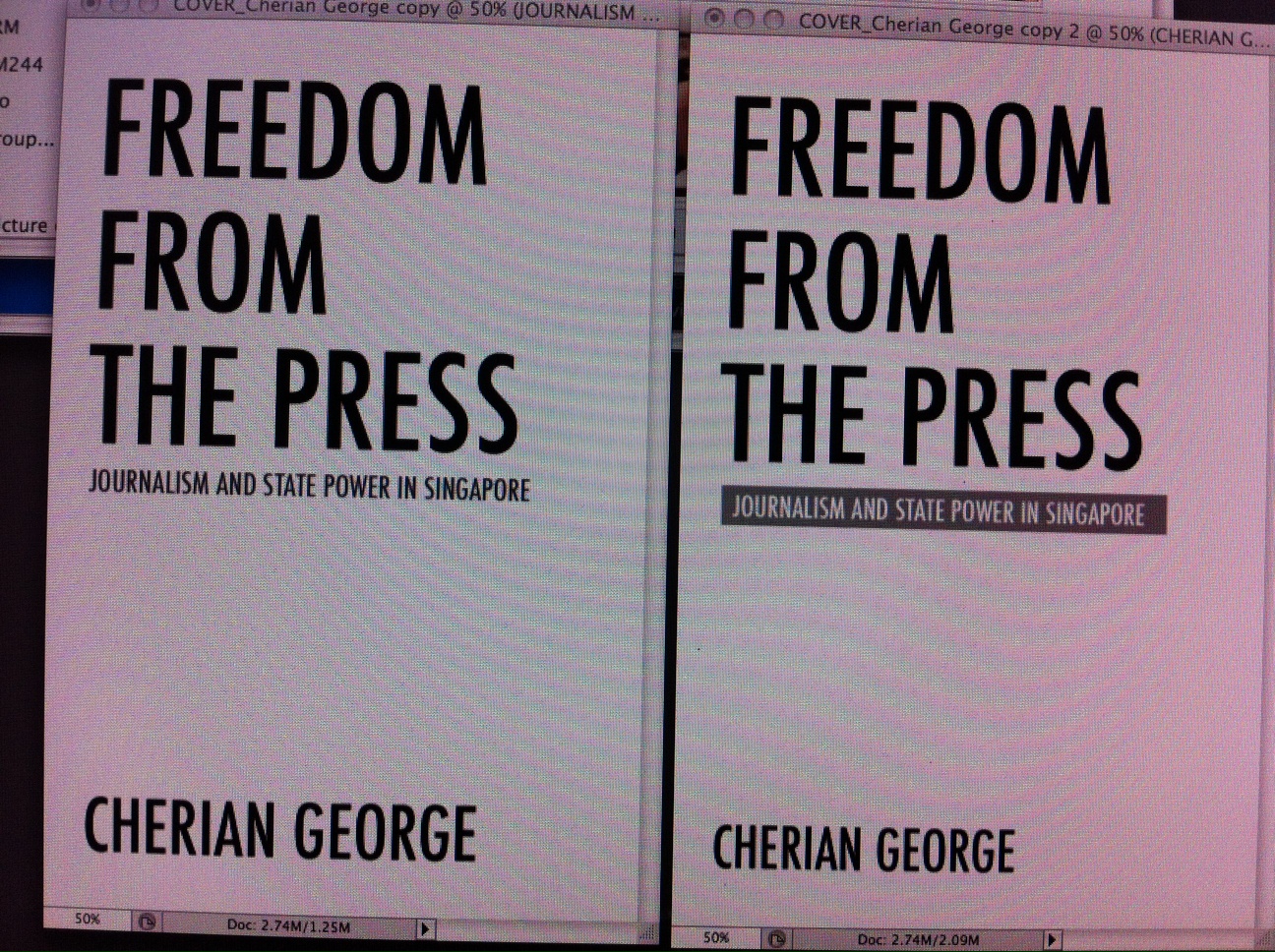
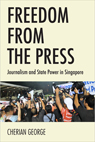
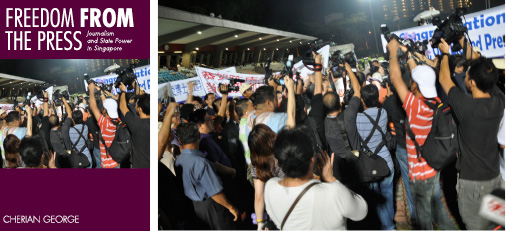
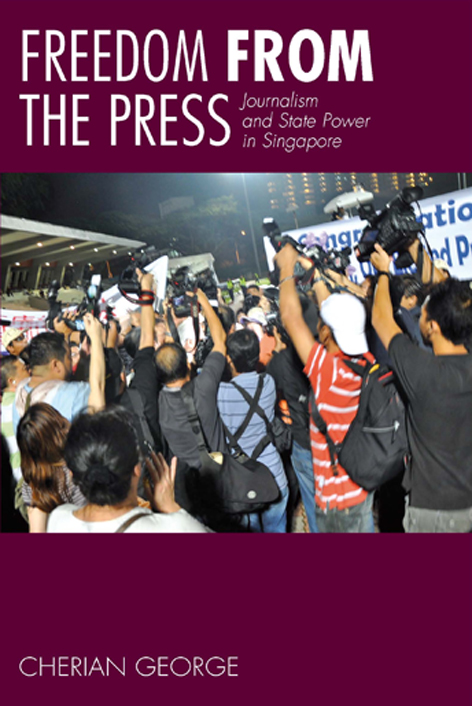
    I’m glad I reached out to my Facebook friends for feedback on my proposed covers. The original design was this:

    I was emotionally attached to the photo – mainly because I shot it myself. But I’m old enough to know that ego is not the best guide to making creative choices. So although my publisher was happy with the mock-up, I decided I’d better consult others.

    I turned to my friend, Tay Kay Chin, who recently collaborated with me on the GE11 photo magazine project and whose design sensibilities I trust. He confirmed my fears, commenting that “the picture of media photographers has become a cliché to illustrate press-related issues”.

    He approved of my choice of Futura for the typeface, though (“tall and classy”, he said) and suggested a typography-only cover. The title was strong enough to sell the book, he said. Kay Chin quickly MMSed a photo of a couple of options (right).

    That’s when I decided to do a poll. In addition to my original design and Kay Chin’s typography-only cover, I did a hybrid version, with larger type and a smaller image.

     Option C (left) turned out to be the crowd favourite, garnering 44 percent of the 115 votes cast, including from cartoonist Otto Fong. Around 23 percent, including Ivan “Rambling Librarian” Chew, liked my original cover for the photo and strong colour. Around 27 percent went for Kay Chin’s type-only version.

    So, should I go with the popular vote and pick Option C? KC Chew, who ran his own publication design house before becoming Singapore’s most successful university fund-raiser, warned me not to be governed by a poll. The respondents are not expert cover designers nor marketeers, he pointed out. “Let the poll results guide you but you can still make a non-bandwagon choice regardless!” he said.

    One thing that the feedback forces me to admit is that my photo will have to go. “The title is great but the photo doesn’t quite do it justice,” said fellow academic Lim Sun Sun. The New Paper’s design chief (and the ST group’s Journalist of the Year 2010) Hup Lee didn’t like the covers with the photos either: “A and C is some thing I would expect to see if Tom, Dick and Harry were to write the same book. My take: B. It’s classy, clean with a tinge of seriousness. No photo needed.”

    But, would an all-typography cover be too austere? Well, one option is to add a graphic illustration. One of Singapore’s most respected newspaper artists has promised to send me some sketches. Watch this space!

  • Why hate speech doesn’t always require the red card

    by

    CHERIAN GEORGE

    December 3rd, 2011

    This article has been published in the Straits Times on 3 December 2011 and on my new website devoted to the topic of hate speech.

  • PM Lee promises more open government but wants sincerity from opponents, too

    October 21st, 2011

    Edited extract from Prime Minister Lee Hsien Loong’s speech during the debate on the President’s Address, 20 October 2011. For a PDF of the full speech, click here.

    It’s necessary and healthy for our politics to adapt to changes and to be up-to-date and in sync with the times because if you don’t adapt, it’s brittle and one day it would break. But we cannot assume that just because you are changing, you are moving forward. You could be going the wrong way, you could get into a dead end. We have to consciously find the right way forward to avoid problems which other countries have run into.

    So how do we respond to this new political situation?

    First, we have to take a much more open approach to government and to governance, the way we organise ourselves, the way we conduct our affairs. Welcome different views, reach out to diverse groups including critics, share more information with the public whether it’s information on population trends, employment figures or foreign workers – even on GIC investments we are publishing more information now than we used to do, whatever we can. Not everything can be disclosed. We don’t want to tell the world the overall size of our reserves, we cannot publish our defence plans, but wherever possible, we will disclose more rather than less. As we go forward, we will review the rules on what we are putting out and over time, we will do progressively more.

    We need to engage citizens more in decisions affecting them, across a wide range. The Institute of Policy Studies put out a paper showing various projections of how Singapore’s population will grow or shrink over the next decade on certain different assumptions. It’s not a conclusive last word but it was a very helpful contribution to the public debate, it helped to educate people and make them understand what this is about. Over the next year we’ll put out more papers, get people to focus their minds and to understand that we actually face very serious trade-offs.

    But a public debate is not a free-for-all and there are risks. The French had a debate on what it meant to be French because they wanted to close over some of the faultlines in their society between the Muslim immigrants and the non-Muslims but it took a nasty turn, it became a xenophobic discussion. While we debate sensitive issues, we have to be very careful not to let sensible, moderate, thoughtful views be drowned out by unthinking xenophobia.

    We need to emphasise how our policies impact Singaporeans and are seen by Singaporeans. We are voted by citizens, our responsibility is to them, what we do must be for them. But government is complicated and very often, the link from the measures to the benefits are indirect and not obvious. So the result is anxiety, opposition, sometimes a lot of angst. We try hard to communicate, make speeches, have dialogues. We don’t always do it as well as we could. We need to communicate better; to listen, engage, explain, to be close and sense one another better.

    If the policies are wrong or circumstances have changed, then say so and change the policies, we are on a new tack. But if the policies are not wrong and we have to persevere – and it’s the perceptions which are mistaken – then we have to have the courage of our convictions. We can be flexible on the implementation and details, but preserve the core principles, and work hard to persuade Singaporeans that we are doing the right thing.

    Finally, we need to harness the power of the new media, to use it better to engage and connect with citizens, to manage it better to encourage responsible and constructive behaviour. We need to strengthen digital judgment: the good sense to know that what you saw on the website doesn’t mean it’s real just because it’s on the website.

    The Internet is pulling us in different directions. The world is pulling us in different directions. So many opportunities in so many countries, so many exciting possibilities for different people to pursue. How do you pull everybody together so that we feel Singaporean together, that we are anchored – this is home truly, as the song says. We have to make maximum use of our schools, national service experience, our HDB communities, our National Day Parades – events, major developments which we share, things we go thorough together whether it’s Sars or economic crisis – so that we have shared reference points, shared memories and we feel one together. It’s a continuing effort.

    The Government at the end of all this, in the new normal, in the new environment, still has a duty to run Singapore. Having heard all views, it has to decide: What we are going to do, this is the way we go. It’s what we were elected for, it’s what the electorate expects of us: produce results and to present our record to voters at the next election for them to judge whether they are satisfied.

    The Government is one of our political institutions, Parliament is another, the Presidency is another. We need strong political institutions to have a good government to work well. So we look forward to joining issue with the opposition.

    They declared they will be responsible and constructive. We will hold them to their word. Don’t just criticise what the Government does. Put up serious alternatives to be considered, argue your case, be scrutinised as you scrutinise us. Speak up for measures which may be necessary but are unpopular like immigration. Being principled doesn’t mean not being afraid to offend the Government, because the Government is not the emperor and doesn’t chop heads off. Being principled means not being afraid to tell unpalatable truths to Singaporeans because voters are the sovereign and they can vote against you.

    But if you have conviction, if you believe in it and have passion, then persuade, persuade to follow you. Don’t lead from the rear. And that applies to PAP MPs too. Speak your minds, speak frankly, vigorously, passionately.

  • Playing with the cover

    Today, I went through my archive of pictures hoping to find an image that might work for the book cover. I settled on a series of photos that I shot at Toa Payoh Stadium around 4am on the morning after the Presidential Election. A scrum of photographers, cameramen, reporters and supporters was surrounding Tony Tan, who had just entered the stadium after having been declared the winner.

    The photo shows the media’s hunger for news. Beyond that, the image could mean different things to different people – which is why I like it. Does it show the media doing their job of scrutinising state power? Or perhaps it represents how they fall over one another to give establishment newsmakers publicity they don’t deserve? It could also symbolise the mob that PAP leaders are so suspicious of – the irrational interference that they believe governance should be insulated from.

    I did a quick mock-up and sent it to my publisher, who said they could work with it.

  • Pritam Singh: Singapore needs a Freedom of Information Act

    October 20th, 2011

    Workers’ Party MP Pritam Singh called for a Freedom of Information Act in his speech in Parliament on 20 October 2011. Here is the relevant extract from his speech.

    What a Freedom of Information Act would do is to allow ordinary citizens to pull information from public bodies that have not put the information sought in the public realm. A Freedom of Information legislation is not meant to oblige the government to release sensitive data such as defence deployments and procurement. Exceptions are routinely scheduled in Freedom of Information legislation elsewhere, which prohibit government release of sensitive information. It is useful to note that Freedom of Information legislation is very much the norm in countries, which host a diverse and plural polity.

    And in case some members feel such open-government legislation only originates in Western countries and that we Asians do it differently, the multi-racial Malaysian states of Penang and Selangor have opened a dialogue on the induction of such legislation. India passed the Right to Information Act in 2005, a high-water mark of the previous UPA government.

    Let’s try to envisage a Freedom of Information Act in practice. In the event, some misinformation is being peddled about on the internet or mainstream media, ordinary citizens and journalists can walk into any ministry, go to the designated information officer and seek official statistics on the matter. With this information in hand, the peddler of misinformation either online or in the mainstream media, would be found out, and the webpage or newspaper which hosted the misinformation would lose credibility.

    No Singaporean will be able to accuse the government of selectively putting out information it wants to, since ordinary Singaporeans will be empowered to seek the information they require.

    A Freedom of Information Act hosts other benefits too. Only a few weeks ago MCYS launched “Be the Change”, an initiative, which invites “young Singaporeans to step forward, share their ideas, and take the lead in turning their ideas into reality.”  Such projects are likely to be far more successful, popular and broad-based if youth can make enquiries of government on data and statistics to ensure their ideas are workable and practical.

    A second arrow in the politics of empowerment is an obligation by the government of the day to order the automatic release and disclosure of official information at fixed intervals of 30 years or so. In the United Kingdom, the Public Records Office manages this process. The disclosure of official documents, apart from introducing substantive accountability and transparency in government-decision making processes, will likely provide Singaporeans with valuable insights on why decisions were made the way they were by political leaders in the past. Such a repository of information is extremely helpful to ensure succeeding generations understand the circumstances behind the success of their predecessors while avoiding the very same mistakes and missteps.

    Automating the periodic disclosure of official documents may necessitate a review of certain sections of the National Heritage Board Act. The government should not see such changes as an attempt to criticize and expose previous governments. But no politician should be beyond reproach and a commitment to open government files for historical scrutiny are important features of a politically mature society.

  • Adapt to new media but don’t over-react, PAP’s Baey tells government

    October 20th, 2011

    PAP backbencher Baey Yam Keng has provided one of the most considered establishment assessments of new media in the post-GE period. In contrast to the moral panic that has been sweeping through government ranks, Baey argues that there is no need to over-react, and that the government should instead adapt by being more open-minded to criticism and by loosening its grip on mainstream media.

    Baey is deputy chairman of the government parliament committee (GPC) for information, communication and the arts. A former director of creative services at MICA, he is now at the public relations consultancy, Hill & Knowlton. He is also the founder of a Chinese drama company.

    Below is the full text of his speech in Parliament in the Debate on the President’s Address on 19 October 2o11, as posted on his Facebook page. The emphases and SUB-HEADINGS have been added for easier reading.

    ADAPTING TO NEW MEDIA

    There has been much discussion about the “new norm” in governance.  Singaporeans are demanding more engagement, consultation and transparency.  We are expressing ourselves assertively and freely on the internet and through social media. President Dr Tony Tan himself had acknowledged the importance of new media as a platform for citizen engagement.  Nonetheless, I perceive a degree of reservation and apprehension among government agencies due to the inherent challenges presented by social media.

    Advances in technology improve the quality of our lives, enhancing the way we interact with our environment and with one another. On the other hand, history is full of examples of those who were left behind because they were unable or unwilling to make the transition.

    Let us turn the time back to 1927.  It was the year when “talkies”, ie movies with sound, were introduced.  It was a technology break-through and audiences enjoyed a new level of entertainment, but many movie stars lost their job.  They had dominated the silent screen but did not manage to make the transition to the new world of moving pictures with sound.  These actors included Emil Jannings, the first winner of the Oscar for Best Actor, whose heavy German accent did not go well on American screens.  On the other hand, Charlie Chaplin was able to thrive on both sides of the sound divide, which is one of the reasons why we remember him today.

    All communication media are neutral and social media is no exception. It is just another milestone in the evolution of media landscape.  It is up to us to adapt and leverage on them.  Even as the establishment is proceeding with caution and perhaps, with some trepidation, our younger generation has taken to social media like ducks to water.

    Personally, I have found Facebook and Twitter very useful in engaging the public.  I give updates on what I do in the community, share my thoughts and sometimes snippets of my personal life, and I receive very good feedback and suggestions.  I ask for opinions and even call for volunteers and help.  In July, I asked for volunteers via my Facebook to help distribute rice packets to needy families in Tampines North.  In just two days, more than twenty people turned up that Saturday morning.  There were young and old people, both residents and otherwise, one even came all the way from Teban Gardens!

    I have learnt a lot from my Facebook friends even though I have not met most of them personally.  Many have become familiar names and profile photos.  There are of course a few ‘friends’ who are not so friendly and choose to be critical of everything.  But if I keep myself out of social media just because of these few characters, I will be missing out on the diversity and richness of views and comments offered by the majority.

    NO NEED TO HAVE THE LAST WORD

    I hope my experience can offer the government some food for thought in its mode of engagement. On social media, the government does not have to rebut every single rumour or set the record straight for every misrepresentation made, even on the platforms it chooses to engage.  Sometimes, it is better to leave the discussion open and not jump into defence too quickly or even at all.  Firstly, it is not possible.  Secondly, the time, money and effort expended would not be justified.  Thirdly, the government should also trust in the public’s ability to make logical assessment of the information they encounter online.  The government has to accept that it cannot and should not try to have the last word on every debate.

    Whether we like it or not, civic engagement in cyberspace has to be treated with the same level of respect and care, planned and delivered with the same competence we wish to achieve in our physical domain.  Netizens expect their government to engage with finesse, diplomacy and sincerity.  This is no different from face to face interactions.

    The government must be able to differentiate among different areas in cyberspace, customise its communications strategies and apply the appropriate treatment.

    If I may share some light-hearted analogies: mainstream media sites like ST online and channelnewsasia.com are the newspapers of the city; Facebook, LinkedIn and other social networking sites are the virtual cocktail parties; chat rooms and forums are the coffee shops of the online world; and Twitter contains casual exchanges similar to housewives comparing notes on what’s fresh and cheap at the market.

    If the government posts on Facebook the same official statement or press release it sends to the mainstream media, the message will be lost.  This is where an understanding of the respective media and creativity in repackaging the same message is needed.  The housewife is unlikely to worry too much about the global food crisis and diversification of food sources, but will flock to buy more apples if her neighbours tell her they are sweet, juicy, and on promotion.

    Regardless of the medium and the presentation format, the content and core of each government message must be consistent.  More importantly, the government must be able to demonstrate that it is objective, transparent, open-minded and sincere about addressing the issue at hand.

    Another aspect of social media is that because of its interactivity, it builds a community.  Netizens will frequent certain forums, follow certain blogs or ‘like’ certain Facebook fanpages because of similar interests, and they recruit the like-minded.  Just like one cannot just gatecrash a cocktail party and be welcomed, the government cannot just intrude into a social media space and expect to be listened to.  It needs to build the comfort level and develop the relationships.

    Two years ago, the Government rejected a recommendation by a government-appointed advisory council on new media to respond to posts at blogs and online forums.  It asserted that such engagement would be “extremely difficult” and better facilitated on REACH, its own feedback portal.  Obviously, the government is not able to engage in all social media platforms.  As a member of the REACH Supervisory Panel, I do know that REACH has done a lot in reaching out to the public in the digital media, via Facebook, Twitter, webchats, forums etc.

    The government can choose to stay put at its own cocktail party.  However, why limit ourselves to one cocktail party?  Why doesn’t the government tap on other forums and reach out to different demographics?  We can tap on the following that others have developed and reach out to them in a sustainable manner.

    DON’T OVER-REACT TO NEW MEDIA

    It is not surprising that many people perceive social media to be a contributor of “noise” to the media landscape.  Is the voice of people really getting louder only now?  I do not think so.

    Singaporeans were not necessarily more docile in the past.  It is the ubiquity of the internet, along with the rise of social media, which has allowed the perennial opinions, including those of the government, to be heard through new platforms. As each generation becomes better educated, more will utilize social media.  Whatever chatter and rumours which used to float around coffee shops and markets or exchanged between taxi drivers and passengers can now be heard online.  The government can go to new media to listen to the ground and gauge the sentiment.

    The recent suspension of the Abercrombie & Fitch advertisement along Orchard Road seems to be sparked by a couple of letters to the Straits Times forum which found the uncovered male torso to be indecent.  If the industry regulator was acting on public interest, did it note the strong support online for the ad to stay put?  The online chatter is the closest to coffee shop talk that should have been taken into consideration before a final decision is made.

    Nonetheless, just as we should not underestimate the impact of social media, we should not overestimate it either. We observed this during the Presidential Election.  According to online polls, certain candidates enjoyed extremely high levels of support but in the end, they did not win.

    This outcome suggests that the rise of new digital platforms had merely enabled certain opinions to be articulated and amplified rather than reflect real changes in public opinion. For me, I cannot assume that just because more than 80% of the comments on my Facebook have largely been supportive and encouraging, I will achieve similar levels of votes at the General Election.

    In a survey on “Political Traits and Media Use” last year, the Institute of Policy Studies found that people on social media are politically more knowledgeable, interested and liberal.  They also tend to be more politically engaged online and off-line, be it posting a comment on a blog or speaking to politicians. Dr Zhang Weiyu, an assistant professor at the National University of Singapore’s Department of Communications and New Media, urged the government and policymakers to take advantage of the online platforms to reach this group directly as “interpersonal talk has a big influence on political psychology.”

    Our President, Dr Tan, had also engaged the “social media crowd” including bloggers such as Mr Brown and The Online Citizen team during his campaign.  How will this be continued, or has it continued?  Is the government going to stand in the way, or build on the starting point and facilitate a closer and constructive relationship?

    However, here is a dilemma.  How can a consistent message be conveyed by the government where there is no framework for the rules of engagement, where efforts are very much individually driven, appear ad-hoc and are neither organized nor uniformly applied through the government or civil service.  On the other hand, if online engagement is conducted in a very systematic or uniform fashion, would the discourse become very impersonal?

    BUILD MAINSTREAM MEDIA’S CREDIBILITY

    Mainstream media will still be a very good vehicle to set the agenda for our nation for the day. Once set, the conversation may be continued online.   It is natural for us to consume information with an inherent bias. If we come across information that seemingly contradicts our own experiences, we will want to address it and the internet is an excellent platform for such discourse.

    Hence, it is important that mainstream media be held in high regard by the public.  It can only maintain credibility if it is perceived to be neutral and objective.  Ideally, mainstream media should be the benchmark for quality of information, and the reference point against which information on new media is compared and analysed.

    Five years ago, I had appealed to the government to relax regulations for traditional media.   I believe the government can afford to loosen up more.

    Former Straits Times journalist, Lynn Lee, in her response to the WikiLeaks report on her comments on journalism in Singapore, mentioned that the government tried “to set the tone and form of media coverage.”  The Review Editor, Chua Mui Hoong, subsequently clarified that it was only natural that “the Singapore Government tries to influence coverage in the national newspaper – just as … anyone who has ever held a view …has tried to influence the media.”

    However, I would urge the government to reduce its effort to remove or correct what it perceives to be negative reports. The relevant departments should take them as constructive feedback, a form of check-and-balance, and work on rectifying the situation.  If the government were to persist on keeping a tight rein on mainstream media, it would lose credibility and people will rely even more on social media and the internet for alternative news and views.  As a PR professional, I know that we can only participate in, shape and influence what the traditional and new media portray.  We do not and cannot own or dictate the media conversation.

    What the government should seek to achieve is to maintain balanced and healthy discussions on all forms of media.  The world portrayed in our newspapers and TV and the world in our blogs and online forums should not appear too different.  As it is, we are already seeing a better balance of views in the internet.  Netizens have set up sites to debunk negative myths about the PAP.  Facebook pages like “Fabrications About the PAP” have sprung up to offer a better balance to the mostly negative online comments about the PAP and government.

    MEDIA LITERACY EDUCATION

    Last but not least, we must teach our people, especially the young, to be discerning in their use of media.  They must learn to navigate in particular, the internet and social media platforms and judge for themselves what is accurate and reliable.

    During a survey of students in a school in London, an independent think tank Demos found that most young people did not know how to navigate information on the Internet. What is even more worrying is that the students placed Youtube as the closest to the heading ‘Trust’ and the government somewhere near ‘Distrust’.  Next, when the students performed searches for information on Google, a significant number “believed the first answer that came up”.  To them, “Google is like a trusted website”. The students did not verify sources, had poor understanding of how search engines work, and were not good at differentiating between propaganda and facts.

    The think tank recommended that ‘digital judgment’ should be a core part of the UK education curriculum.   The emphasis should be on research and interpretation of information.

    I understand that IDA has worked with our schools on some media literacy courses.  However, I understand that these courses are not part of the core curriculum.  It would be better if these courses can be integrated into our core syllabus to ensure that every cohort attains a minimum standard of competence.

    I would like to come back to my analogy of the movie world.  The cinematic experience has come a long way since sound was introduced to film.  Every other movie is now made in 3D, or has a 3D version.  However, CGI effects do not guarantee a blockbuster, nor is a low budget independent film not able to win awards or be a box office hit.  Good story telling is still fundamental.

    Likewise, whether the engagement is via the newspapers, TV, radio, Facebook, Twitter or face to face dialogue sessions, the right message in the right tone will reach and touch the hearts of people.  The government must continue its efforts with sincerity, transparency, magnanimity and willingness to accept differences and failure.

  • Feedback chief calls on Government to engage ‘rational’ websites

    by

    CHERIAN GEORGE

    October 19th, 2011

    Amy Khor, chairman of REACH, has encouraged the Government to engage netizens on sites that “allow for reasoned and constructive debate and gain traction”. “Netizens themselves who desire rational discourse should support such sites or else start them,” she said.

    Khor’s speech in Parliament also reflected the PAP’s alarm at the appeal of less rational websites – an alarm that may result in new legislation.

    Citing a REACH survey, she said that it was “worrying” that only 62% agreed that with the statement that the “anonymous and chaotic nature of the internet often lends itself to negative views and ridiculous untruths, which can distort reality”.

    She read this to mean that there is a “bias toward online extreme views which are more tantalising than pro government or ‘balanced’ views”.

    But, is it quite possible that the reason why many Singaporeans do not agree that even irrational postings “distort reality” is that these Singaporeans are confident about their own ability to discern the wheat from the chaff – and not because they prefer the chaff, as Khor suggests.

    It is of course true that a high proportion of online discussion (like offline conversation, let’s not forget) is ill-informed and irrational. There also seems to be no shortage of cowards who enjoy slinging mud from behind their shields of anonymity at anyone who doesn’t share their violent allergic reaction to every word uttered by the PAP. I’ve been on the receiving end of such attacks and it is not pleasant.

    Yet, as ugly as these anti-social elements can make cyberspace, we’ve seen little evidence that, all said and done, they have caused actual harm.

    The tenor of the GE campaign may have alarmed those who prefer stability and – since politicians are only human – would have certainly hurt the PAP’s feelings. But, in the end, the results of the GE (a “win-win-win” result, as Tony Tan called it) reflected the wisdom of the crowd. It showed that we are a sophisticated, astute electorate that can grasp what is in our long-term interests – not the fickle, impressionable horde that the government seems to picture as it contemplates tighter regulation.

    AMY KHOR ON ONLINE ENGAGEMENT

    Extract from the speech by Amy Khor during the Parliament Debate on the President’s Address, 17 October 2011. Amy Khor is the Chairman of REACH, the Singapore Government’s feedback unit. The full speech is found in her Facebook Notes.

    We are at the threshold of a new era in Singapore’s political scene. We have a younger electorate with higher expectations, and who are more outspoken.  They represent a new generation of voters, who are unencumbered by the past.  For good or for ill, this is likely to be the norm for Singapore.

    Sir, the recent two elections, the GE and PE, have shown that politics is becoming more polarising and that an increasing number of Singaporeans want their voices to be heard.

    Opposition politicians will in all likelihood challenge many policies.   If so, they are doing what they set out to do, but this could make for a more fractious political scene.

    In this context, to keep to the vision which President Tan has articulated, we need to approach differences and debate in a spirit of dialogue and civility.

    Criticism must be welcome, because it will sharpen policies.  But criticism must also be responsible and constructive, with the view to improving policies, not merely scoring political points.  Hence, debate, and not just in Parliament, but also in personal dialogues, in any and every platform, but especially online, needs to be rational, sensible, well thought-out and meaningful.

    Smoke and noise will only befuddle, and not enlighten.

    But for broad based intelligent and responsible debate to occur, the government will need to step up its engagement efforts both online and offline.

    Indeed, in the REACH NDR survey, more than 8 in 10 (83%) feel that the government as a whole should be more active and adept at engaging Singaporeans online.  A similar percentage (82%) also desire reliable websites where people can have open debate and express different but balanced views.

    But what is worrying is that only slightly more than 6 in 10 (62%) agree that the “anonymous and chaotic nature of the internet often lends itself to “negative views and ridiculous untruths, which can distort reality”. This seems to suggest that there is a bias toward online extreme views which are more tantalising than pro government or “balanced” views.

    Online engagement will increasingly become more important with the growing number of digital citizens. It is simply impossible to engage on all sites. The government could engage on sites which allow for reasoned and constructive debate and gain traction. Netizens themselves who desire rational discourse should support such sites or else start them. They should not be afraid of being labelled “pro government.”

    Of course, engagement must go beyond mere solicitation of feedback to follow up action and co-creation of programmes, where possible.  The government through REACH and other platforms have attempted to close the feedback loop in this manner, but it must strive to do even better as expectations for engagement rise.

    But while policies continue to be refined, there are always fundamental values, and basic principles which we should adhere to.   The same REACH survey on responses to this year’s National Day Rally show that 76% of the respondents agree that Singapore should maintain its basic strategic directions instead of veering towards populist policies.

    Despite the sound and fury of both the GE and PE, I find these responses very heartening. Because they indicate that Singaporeans by and large do not expect major policy shifts which may endanger our long term survival.

    Note: Emphases (bold text) are in the original.