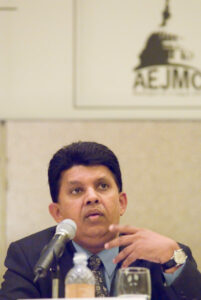
Year: 2007

  • The impact of new media on governance

    by

    JUNE GWEE AND WENDY WONG

    July 11th, 2007

    A research paper in the Civil Service College publication, Ethos Perspectives (December 2006), provides a window on current thinking within some sectors of the administration.

    The new media challenges our current assumptions about citizen engagement in the policy-making process. Blogs as a tool for governance can only be effective if governments can develop the right approach, in the context of its values, environment and vision, for engaging its citizenry. In addition, there is an urgency to review current media policies so that it can address the challenges and opportunities of the new media. Before we are too quick to label new media as the playground of the young and restless, or consider hard-headed measures to harness the power of blogs, we need to better understand the motivations and socio-demographics of bloggers in order to develop a more informed strategy to connect and interact with these netizens.

  • More political space needed to cope with falling ad revenue

    by

    P N BALJI

    July 10th, 2007

    Writing in Today, veteran editor P N Balji argues that newspapers need to practise less government-centric journalism to retain their readers’ interest and fight the trend of falling ad revenue. Read the full column on Today’s website.

    So, what are the media managers doing? Opening up new revenue streams by investing overseas, kick-starting alternative media ventures and wooing expatriate readers who are surging into Singapore now that the floodgates have been thrown wide open. But these are slow-burn measures, risky and tentative. What is more important is to relook the kind of news in our media. Today, domestic news coverage has got an over-emphasis on government information, with nearly every item containing a mention of a minister, government policy or view. The end result is that the news gets predictable and even boring, as one group of young Singaporeans said during a focus group discussion.

  • The press is like a feral beast

    by

    TONY BLAIR

    July 3rd, 2007

    In one of his final speeches before stepping down as Prime Minister of Britain, Tony Blair held an unflattering mirror up to the press. His widely reported speech (it was reproduced in The Straits Times) is likely to strengthen Singapore leaders in their conviction that press freedom is overrated.

  • Anwar Ibrahim attacks the notion of Asian values in journalism

    June 28th, 2007

    Anwar Ibrahim, the former deputy prime minister of Malaysia turned iconic freedom fighter, spoke on the closing day of the AMIC annual conference in Singapore.

    Listen to audio recording

    Partial recording of Anwar Ibrahim’s speech

    (Apologies for the poor quality of the recording.)Â

  • Han Fook Kwang: We will continue to protect our sources and reporters

    by

    JUSTIN ZHUANG

    June 27th, 2007

    dsc_0174The need to pursue quality journalism and keep faith with its sources are why The Straits Times will continue to “vigorously resist” pressure to disclose its confidential sources, said its editor Han Fook Kwang. He reiterated that Singapore courts’ recent rulings on the Prebon-BCG case do not change this position.

    Han said that the company would back its reporters all the way if they chose to be in contempt of court and risk going to jail in order to abide by the professional ethic to protect their sources.

    He revealed that ST had encountered similar demands to reveal sources in the past and had always said no, confronting lawyer’s letter with lawyer’s letter. Usually, the matter ended there without going to court. He said that the Prebon-BCG case was different because the multi-million-dollar stakes meant that the two broking firms were prepared to go all the way.

    He explained that ST had exhausted all legal options, but in the end had to leave it to the journalist to decide whether to reveal the source. Whatever the decision, ST would have backed him all the way “legally, financially and professionally”, he said.

    On a more positive note, Han emphasised that such cases were extremely rare and the recent setback was no reason for journalists to change their approach to newsgathering.

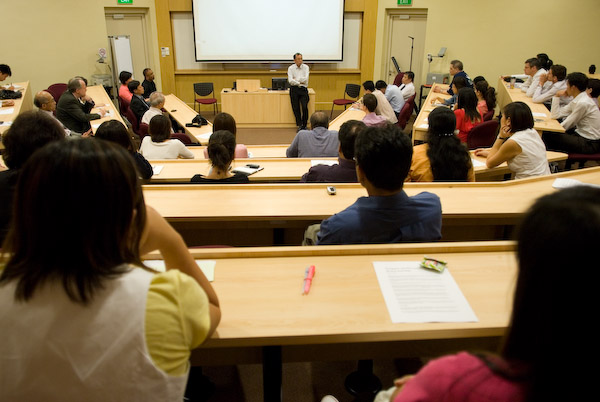
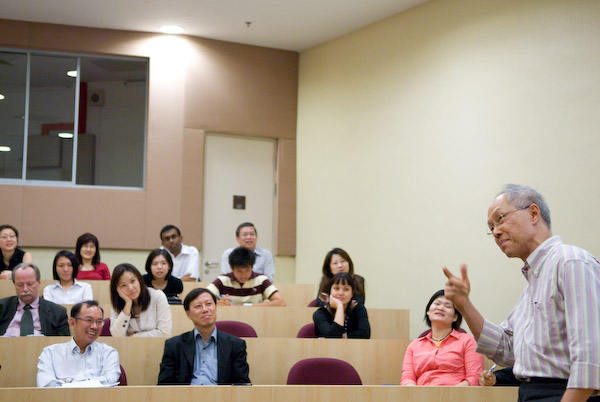
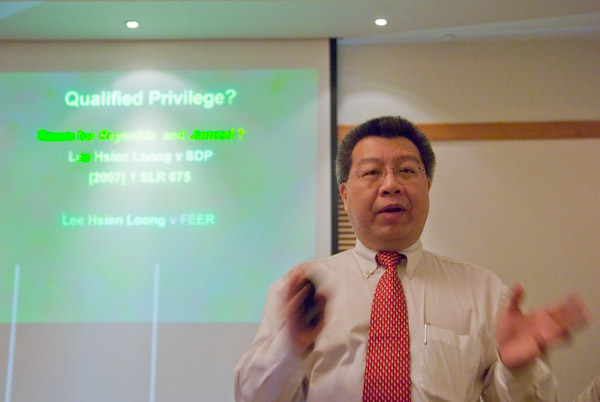
    He was speaking at a forum organised by the Singapore Press Club and the Wee Kim Wee School of Communication and Information (WKWSCI) about the so-called “reporter’s privilege” to keep sources confidential. Other speakers were lawyer Peter Cuthbert Low, Ang Peng Hwa, chair of WKWSCI, and Peter Lim, former editor-in-chief of The Straits Times group.

    dsc_0177Peter Lim recounted his own dramatic experience after the 1981 by-elections when, at a specially convened press conference, he was asked to reveal the source of a story on possible bus-fare hikes by the late Ong Teng Cheong, who was then communications minister.

    In the subsequent ST report, Lim was quoted as saying that he was proud of his reporters for sticking to principle and refusing to divulge their sources. The quote, Lim said, did not win him any fans in the upper reaches of government.

    The legal experts surveyed relevant laws around the world. Ang noted that source confidentiality was never an absolute right but rather an “issue of balance” – courts also had to take into account the interests of justice. Both Ang and Low made it clear that the trend globally was towards greater protection for reporter-source confidentiality, since the ability to gather information was central to the universally recognised right of freedom of expression.

    However, do international trends matter, when Singapore constantly asserts that it is an exceptional case? Low noted that so many countries were moving in the same direction that the trend was hard to ignore. Ang added that even the relatively undeveloped “-stans” of the former Soviet Union had stronger recognition of reporter’s privilege in their new constitutions. While Singapore need not have identical laws to the rest of the world, it should not be so far off as to become an outlier, he said.

    Han added that while Singapore was a special case in certain other respects – particularly in the kind of relationship it wanted between government and press – the issue of reporter’s privilege was not one of those where Singaporean exceptionalism seemed relevant. The principles were fairly universally accepted and there was a global convergence in thinking, he said.

    Related Documents

    Newspapers and their sources: The issue of privilege

    Straits Times coverage of the Prebon-BGC case by Lee Su Shyan

    1981 Bus Fare Hike Fiasco

    The dramatic confrontation between government and the Straits Times over an unnamed source – PDFs of the ST reports of the time.

    Article 19’s position on reporter’s privilege

  • Few takers for online dissent, say experts

    by

    JUSTIN ZHUANG AND LIN JUNJIE

    June 27th, 2007

    dsc_0153-edit

    While the Internet has opened up unprecedented opportunities for dissent, Singaporeans have not exploited it, said panelists at a media conference yesterday.

    “Singaporeans just do not seem to know what to do with it, nor do they seem to care to use this instrument for political ends,” said Arun Mahizhnan and Tan Tarn How from the Institute of Policy Studies. They speculated that this could be a result of a young generation that views democracy in terms of prosperity, stability, security and responsibility rather than “freedoms, rights and political choice”.

    Tan added that Singaporeans may not actually feel repressed as Singapore is “a very free society” where people can freely engage in almost anything – besides political activity.

    The IPS researchers were part of a panel addressing freedom of digital speech at the 16th annual conference of the Asian Media Information and Communication Centre being held this week.

    Fellow panelist Alex Au, a gay rights activist, pointed out that the government’s “light touch” regulation on the Internet had given “unprecedented leeway” to dissent online, but that this has had little impact on Singaporean’s electoral behaviour.

    “But no one should be under the illusion that that is all there is to it. The government does carry a big stick behind its back,” Arun added.

    The state attempts to “control what is actually controllable” by “narrow[ing] the retaliatory action to those that seriously challenge a principle, or a value that the society cherishes … rather than attack all and sundry offenders.” He cited racial harmony, protection of minors and public decency as examples.

    Law professor Tey Tsun Hang from the National University of Singapore agreed that regulation of online media was not as heavy as print media controls, which he described as “sophisticated, calibrated and effective”.

    Arun said this difference in regulation was creating “a sense of schizophrenia”. For instance, while the Singaporean blogger Mr Brown, also known as Lee Kin Mun, was allowed to criticise the government online, he was chided when he wrote a similar column in a mainstream media publication Today.

    When quizzed by a member of the audience about the future of media regulation in Singapore, all four speakers agreed that it was unlikely that regulation of online media will tighten. However, any evolution will be slow.

    “The fairways are getting wider… the OB markers will be reduced in numbers but in certain cases the intensity of the OB markers will remain,” said Arun.

    dsc_0160In a separate forum on media law, constitutional law expert Kevin Tan touched on how previous court rulings in Singapore suggested that the “newspaper rule”, which protects journalists from revealing their sources, is not a “sacred cow of journalism that cannot be slaughtered” in Singapore.

    As for the Sedition Act, he pointed out that while similar laws in many other parts of the world had become disused or even been repealed, it was recently used against two Singaporean bloggers who made racist remarks online and was even being “strengthened and renewed”.

    – journalism.sg photo by Lin Junjie.

    Listen to full audio recording

    Tan Tarn How and Arun Mahizhnan

    Freedom of Speech in the Digital World — Drawing Boundaries in a Borderless World

    Tey Tsun Hang

    Electric Fences and Land Minds: Behind Singapore’s Regulatory Regime

    Alex Au Waiping

    Virtual Insurgencies: Gay Speech on Singapore’s Internet

    Kevin Tan

    Recent Developments in Singapore Media Law & Practice

  • Content and Credibility Key to Newspapers’ Survival

    by

    JUSTIN ZHUANG

    June 25th, 2007

    dsc_0096

    Singapore’s most powerful newspaper publisher admits that “the days of easy growth… are behind us”. But, “unique and differentiated content” plus “credibility and trust” will help newspapers continue to survive, said Dr. Tony Tan Keng Yam, Chairman of Singapore Press Holdings. He was delivering the keynote address at the 1st World Journalism Education Congress being held in Singapore this week. Dr Tan also stressed the importance of quality leadership in newspaper boards and management. -Â journalism.sg photo by Lin Junjie.

    Listen to full audio recording

  • Patrick Daniel: There’s space for quality journalism here

    by

    JUSTIN ZHUANG

    June 25th, 2007

    dsc_0137

    Singapore’s national newspapers must operate within out-of-bounds markers, but the “fairways are wide enough” for quality journalism, the country’s top editor said today. Patrick Daniel, editor in chief of Singapore Press Holdings’ English and Malay newspapers, spelled out what would happen if the space got too narrow: SPH would not be able to keep its highly mobile talent and its papers would decline. Speaking at a forum on media freedom and responsibility as part of the 1st World Journalism Education Congress, Daniel also said that SPH makes “no apologies for being pro-Singapore”, and suggested that the American-style marketplace of ideas was not part of its culture and heritage.

    – journalism.sg photo by Lin Junjie.

    Listen to full audio recording

  • Changing the information landscape

    by

    ALEX AU

    June 23rd, 2007

    Alex Au argues for a Freedom of Information Act to improve the level of transparency in Singapore.

    We have known nothing but a ruling class that sees itself as a mandarinate in the Confucian style, answerable only to itself. To question these scholar-mandarins is treated as an act of disloyalty.

  • Newspapers and their sources: the issue of privilege

    by

    LEE SU SHYAN

    June 22nd, 2007

    The Straits Times, 31 May 2007, p. 42 -– THE news was that one company had sued its rival for poaching staff. But what might have been a simple settlement between them spilt over unexpectedly to the media and the practice of relying on unnamed sources for information.

    It brought into focus the relationship between reporters and newsmakers willing to give information if they are not named. Last year, the Singapore subsidiary of London-listed international brokerage Tullet Prebon sued US-based BGC International for conspiring to poach 51 of its staff here. Prebon claimed $66.4 million in lost business.

    In November, the two firms settled out of court, with BGC agreeing to pay Prebon an undisclosed sum. A short press statement to the effect was released on Nov 24.

    On the same day, the wire agency Reuters reported that the settlement amount was “around a fifth” of the $66.4 million. The following day (Nov 25), The Straits Times and The Business Times also referred to the settlement sum, quoting unnamed sources. ST said it was “slightly less than half the amount”, whereas BT said it understood BGC would pay “less than half” of what Prebon wanted.

    The reports sparked an immediate response on two fronts. BGC claimed breach of confidentiality over the settlement terms. It is now seeking to set aside the amount it has to pay. Prebon countered by accusing BGC itself of breaching the gag on releasing the settlement details.

    On Nov 27, lawyers for BGC asked The Straits Times and The Business Times to reveal the identity of their sources. Both said no. BGC immediately took Singapore Press Holdings, the publisher of both newspapers, together with the two reporters who wrote the articles and their respective supervisors, to court to compel the disclosure of the sources as well as other information. SPH engaged lawyers to resist the action.

    After considering affidavits filed by both sides, the High Court in January cut down the amount of information that BGC would be allowed to obtain from SPH and its journalists, but it ordered SPH to disclose the source of the settlement amount.

    Subsequently, Prebon sued Reuters to find out the source of its information. Last Thursday, the Court of Appeal ordered the Reuters’ journalist to name her source. She did, and the agency said this was only after her source had given permission to be named.

    Confidentiality

    LAST week’s ruling is significant because it sets a precedent for Singapore in the relatively untested area of the confidentiality of journalists’ sources. In particular, the outcome shows that sources may not enjoy automatic protection under the so-called “newspaper rule”.

    The “newspaper rule” is a principle that governs applications against newspapers to disclose their sources. The rule, which has existed for more than a century, arose in defamation cases as it was the first type of case where journalists were asked to reveal their source. But the courts had ruled that the identity of the source was not relevant to whether an article was defamatory, so it need not be disclosed.

    This “newspaper rule” has since been used as shorthand for a wider principle recognising journalists’ right to protect their sources in all cases. It has been held and applied in various Commonwealth jurisdictions including the United Kingdom, New Zealand, Hong Kong, Australia and Canada.

    But in non-defamation cases, judges may still order disclosure if “exceptional circumstances” can be shown or where it is found to be in the “interests of justice”.

    Singapore is not the only jurisdiction to not apply the “newspaper rule”. New York Times journalist Judith Miller went to jail for 85 days in July 2005 for refusing to name her sources to a federal prosecutor examining whether anyone in US President George W. Bush’s administration had illegally leaked the name of Central Intelligence Agency spy Valerie Plame.

    After Ms Miller was released, she did reveal her source – the former White House official Lewis “Scooter” Libby – as he had given her permission to do so.

    Public interest

    IN SINGAPORE, the Reuters case seems to indicate that the confidentiality of a journalist’s sources cannot be protected in certain circumstances.

    This raises the question of whether the journalist’s job will become more difficult. In reporting on matters of public interest, journalists do their own research and cultivate newsmakers and experts who are knowledgeable and prepared to provide information which can be used in reports.

    Sometimes the sources are not named, or give information on condition that they are not named. In seeking to report the truth, the journalist may need to protect the source.

    SPH has said that it wants its journalists to “remain true to the fundamental principles of truthfulness, accuracy, public accountability, objectivity and fairness, as these qualities are critical to discharge their role of reporting newsworthy information to the public”.

    That is why, in the Prebon- BGC case, SPH exhausted all options before both newspapers’ sources were revealed. And this remains the company’s stand. ST editor Han Fook Kwang said: “We will try our hardest to resist any attempt to get our reporters to disclose our sources. It has been our long-standing policy that we will not disclose until we are compelled to do so by the court and we have no further recourse.”

    Once a judge rules that the source must be named, the decision rests with the individual reporter, the reason being that it is the reporter who will face the legal penalty for refusing to abide by the court ruling, Mr Han said.

    “But we will support his decision. If he does disclose the source, it is up to the reporter and we will not hold it against him. If he decides not to disclose, we will also support him, in terms of legal representation and other financial support.”

    Looking back at the Prebon- BGC case, Mr Han added: “We fought all the way until the court ordered us to disclose our sources.” External lawyers were engaged and much resources were expended in preparing for the case, he disclosed.

    But unlike Reuters, SPH did not take the case to the Court of Appeal. Lawyer Hri Kumar, the Drew & Napier partner who advised SPH, said it was a matter of strategy. “We had already successfully resisted a wider disclosure. If we appealed, we might be inviting an appeal from the other side for a wider disclosure order,” he said.

    Looking at the outcome of the Reuters case, he added: “In the end, we made the right call, because the court ruled against Reuters.” Mr Han highlighted another factor that influenced the reporter and the newspaper – the nature of the source.

    The ST report in question was a brief article that followed on the press release announcing the settlement between Prebon and BGC. The ST source was in fact someone from a public relations company linked to one of the parties.

    Mr Han said: “This was a source familiar with handling media queries, someone the reporter called to try to get more information to do the story. “It wasn’t a source the reporter had been cultivating and who would get into serious trouble if found to be talking to us.

    “Even then, we resisted disclosing his identity until compelled to do so by the court.”

    The ST source was unlike the Reuters source, reportedly someone from within one of the companies. Still, for ST reporter Arthur Poon, who wrote the original story, the decision to reveal was not something taken lightly.

    “We respect the confidentiality of sources and the information that they provide,” he said. “When we first received the lawyers’ letters, we were surprised that they demanded that we reveal our sources.

    “After lengthy discussions with my editors, it was with great reluctance that I made the difficult decision to reveal the identity of the source, and only after the court had made the order.”

    Copyright Singapore Press Holdings. Reproduced in journalism.sg with permission.